An aspiring screenwriter (co-writer/director Rufus B. Seder) arrives in Hollywood with his typewriter and sets out to write the script that will help him make it big in Tinseltown. He takes up residence in the Welcome Apartments, where he encounters an eccentric cast of characters that inspire the series of gruesome killings he writes in his script, but soon life begins to imitate art, and the writer finds himself at the center of a police investigation as the other tenants begin meeting the same grisly ends as the characters in his screenplay.
Filmed on sound stages in Boston, this is a remarkably evocative independent film that pays homage to the Hollywood B-movies and German Expressionist silent films that clearly served as its inspiration. Underground film legend George Kuchar plays the sleazy hotel manager, and it's great to see him in a starring role here.
This is a good behind-the-scenes documentary on the making of Screamplay. It's a model of what you can do with a lot of imagination on a small budget.
The low-rent, stylized B&W evocation of Hollywood reminded me of what Tim Burton did with a similar approach in Ed Wood, though of course he had far more of a budget to work with. Screamplay has a home-made quality to it that adds immeasurably to its atmosphere.
I watched a silent Laurel & Hardy comedy last night, Two Tars (1928), which finds the boys as sailors on shore leave who get involved in a nightmare of a traffic jam that turns into a violent battle between the frustrated motorists. I was particularly struck by the influence this film must have had on Jean-Luc Godard when he staged the similarly violent traffic jam in Weekend (1967).
This is an amazing trick film made by Ferdinand Zecca in France in 1910. The premise involves a prisoner who is also a master escape artist and finds the most unusual ways of eluding his captors. One of the exuberant, gloriously free-spirited comedies produced by the Pathe Studio in the early years of the 20th century.
This is the kind of lurid Hollywood melodrama I love. It follows the torrid love affair between a Manhattan call girl (Elizabeth Taylor, in one of her finest performances), and a tormented businessman (Laurence Harvey).
There's an interesting subplot with Eddie Fisher as Taylor's long-time closest friend, and the film spends a good deal of time examining their relationship and the tension that it causes with Fisher's fiancee.
I'd been meaning to see this one for a while. I'd heard in an interview that George Kuchar cited it as a big influence on his own films, which made me even more curious to see it.
New short film, Scared 2 Death II: 2 Scared 2 Live:
This is a sequel to the short film I made this past spring, Scared 2 Death. Like many filmmakers, I found myself wanting to create something even though we were still in a strict lockdown period. As I've written elsewhere on this blog, I made a film back in January called Unknown Number, which had taken a great deal of preparation and a full day of shooting to pull off. While I was certainly happy with how it turned out, I also realized that the requirements of making a film even on that scale, with the limited resources I had, had sucked a lot of the joy out of the filmmaking process for me.
Several months later, I had the idea to make Scared 2 Death, a simple idea that I'd thought up about a decade ago while I was still living in Brooklyn. The situation is a horror film cliche -- the woman walking alone at night down a dark street, followed by an unseen menace. But the whole point of making the film for me was to take this situation and have fun with it. The fact that it was ultra-short and a very simple scenario to film made it all the more enjoyable to shoot.
Scared 2 Death is maybe my favorite of the movies I've made, because it got me back to the basics of what I love about making little films, and allowed me to re-connect with the joy I get just from filming a simple situation like that.
So, after a few more micro-shorts that I've made over the summer -- Isolation, Lights Out, and Scarcity -- I decided to have some fun by re-visiting the simple premise of Scared 2 Death with a tongue-in-cheek sequel, Scared 2 Death II: 2 Scared 2 Live. In this one, I take another staple of the horror film and just had fun with my own little interpretation of it.
This is another short film that I made under the lockdown restrictions, back in late June, called Lights Out. I premiered it on YouTube on June 26.
This one was born out of some of the darker ideas I wanted to explore about the idea of a character holed up in a single location during a catastrophe. I'd made a film along similar lines a few years, called Aftermath, so I was reluctant to tread too familiar territory. But I had the idea of a character alone in a house on the hottest night of the summer, when the power is suddenly knocked out during an electrical storm, and the dangers that await him in the dark.
I shot this one over the course of two nights -- a comparative luxury compared to the many one-day shoots I've done over the past several years. The Canon Powershot camera that I was shooting with handled the low-light situations very well, which made it possible for me to shoot in the darkness using only a flashlight as the lighting source. I liked the effect it produced, because it allowed me to highlight the little objects that are completely ordinary in the daylight, but at the same time take on menacing new implications in the dark.
This is also a good example of inspiration striking as a result of unexpected conditions. The lightning storm that I captured at the beginning of the film was not planned for -- but the storm came up the evening of the shoot and I knew it would be the perfect way to open the film.
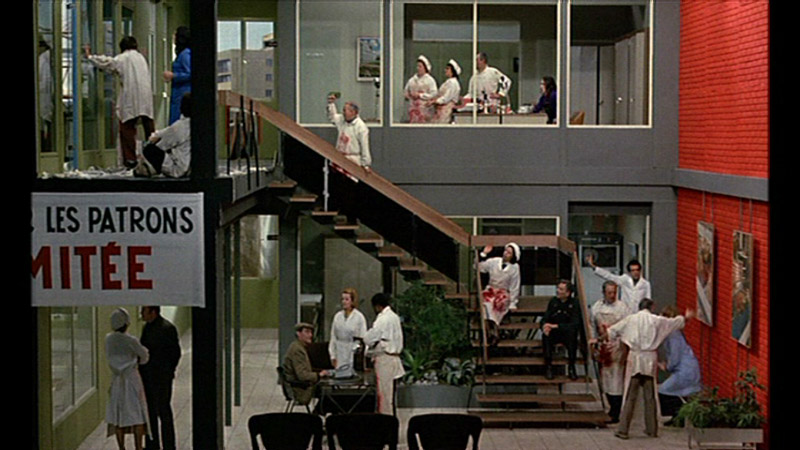
Watched Godard's TOUT VA BIEN (1972) the other night. His large-scale, multi-level set for the meat-packing plant brought to mind Jerry Lewis' similarly impressive "dollhouse" set from THE LADIES MAN (1961). I love the photo of Lewis directing on the camera crane.
John Cassavetes wrote and directed this story of a woman with mob ties who takes on the role of protector to a little boy after his family is murdered. Gena Rowlands is excellent in the title role, bringing the right combination of charm and toughness to the character. Cassavetes manages to make the film suspenseful and touching in equal measures without hitting a false note.
This was an offbeat Western about greenhorn Jack Lemmon teaming up with seasoned cowboy Glenn Ford to learn the ropes of riding the trail and herding cattle. Ford appeared in so many films for Columbia Pictures around this time; it seems he was called on to portray virtually any kind of character they needed filled. He's effective here in the quieter, more introspective moments. Lemmon gives a typically excellent performance as the greenhorn who has his eyes opened to the realities of life on the trail. The beautiful color cinematography is a highlight.
I was just listening to the soundtrack from Salo last night and thinking about Morricone's versatility as a composer. This theme was such a brilliant choice to contrast with Pasolini's shocking images that follow in the film.
This is another short film I recently made under the current restrictions. Called Isolation, it is about a man reflecting on his experiences under quarantine.
Since the lockdown began, I've found myself inspired to start creating short films. I'd made a short film backed in January, Unknown Number, whose production I have detailed on this blog. I was certainly pleased with how that film had turned out, but I found myself wanting to return to making smaller-scale films, that could be written and filmed quickly and cheaply with minimal resources (even smaller than what I'd worked with on Unknown Number). It's liberating and invigorating to make films this way -- just small-scale, down 'n' dirty filmmaking.
I haven't felt this energized by making films in years.
This is the first of these that I put together back in May, called Scared 2 Death. It's based on an idea that I had a few years ago, when I was living in Brooklyn. I thought of this idea again recently and realized it would make a perfect small project that I could film under the current restrictions.
This is an intriguing crime drama about a group of college students pulling off a heist of a Reno, Nevada casino. After a holiday trip to the casino, one of the students gets the idea of pulling off the perfect crime, and gets his classmates involved -- some of them against their will. One of them, a traumatized Korean war vet (Brian Keith) gets carried away and takes charge of the heist himself, with devastating consequences.
Directed by Phil Karlson, it builds some effective suspense about how the characters will be impacted by the scheme, but the heist itself is a relatively minor element compared with other films of this genre. The script is by a team of writers including Stirling Silliphant and Frank Tashlin. Guy Madison, Kerwin Mathewsm, and Kim Novak co-star.
An adventure-packed "North"-Western about a Canadian Mountie who takes up the protection of the lone survivor of an Indian attack, and defies commands in order to strategically lead his troops to the border to avoid another attack. Splendid Technicolor location photography (actually filmed in Alberta), with great contrasts between the bright red coats of the Mounties against the breathtaking mountain scenery in the background. Directed by Raoul Walsh.
"Quota Quickie" produced in Victoria B.C. for the British market, with American stars Charles Quigley and Marc Lawrence.
Hayworth plays a nightclub singer whose brother is framed for a murder, and must hunt down the real killer. Otherwise routine crime drama (based on the Cornell Woolrich story "Face Work") enhanced by the presence of Hayworth in an early role right before coming to the attention of Hollywood.
Not a great or even particularly good film, by any means, but I could watch Maurice Chevalier in anything and this gives him a fun role as a cafe waiter who comes in to a fortune but has to continue working his job in the cafe. The plot is wafer thin but I enjoyed the fun spirit and energy of it all. I'm also intrigued by this director, Ludwig Berger (whose other films include the Korda THIEF OF BAGDAD and the 1937 Dutch version of PYGMALION), and was interested to see another example of his work.
I watched this strange little number from 1930 recently. It showed up on my radar after reading "Red Harvest", as this film is described as a loose (very loose, I'd say) adaptation of Hammett's book. It's so loose, in fact, that the book isn't even listed as a source in the film's credits, the script attributed solely to Ben Hecht.
I strongly suspect that little of Hecht's original script ended up on the screen, because it's an utterly bizarre mixed bag. The film tells the story of a reporter (Charlie Ruggles, in a dramatic role) who is sent to a small town outside of Chicago to investigate the disappearance of a fellow reporter, who went MIA while investigating a mob of rum-runners operating out of the town. We know that the reporter was bumped off by the mob leader when he got a little too close to uncovering the operation.
The plot finds time for music numbers by Helen Morgan, as the gangster's moll who also turns out to have been an old sweetheart of Ruggles, and some energetic comedy singing and dancing from the team of Clayton, Jackson & Durante (with Jimmy making his film debut in a role that also calls for some dramatic support).
It all runs out of steam by the end, with the absurdity of the situations working against the dramatic tension, but it's all oddly fascinating in its strangeness. The performances and direction have a stilted and lugubrious quality that give the impression of a bad dream.
Based on a play by Sidney Kingsley, this William Wyler film shows its theatrical roots but is imbued with a strong degree of realism. Set almost entirely inside a New York City police station and centered around the revolving group of characters who come and go throughout the day, it offers a first-rate showcase for its powerhouse ensemble cast headed by Kirk Douglas, Eleanor Parker, William Bendix, Cathy O'Donnell, and standout performances by newcomers Lee Grant and Joseph Wiseman.
This was right around the time that Douglas was essaying some really dark, intense roles (notably ACE IN THE HOLE), and his Jim McCleod here is one of the best of those. McCleod is angry and vengeful, uncompromising in his tough-as-nails attitude toward crime. He is anchored only by his love for his wife as his growing bitterness threatens to destroy him both personally and professionally.
The set design of the police station perfectly captures the claustrophobic atmosphere and the resulting high tensions of all who work within it. Special mention should also be made of the fine cinematography by Lee Garmes and John F. Seitz. Screenplay by Robert Wyler and Philip Yordan from Kingsley's 1949 play of the same name.
I watched this Laurel and Hardy short on TV this morning. I've seen it probably close to a dozen times over the years, and it's never been one of my favorites. I've always found it a little too slow and plodding, even clumsily-staged compared to their best work. I had chalked this up partly due to the lack of fluidity in the early talkies, but even then, Laurel and Hardy had achieved a more relaxed, smooth pace in even earlier films like The Perfect Day and The Hoosegow (1929), so I wasn't sure I could explain my reaction to Night Owls based purely on the challenges of adapting their comedy to early sound film.
For whatever reason, when I watched Night Owls again this morning, I thoroughly enjoyed it, and found my estimation of it much higher than before. The version shown on the "Laurel and Hardy Show" features new musical under-scoring of the familiar LeRoy Shield tunes, arranged by Ronnie Hazlehurst, so perhaps that added to my enjoyment and smoothed over the flow of the action. But beyond that, the antics of the Boys' repeated attempted break-ins struck me as much funnier this time around. What had struck me as one of their weaker shorts in the past now had me in stitches.
Maybe it was just the laughs I needed this morning.
American Cinematographer ran an article by Sven Nykvist, "Photographing the Films of Ingmar Bergman", in which the cinematographer talks about his work with the great director. The article provides a fascinating insight into their working relationship and Bergman's working methods.
Nykvist describes his approach to working with Bergman:
"I am grateful to Bergman’s scripts that his photographic goal always changes with each one. There is no possibility for his cameraman to just alter his ordinary routine lighting technique or to shoot production after production in the same manner. All easy-come effects must be sacrificed for the simplicity which does not disturb. Although public acclaim in cinematography often can be achieved by instantaneous effects, it is in the long run only the true light which is interesting and which I strive for more and more in my work."