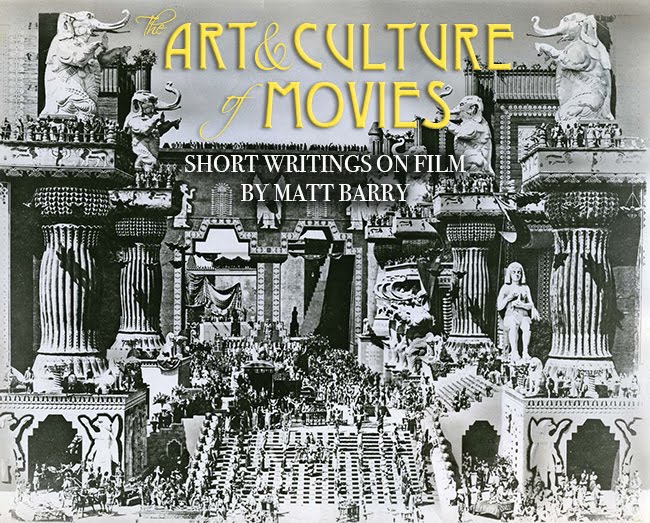
The Lumiere Brothers debuted their first film, Workers Leaving the Lumiere Factory, on March 22, 1895, in a private screening for a small group. Workers Leaving the Lumiere Factory would go on to become the first Lumiere film on their program of subjects shown before a paying audience at the Grand Cafe on the Boulevard des Capucines, later that year on December 28, 1895.
Although not the first film, nor the first film publicly exhibited, nor even the first film publicly exhibited on a screen, Workers Leaving the Lumiere Factory has become seen as the symbolic moment that "the movies" -- as we think of them today -- were born.
In his book Flickers, Gilbert Adair writes of Workers Leaving the Lumiere Factory:
"La Sortie des usines Lumiere is, after all, a work of art. It demonstrates, no less than the Lascaux cave drawings of which it may be said to be the exact filmic equivalent, the axiomatic truth that art is, ultimately, whatever lasts."
Monday, March 23, 2020


Thursday, March 05, 2020
Networking
I went to a local filmmakers lounge event last night and showed Unknown Number to the group. It was a great event -- a nice size, good atmosphere, and a welcoming place to show the movie, get some feedback, and network with other filmmakers.
I'm very pleased with the response I've been getting to Unknown Number so far. I've submitted it to a festival that I'm waiting to hear back from. Whether I decide to submit it to further film festivals will depend on how it fares in this one. The cost is just too high for me to submit widely if the responses just aren't there. But we'll see.
I really enjoy the experience of meeting and chatting with other filmmakers, actors, or just anyone who wants to be involved in the experience of making a movie. I immediately get that sense of being among kindred spirits. It's very encouraging to experience that when it sometimes feels like I'm off in my own little corner of the world doing my own thing in solitude. It's nice to know there are other folks out there working toward the same goals, aspirations, and dreams, and to have a chance to connect with them.
I'm very pleased with the response I've been getting to Unknown Number so far. I've submitted it to a festival that I'm waiting to hear back from. Whether I decide to submit it to further film festivals will depend on how it fares in this one. The cost is just too high for me to submit widely if the responses just aren't there. But we'll see.
I really enjoy the experience of meeting and chatting with other filmmakers, actors, or just anyone who wants to be involved in the experience of making a movie. I immediately get that sense of being among kindred spirits. It's very encouraging to experience that when it sometimes feels like I'm off in my own little corner of the world doing my own thing in solitude. It's nice to know there are other folks out there working toward the same goals, aspirations, and dreams, and to have a chance to connect with them.
Sunday, March 01, 2020
Once Upon a Time in Hollywood (2019)
I watched Tarantino's latest film, Once Upon a Time in Hollywood, again last night. It was the third time I'd seen it, and enjoyed it as much as ever. Two of my favorite moments are the montage sequences of Hollywood at night. The first occurs after the day that DiCaprio's character has been shooting his TV episode and Pitt's character has a run-in with the hippies at Spahn Ranch. Pitt picks DiCaprio up at the studio and drives him home, and we see Hollywood at dusk as the sun is going down and the town is lighting up, accompanied by the Jose Feliciano's rendition of "California Dreamin'". The other scene occurs when DiCaprio and Pitt arrive home from Italy and prepare to go out for one last night on the town before DiCaprio settles down to married life with his new Italian wife. We see Hollywood coming to life, with the neon signs of the movie theaters (specifically the Cinerama Dome) and restaurants lighting up.
It's just so evocative of the attitude and spirit of the movie, and conveys so much of the magic of Hollywood that Tarantino captures in this movie.
It's just so evocative of the attitude and spirit of the movie, and conveys so much of the magic of Hollywood that Tarantino captures in this movie.
Sunday, February 23, 2020
Cuban Rebel Girls (1959)
I watched this low-budget independent production, Cuban Rebel Girls (1959), on Tubi tonight. I'd read about this one in Allen Baron's book, since he was involved in it as an actor and general assistant. His stories about the circumstances involved in the production certainly piqued my interest.
This is the final film of Errol Flynn, effectively playing himself as a Hollywood star who goes to Cuba to write about the revolution. It's based on a story by Flynn, which he apparently conceived of as a vehicle for his girlfriend, Beverly Aadland, who co-stars with him. The pro-Castro story follows two American women, sympathetic to Castro's revolution, who travel to Cuba and become involved with a group of rebels, raising money to buy guns to be used in the revolution.
Cuban Rebel Girls was produced and directed by Barry Mahon, and photographed by Merrill Brody (who would go on to shoot Baron's Blast of Silence). The movie is a fascinating study in guerilla-style low-budget filmmaking, being shot on location in Cuba. Much of the film is shot silent and accompanied by voice-over narration, a good technique to save money and time shooting sync-sound sequences.
This is the final film of Errol Flynn, effectively playing himself as a Hollywood star who goes to Cuba to write about the revolution. It's based on a story by Flynn, which he apparently conceived of as a vehicle for his girlfriend, Beverly Aadland, who co-stars with him. The pro-Castro story follows two American women, sympathetic to Castro's revolution, who travel to Cuba and become involved with a group of rebels, raising money to buy guns to be used in the revolution.
Cuban Rebel Girls was produced and directed by Barry Mahon, and photographed by Merrill Brody (who would go on to shoot Baron's Blast of Silence). The movie is a fascinating study in guerilla-style low-budget filmmaking, being shot on location in Cuba. Much of the film is shot silent and accompanied by voice-over narration, a good technique to save money and time shooting sync-sound sequences.
Saturday, February 22, 2020
Magic Hour & Filmmaker Dreams
I was driving through the countryside this evening at "magic hour" -- that time when the sun has set below the horizon but the sky is still illuminated by the lingering light. This special time of day is a favorite of directors and cinematographers.
It reminded me of a couple things:
I had recently watched Visions of Light, the 1992 documentary about the art of cinematography. Nestor Almendros was talking about shooting Days of Heaven, and how much of the distinctive look of that film was achieved by filming during "magic hour". He made the point that, despite its name, it's really more like a 20 minute time window that you have to capture your shot.
It also reminded me of a dream I had about filmmaking. This was a few years ago. I dreamed I was in Brooklyn, at the edge of the water where you can get a really spectacular view of the sunset. It was "magic hour", and was an stunningly beautiful sight. However, I had left the camera and tripod in the car, and I couldn't remember where I had parked. I had to frantically search for the car to get the camera before the light was gone.
That reminds me of another filmmaking dream I had. This was about ten years ago when I was directing the first episode of a straight-to-DVD series. We had a six day schedule to shoot the entire film. After we wrapped, I began to have a recurring dream that I was going over the script for the film and kept finding some scene that I'd forgotten to schedule and shoot.
It reminded me of a couple things:
I had recently watched Visions of Light, the 1992 documentary about the art of cinematography. Nestor Almendros was talking about shooting Days of Heaven, and how much of the distinctive look of that film was achieved by filming during "magic hour". He made the point that, despite its name, it's really more like a 20 minute time window that you have to capture your shot.
It also reminded me of a dream I had about filmmaking. This was a few years ago. I dreamed I was in Brooklyn, at the edge of the water where you can get a really spectacular view of the sunset. It was "magic hour", and was an stunningly beautiful sight. However, I had left the camera and tripod in the car, and I couldn't remember where I had parked. I had to frantically search for the car to get the camera before the light was gone.
That reminds me of another filmmaking dream I had. This was about ten years ago when I was directing the first episode of a straight-to-DVD series. We had a six day schedule to shoot the entire film. After we wrapped, I began to have a recurring dream that I was going over the script for the film and kept finding some scene that I'd forgotten to schedule and shoot.
Friday, February 21, 2020
Director's Favorite Films
I enjoy occasionally perusing lists of the favorite films of certain directors. The Sight & Sound poll results are a good source of such lists.
I came across a couple of such lists from No Film School. One is the 100 favorite films of Akira Kurosawa:
https://nofilmschool.com/2017/06/kurosawa-master-list-akiras-100-favorite-films-all-time
The other is a list of Kubrick's 93 favorite films:
https://nofilmschool.com/Stanely-kubricks-favorite-movies
It's interesting to see the mix of expected titles, and the surprises. I like to see what the individual choices say about each filmmaker.
I came across a couple of such lists from No Film School. One is the 100 favorite films of Akira Kurosawa:
https://nofilmschool.com/2017/06/kurosawa-master-list-akiras-100-favorite-films-all-time
The other is a list of Kubrick's 93 favorite films:
https://nofilmschool.com/Stanely-kubricks-favorite-movies
It's interesting to see the mix of expected titles, and the surprises. I like to see what the individual choices say about each filmmaker.
Thursday, February 20, 2020
Black & White vs Color

I watched an interview with Peter Bogdanovich tonight, in which he shared an anecdote I've heard before. When he was preparing to shoot The Last Picture Show in black and white, Orson Welles told him that black and white was the actor's friend, that all performances were better in black and white, and challenged Bogdanovich to name him one great performance that had been filmed in color. He couldn't.
Bogdanovich speculated that black & white strips away all the distractions -- you don't notice the color of the actor's eyes, for example, and thus can focus entirely on their performance.
Bogdanovich would go on to film Paper Moon in black and white (which he felt was appropriate given the 1930s Depression-era setting), and had intended to shoot Nickelodeon that way, too, but the producer insisted on color. Bogdanovich told his cinematographer to light for black and white anyway, though, because he always intended to return to the film at some point and re-release it minus the color. He said that it made sense to shoot it in black and white since it's a film about the silent era, and made the comment that in color, it looked like a movie made in 1975.
He did later release a black and white version of the film, but I haven't seen it. It's one of my favorite Bogdanovich pictures, and one of my favorite films-about-film, so I really should try and track it down, for comparison to the color version if nothing else.
"The Interview"
I watched a cute short film tonight on one of the free Roku apps, called The Interview (no relation to my own short film of the same title). A woman goes for an interview with the daughter of the man she is dating, who grills her with a series of questions to assess her qualifications to join the family. It was a good example of an amusing idea well-executed in a short timeframe and on a low budget. I wasn't able to find any information on the director but it appears that the producer has done quite a few videos that are available on YouTube.
Monday, February 17, 2020
Kurosawa, Spielberg, and Lucas
I watched a video yesterday of Akira Kurosawa receiving a special Oscar at the 1990 Academy Awards. It was presented by Steven Spielberg and George Lucas, who were introduced by Jack Valenti as the "new kids on the block". That struck me as a little disingenuous, given that they'd already been working in Hollywood for a couple of decades at that point and were hardly "kids". But in any case, it was good to see the two filmmakers pay tribute to the master who'd had such a profound influence on both of them.
I found Kurosawa's speech especially moving. He said that he did not feel that he had earned this Oscar yet, because he feels he does not yet understand cinema, and has not yet discovered the essence of cinema. But now that he has the Oscar, he promises that he will keep working at it and do his best to earn the award. It's a good reminder that even someone as accomplished as Kurosawa, undoubtedly one of the very finest film artists the medium has ever produced, continued to grapple with these questions about the art of cinema and pushing himself to reach new heights.
You can watch his full speech on YouTube:
I found Kurosawa's speech especially moving. He said that he did not feel that he had earned this Oscar yet, because he feels he does not yet understand cinema, and has not yet discovered the essence of cinema. But now that he has the Oscar, he promises that he will keep working at it and do his best to earn the award. It's a good reminder that even someone as accomplished as Kurosawa, undoubtedly one of the very finest film artists the medium has ever produced, continued to grapple with these questions about the art of cinema and pushing himself to reach new heights.
You can watch his full speech on YouTube:
Netflix Viewing: "Brain on Fire" and "To the Bone"
I caught up with two movies on Netflix last night. The first one sounded intriguing -- Brain on Fire (2016) was a true-life drama about a young woman who develops an unknown condition that leads to hallucinations, seizures, and eventually puts her into a near-catatonic state that results in her hospitalization. I saw that it starred Chloe Grace Moretz, whom I had only previously seen in Martin Scorsese's Hugo as the granddaughter of Georges Melies. Also in the cast were Jenny Slate, Thomas Mann, Tyler Perry and Carrie Ann Moss.
Afterward, I watched To the Bone (2017), about a young woman recovering from anorexia. She's an aspiring artist and had gained some attention for her self-portraits on her blog, but is now placed into a recovery center for people struggling with eating disorders. Lily Collins stars along with Keanu Reeves, Carrie Preston, Lili Taylor, Alex Sharp and Liana Liberato.
One thing that struck me about both films is the degree to which either one would have felt right at home as a TV movie of the week on network television in years past. I admire the craftsmanship and economy of storytelling in these productions. They can also serve as a good actors' showcase. Moretz in Brain on Fire and Collins in To the Bone both did excellent work, largely carrying the film through their respective performances.
TV movies and their various iterations get a bad rap in some quarters for their predictability or formulaic qualities, but I find them inspiring from the perspective of the opportunity they offer to practice the craft of directing.
I think what draws me to the idea of directing professionally for TV/streaming/web is that the process of it reminds me of what I've read about the Hollywood studio system of the '30s and '40s. I now watch a lot of TV shows in the evenings, old programs like "Hogan's Heroes" and "Perry Mason" as well as newer ones, both on TV and on Netflix, and find myself drawn to the way they're staged, shot, edited. It's funny, because I never paid that much attention to them before, but as of late, I've really taken notice.
Afterward, I watched To the Bone (2017), about a young woman recovering from anorexia. She's an aspiring artist and had gained some attention for her self-portraits on her blog, but is now placed into a recovery center for people struggling with eating disorders. Lily Collins stars along with Keanu Reeves, Carrie Preston, Lili Taylor, Alex Sharp and Liana Liberato.
One thing that struck me about both films is the degree to which either one would have felt right at home as a TV movie of the week on network television in years past. I admire the craftsmanship and economy of storytelling in these productions. They can also serve as a good actors' showcase. Moretz in Brain on Fire and Collins in To the Bone both did excellent work, largely carrying the film through their respective performances.
TV movies and their various iterations get a bad rap in some quarters for their predictability or formulaic qualities, but I find them inspiring from the perspective of the opportunity they offer to practice the craft of directing.
I think what draws me to the idea of directing professionally for TV/streaming/web is that the process of it reminds me of what I've read about the Hollywood studio system of the '30s and '40s. I now watch a lot of TV shows in the evenings, old programs like "Hogan's Heroes" and "Perry Mason" as well as newer ones, both on TV and on Netflix, and find myself drawn to the way they're staged, shot, edited. It's funny, because I never paid that much attention to them before, but as of late, I've really taken notice.
Saturday, February 15, 2020
DIY Dolly
In his memoir, Allen Baron mentions that in filming Blast of Silence, they used a dolly consisting of wheels that attached to the base of the tripod. I used this same type of dolly when I shot Unknown Number. The trick, of course, is stabilizing the movement when you have the wheels but no track to run them on. Well, Baron and his crew came up with a good solution to that: throwing a 100-pound sack of sand across the base of the dolly to help keep it steady!
Wish I'd thought of that...

Wish I'd thought of that...

Peter Bogdanovich on Film Technology
Peter Bogdanovich was interviewed on Reddit a few years ago. He was asked about his thoughts on the digital revolution in filmmaking, and the fact that it's possible to shoot a film on a smartphone for very little money. He viewed this as a plus, and brought up a good point that doesn't get talked about that often in relation to these developments:
The ease of access to technology and the low cost of production have laid bare the realities of moviemaking for even the most entry-level amateur. For those willing to put in the work and who have the dedication and discipline to see the project through, it is indeed easier than ever before at a purely technical level to get the movie made. However, these same advantages have made it more difficult for wannabes to make excuses about why they aren't making anything.
It strikes me that at the beginning of the digital revolution, there was this idea that anyone could make a movie and indeed it seemed like everyone with even a passing interest in it was giving it a try. Now, to some extent, it might be that -- as with anything -- digital filmmaking has simply become more professionalized in a way that it wasn't 20 years ago, back when digital was viewed largely as the purview of the amateur or DIY hobbyist. Now that Hollywood has gone digital, and the professional level equipment has become so much more costly and sophisticated, it could be that it has opened up a lot of the same insecurities and disparities that existed before with film.
But I tend to agree with Bogdanovich -- that when wannabes who think that it will be "easy" to make a movie get their hands on digital tools that they think will make the movie for them, they're going to be in for a surprise that it's still not that easy.
"Because I think amateur filmmakers, or wannabe filmmakers, will discover from using that equipment that it isn't as easy to make a movie as sometimes people think it is.
And it might actually invigorate the art of the movies, because younger people who want to make movies can get the materials, the technical materials necessary to make the movies, much more easily." (source: https://www.reddit.com/r/IAmA/comments/38kdsr/i_am_peter_bogdanovich_an_actor_film_historian/)
The ease of access to technology and the low cost of production have laid bare the realities of moviemaking for even the most entry-level amateur. For those willing to put in the work and who have the dedication and discipline to see the project through, it is indeed easier than ever before at a purely technical level to get the movie made. However, these same advantages have made it more difficult for wannabes to make excuses about why they aren't making anything.
It strikes me that at the beginning of the digital revolution, there was this idea that anyone could make a movie and indeed it seemed like everyone with even a passing interest in it was giving it a try. Now, to some extent, it might be that -- as with anything -- digital filmmaking has simply become more professionalized in a way that it wasn't 20 years ago, back when digital was viewed largely as the purview of the amateur or DIY hobbyist. Now that Hollywood has gone digital, and the professional level equipment has become so much more costly and sophisticated, it could be that it has opened up a lot of the same insecurities and disparities that existed before with film.
But I tend to agree with Bogdanovich -- that when wannabes who think that it will be "easy" to make a movie get their hands on digital tools that they think will make the movie for them, they're going to be in for a surprise that it's still not that easy.
Thursday, February 13, 2020
Releases and Permits
I've been reading Allen Baron's memoir about the making of Blast of Silence. He mentioned how they shot the film around NYC entirely without permits. One of the locations was a barge that was tied up in the harbor. Baron, playing the hitman, climbed up on the barge and was filmed walking around on it. The watchman spotted him and told them to stop filming. He continued to film on the barge for a few more minutes while the crew distracted the watchman.
When the film was picked up for distribution by Universal, the owner of the barge evidently saw the film and successfully sued the studio for a small sum because he hadn't given permission for the barge to be used.
I remember reading an interview with Kevin Brownlow somewhere. He said that when United Artists picked up his film It Happened Here for distribution, they asked him to get talent releases for all of the people involved. Since there was a cast of hundreds, most of whom were non-professional volunteers, it took something like two years to fully track down every last one of them and get them to sign off.
When the film was picked up for distribution by Universal, the owner of the barge evidently saw the film and successfully sued the studio for a small sum because he hadn't given permission for the barge to be used.
I remember reading an interview with Kevin Brownlow somewhere. He said that when United Artists picked up his film It Happened Here for distribution, they asked him to get talent releases for all of the people involved. Since there was a cast of hundreds, most of whom were non-professional volunteers, it took something like two years to fully track down every last one of them and get them to sign off.
Observations on Film Art
I've been watching a good series of videos on the Criterion Channel called "Observations on Film Art". These video essays by David Bordwell and Kristin Thompson that take a formal analysis of various films. I watched one this morning about the use of three-point lighting in Ernst Lubitsch's To Be or Not to Be (1942), followed by one on classical Hollywood editing in Harold Lloyd's Girl Shy (1924).
These are fascinating for budding filmmakers to understand how some of these films are put together and how they work. It's like a master class in the construction of different film elements. These videos really make you appreciate how the techniques are used, and the effects that they create.
I keep thinking what an incredible time it must be to be a budding filmmaker. There is so much material out there to learn from. I was watching the 1992 documentary Visions of Light the other night, about the art of cinematography, and thinking back to how inspiring I found that film when I saw it as a kid in the '90s. There are so many great videos out there now on YouTube and streaming sites like Criterion that a young filmmaker could learn from. It really is like having a whole, virtual film school at your fingertips.
The great thing, to me, about this "Observations on Film Art" series is that it is of value to both scholars and filmmakers. If you're interested in learning about the theoretical and conceptual aspects of making a film, the videos do a good job of illustrating that angle. And as a filmmaker, you can learn how the films are put together and achieve the effects that they have on audiences. Learning this way provides a more comprehensive experience for both -- learning not just how something was done, but why.
These are fascinating for budding filmmakers to understand how some of these films are put together and how they work. It's like a master class in the construction of different film elements. These videos really make you appreciate how the techniques are used, and the effects that they create.
I keep thinking what an incredible time it must be to be a budding filmmaker. There is so much material out there to learn from. I was watching the 1992 documentary Visions of Light the other night, about the art of cinematography, and thinking back to how inspiring I found that film when I saw it as a kid in the '90s. There are so many great videos out there now on YouTube and streaming sites like Criterion that a young filmmaker could learn from. It really is like having a whole, virtual film school at your fingertips.
The great thing, to me, about this "Observations on Film Art" series is that it is of value to both scholars and filmmakers. If you're interested in learning about the theoretical and conceptual aspects of making a film, the videos do a good job of illustrating that angle. And as a filmmaker, you can learn how the films are put together and achieve the effects that they have on audiences. Learning this way provides a more comprehensive experience for both -- learning not just how something was done, but why.
Wednesday, February 12, 2020
The Art of Subtitling
I watched an interesting featurette on The Criterion Channel yesterday about the history of subtitling foreign films for English-language audiences. It included some excerpts of films like Grand Illusion and Open City in their original US release prints, which illustrated how limited the early subtitle translations were compared to their latter-day restorations. The point was made that, even though far more dialogue is translated today than in the '40s, say, it is still unwieldy and counterproductive to try and translate all of the dialogue spoken in a film, because it would become overwhelming to read that many subtitles in such short order. It made me think about how much dialogue we hear in films that is not absolutely essential to conveying information that we need to know, but adds a layer of texture to the experience. As Bruce Goldstein pointed out, the subtitler's job is to capture the essence of what is being said, rather than trying to translate each and every spoken word.
I was glad to see Herman G. Weinberg mentioned in the video, as a pioneer of the subtitling process back in the '30s. It was Weinberg who was responsible for helping to bring many foreign-language classics to US audiences for the first time. I've long been interested in Weinberg's work in cinema. He was really a jack-of-all-trades, working as a music arranger for silent film scores and as a manager of the Little Theater in Baltimore, an early arthouse theater. He also made the avant garde short film, Autumn Fire, while he was living in Baltimore in 1931.
I was glad to see Herman G. Weinberg mentioned in the video, as a pioneer of the subtitling process back in the '30s. It was Weinberg who was responsible for helping to bring many foreign-language classics to US audiences for the first time. I've long been interested in Weinberg's work in cinema. He was really a jack-of-all-trades, working as a music arranger for silent film scores and as a manager of the Little Theater in Baltimore, an early arthouse theater. He also made the avant garde short film, Autumn Fire, while he was living in Baltimore in 1931.
Monday, February 10, 2020
Film music
I attended a concert yesterday by the Baltimore Symphony Orchestra. They performed a selection of music from the film scores of Charlie Chaplin, including suites from The Kid and City Lights. Having seen the movies so many times, the music and images are burned in to my mind. Just hearing the music could make me laugh or cry, thinking about the scenes that it accompanies. This was especially true for The Kid, with that beautiful, powerful music during the scene when Jackie Coogan is taken away in the orphanage truck.
It was a delightful concert. They also performed selections of classical music that either influenced Chaplin, or which show his influence in the art of film scoring, such as the themes from Schindler's List and Cinema Paradiso.
It was a delightful concert. They also performed selections of classical music that either influenced Chaplin, or which show his influence in the art of film scoring, such as the themes from Schindler's List and Cinema Paradiso.
Saturday, February 08, 2020
Son of Kong (1933) on Svengoolie
I'm watching Svengoolie on MeTV tonight, and he's showing Son of Kong, the sequel to King Kong released later the same year as the original (1933). I've always marveled at how quickly this film must have been rushed through production in order to get it out so quickly. It's a far cry from the brilliance of the first film, to be sure. But it's another reminder of how much I love these monster movies, especially with the characters that Willis O'Brien imbued with so much personality. Robert Armstrong was really a great lead in the Kong films and in the later Mighty Joe Young, bringing just the right mix of attitude and humor to the mix.
For as quickly as this must have been produced, the stop-motion animation is still quite good, even if it is a bit less memorable than that in the original Kong. And of course, it's also lacking Fay Wray. But otherwise, it's a fun excursion back to the magical world of Skull Island.
For as quickly as this must have been produced, the stop-motion animation is still quite good, even if it is a bit less memorable than that in the original Kong. And of course, it's also lacking Fay Wray. But otherwise, it's a fun excursion back to the magical world of Skull Island.
Big Studio Backing
At the gym last night, I was watching the making-of doc about the production of Spike Lee's Do the Right Thing (1989). In it, he mentions that the film was originally with Paramount, but that the studio got nervous as the production date got closer, and pulled the plug. Fortunately, Universal picked up the project and carried on getting it made.
It hit me how much things have changed in the film industry that a unique, provocative, and personal film like Do the Right Thing could get big studio backing.
It reminds me of a good article published in Flavorwire a few years ago, "How the Death of Mid-Budget Cinema Left a Generation of Iconic Filmmakers MIA":
https://www.flavorwire.com/492985/how-the-death-of-mid-budget-cinema-left-a-generation-of-iconic-filmmakers-mia
The article cites directors like David Lynch and John Waters as examples of the really distinctive, personal filmmakers who are finding it increasingly difficult to get their projects off the ground given the shifting expectations of mid-budget cinema.
Thankfully, things have improved somewhat since that article was published in 2014, largely due to new opportunities afforded by streaming platforms like Netflix and independent studios like A24.
It hit me how much things have changed in the film industry that a unique, provocative, and personal film like Do the Right Thing could get big studio backing.
It reminds me of a good article published in Flavorwire a few years ago, "How the Death of Mid-Budget Cinema Left a Generation of Iconic Filmmakers MIA":
https://www.flavorwire.com/492985/how-the-death-of-mid-budget-cinema-left-a-generation-of-iconic-filmmakers-mia
The article cites directors like David Lynch and John Waters as examples of the really distinctive, personal filmmakers who are finding it increasingly difficult to get their projects off the ground given the shifting expectations of mid-budget cinema.
Thankfully, things have improved somewhat since that article was published in 2014, largely due to new opportunities afforded by streaming platforms like Netflix and independent studios like A24.
Friday, February 07, 2020
Indie Filmmaker in Hollywood

I've been reading the Allen Barron memoir Blast of Silence. I knew he'd directed many episodes of TV shows from the '60s-'80s, and decided to look some of them up to see which of his episodes I could find online. I saw that Roku was offering three seasons of "Charlie's Angels", which included at least a couple directed by Barron.
I watched one last night called "Angels at Sea", from 1977. The plot found the Angels on a cruise ship being menaced by a madman. The climax finds them having to diffuse a series of bombs that have been planted around the ship. It was fun seeing an example of Barron's Hollywood directing work. It made me think about the career trajectory of filmmakers who direct an independent movie and then go on to work in the Hollywood film industry making commercial, mainstream films or TV shows.
For someone who loves directing and the process of making movies, it seems like it would be a great way to spend your career, because of the sheer amount of experience you could get with a steady stream of work. Some filmmakers take the approach that they only want to direct projects over which they have complete creative control, that they've developed from scratch, etc. But it seems to me that commercial work in directing film and television would provide a lifetime of learning about the medium, similar to the working methods of studio contract directors of Hollywood's golden age. I remember in Martin Scorsese's Personal Journey through American Movies, he mentions that Michael Curtiz directed something like 60 films in the 1930s alone, and points out what an incredible opportunity this must have been for him to perfect his craft.
Thursday, February 06, 2020
Obsessing over gear
 |
| Victor Kemper in Light and Shadow -- Greatest Cinematographers of the World, Interviewed. |
I watched a good documentary on YouTube while at the gym last night, Light and Shadow -- Greatest Cinematographers of the World, Interviewed. It features short interviews with many of the top cinematographers discussing their art and craft. It makes a nice supplemental companion piece to Visions of Light.
One comment, made by Victor Kemper, particularly stood out to me:
"I feel very strongly about this for kids who are just trying to get in to the industry. If you think for one moment that Hollywood gives a damn about what camera you used on a job, they don't even know, and I bet you couldn't even find three people who would even ask. So nobody should be worried about what camera they're using. The tool is there -- if you know how to use it, and you've got the talent, and you've got the drive, you can shoot a damn good movie."
I'm always struck by how the further up the chain you go, the less people seem to care about issues of gear and equipment. I certainly agree with the view that he expresses here, as someone who has always been dogged by criticism over not using the latest and greatest cameras and gear for my own shoots, for the simple fact that I am unable to afford them.
At the same time, I can't help wondering if this is a little bit of wishful thinking. Although we hear lots of stories about movies shot on iPhones or what have you, there's still the reality that Netflix, for example, has certain requirements about what cameras can be used to shoot original productions for their streaming service. So they most definitely care.
And of course, there's the reality that were you to try and shoot a Hollywood movie with a consumer level camcorder (like the one I used on Unknown Number), it would never fly.
Still, though, it's interesting that I've heard this sentiment expressed by professionals before. I find that among amateurs or non-professionals I encounter, they are often a lot more hung up on the gear being used, rather than the ideas you're working toward expressing. I've never understood this mindset. If you get so hung up on the equipment you're using that you freeze up and never produce anything, then what good is it doing you?
The issue of cameras and gear becomes a convenient excuse for why someone isn't producing anything, and can also be used as a way of marking by degrees the "serious" non-professional from the amateur hobbyist. At the end of the day, none of these distinctions should matter. But now that the means of production are now theoretically available to anyone, I suppose it's inevitable that new barriers to entry should be put up.
I'm reminded of something I noticed about 10 or 12 years ago, right after YouTube had really started to become big. Now that anyone could put their films out there for a worldwide audience to see, it took some of the power away from small film festivals that had previously been the only way for filmmakers to have their work shown. I remember reading an interview with a programmer from a local, DIY film festival who was bemoaning the fact that it was getting more difficult to find filmmakers interested in even showing their work at the festival, because they were now able to post their films to YouTube. I don't think it's surprising that film festivals came back with a vengeance around this time, because -- as with the fixation on gear -- it provides a further barrier to entry in an age when those barriers are continually being demolished by new possibilities.
Subscribe to:
Posts (Atom)