The Lumiere Brothers debuted their first film, Workers Leaving the Lumiere Factory, on March 22, 1895, in a private screening for a small group. Workers Leaving the Lumiere Factory would go on to become the first Lumiere film on their program of subjects shown before a paying audience at the Grand Cafe on the Boulevard des Capucines, later that year on December 28, 1895.
Although not the first film, nor the first film publicly exhibited, nor even the first film publicly exhibited on a screen, Workers Leaving the Lumiere Factory has become seen as the symbolic moment that "the movies" -- as we think of them today -- were born.
In his book Flickers, Gilbert Adair writes of Workers Leaving the Lumiere Factory:
"La Sortie des usines Lumiere is, after all, a work of art. It demonstrates, no less than the Lascaux cave drawings of which it may be said to be the exact filmic equivalent, the axiomatic truth that art is, ultimately, whatever lasts."
Showing posts with label Film History. Show all posts
Showing posts with label Film History. Show all posts
Monday, March 23, 2020


Wednesday, December 19, 2018
Cleo Madison

Cleo Madison (1883-1964), pioneering film actress, screenwriter, producer, and director of 16 shorts and two features for Universal Pictures in 1915-16.
Key films include Her Defiance (1916), Eleanor's Catch (1916), and Triumph of Truth (1916).
Thursday, December 13, 2018
Lule Warrenton

Pioneering filmmaker and actress Lule Warrenton (1862-1932) -- after a career on the stage, she began directing for Universal in 1916 where she had her own studio and gained a reputation as a strong director of children's films. She worked for Universal from 1913-1917 as both a director and actress (including several films with director Cleo Madison), and had a brief stint as an independent filmmaker before returning to acting at Universal. Warrenton left Universal in 1922 to join the San Diego Conservatory of Music and reportedly organized an all-female film company in San Diego.
Her son, Gilbert Warrenton, became one of Universal's top cameramen in the 1920s.
Key Films: PIE, WHEN LITTLE LINDY SANG, US KIDS (1916), THE VALLEY OF BEAUTIFUL THINGS, A BIT O' HEAVEN (1917)
 |
| Ernestine Jones in WHEN LITTLE LINDY SANG (1916) |
Tuesday, October 31, 2017
Thomas H. Ince: American Cinema Pioneer
 |
| American cinema pioneer Thomas H. Ince (1880-1924) |
In 1912, Ince built a massive studio, named "Inceville", which was the first all-purpose film studio built in Hollywood; and in 1915, he partnered with D.W. Griffith and Mack Sennett to form the Triangle Motion Picture Company, one of the first studios to handle both production and distribution (the studio itself was located at the current site of Sony Pictures). Later on, Ince was briefly involved with Adolph Zukor in the formation of Paramount, but desired to return to working independently.
By the early 1920s, Ince was no longer quite the heavy hitter in Hollywood that he'd been a decade earlier. His life came to an abrupt and tragic end in 1924, while aboard the yacht of William Randolph Hearst, under circumstances that remain unclear to this day, due to conflicting reports from all involved. Likely due to his untimely death, and the fact that he was not easily identified with key landmark films of the silent era in the way that Griffith, DeMille, and certain other directors were, Ince's legacy tended to fade from film history, but he made a tremendous impact on the Western genre, on the development of the American film industry, and on the studio system model that would make Hollywood the center of that industry.
Tuesday, July 25, 2017
Film Prints with Stories to Tell


Something I often find interesting in the older, pre-restoration versions of silent films that long circulated on 16mm are the listings of the archival sources through which the prints were acquired, or the program notes and the original year of release added on to the beginning of the film when they were shown as part of a larger program or series. I've seen a number of these older editions used as sources for public domain videotapes and DVD releases over the years, which I like to think of as carrying on the life of these prints...almost as if they have their own stories to tell.
Friday, July 14, 2017
German Buster Keaton

Examples include a German-language version of ANNA CHRISTIE (1930), directed by Jacques Feyder and starring Greta Garbo and Salka Viertel; a German-language MOBY DICK (1930), directed by Michael Curtiz and William Dieterle (who also replaced John Barrymore as the star); and perhaps most famously, the Spanish-language version of DRACULA (1931), directed by George Melford and starring Carlos Villarias, which some critics consider to be superior to the Bela Lugosi version for its comparatively fluid camera movement.
Especially popular in foreign markets were the comedians. Hal Roach produced foreign-language versions of short comedies starring Laurel and Hardy, Charley Chase and Our Gang, often with the stars reading their lines phonetically off a blackboard. In the case of Laurel and Hardy, who enjoyed great popularity in Spain and South America, the team not only made Spanish-language versions of their two-reel comedies, they were even sometimes expanded to four or five reels in length (often by combining the plots of two or more shorts) in order to market them as features and charge higher rental fees in those markets. These foreign language versions are thus not simply carbon copies of the domestic version, but often differ significantly.
At MGM, Buster Keaton -- the studio's star comedian in the early days of sound -- was struggling to adapt not only to the new medium of sound film, but the constraints imposed on him by the corporate hierarchy of the studio system. Accustomed to the creative freedom that he'd enjoyed working for Joseph M. Schenck during the 1920s, Keaton found himself increasingly reined in after his expensive comedy epic THE GENERAL under-performed at the box office in 1927, and the subsequent combined factors of his signing with MGM and the end of the silent film form in which he had perfected his art marked a massive change in his working methods and the kind of comedies that he could make.
 Keaton's struggles at MGM are well-documented, but they are worth reiterating here when one
 considers that not only was he forced to make these films not just once, but often multiple times, each in different languages. Following a non-speaking appearance in MGM's THE HOLLYWOOD REVUE OF 1929, a variety-show style film in which most of the studio's major talent performed musical numbers and sketches to show off their voices, Keaton appeared in the musical comedy FREE AND EASY (1930), in which he was required to sing and dance as well as engage in uncharacteristically labored verbal humor. To top it off, the film was simultaneously shot in a Spanish-language version titled ESTRELLADOS.
Subsequent foreign-language versions of Keaton's early MGM talkies include De Frente, Marchen (a Spanish version of DOUGHBOYS [1930]), Buster se Marie and Casanova wider Willen (French and German versions, respectively, of PARLOR, BEDROOM AND BATH [1931]), and Le plombier amoureux (a French version of THE PASSIONATE PLUMBER [1932]). The advent of dubbing and subtitling helped bring an end to the practice of shooting separate foreign-language versions of Hollywood films around 1932.
Distinctive from the other foreign-language versions that Keaton appeared in, however, is WIR SCHALTEN UM AUF HOLLYWOOD (1931, We Switch to Hollywood, a reference to the radio broadcast report from Hollywood that serves as the set-up for the movie). Sometimes described as a German-language version of THE HOLLYWOOD REVUE OF 1929, WIR SCHALTEN UM AUF HOLLYWOOD is instead an entirely unique film. This is where WIR SCHALTEN UM AUF HOLLYWOOD differs from the typical foreign-language version of the period, rather than simply re-creating the domestic version shot-for-shot but in a different language.
The main draw of THE HOLLYWOOD REVUE OF 1929 was in being able to hear many of MGM's biggest stars talk on-screen for the first time. But WIR SCHALTEN UM AUF HOLLYWOOD was released a full two years later, in 1931, by which time these same stars had already been talking on the screen for quite a while, so the novelty of hearing their voices had presumably worn off. Whereas HOLLYWOOD REVUE was a standard variety-style presentation of the studio's top talent, similar to Warners' SHOW OF SHOWS or PARAMOUNT ON PARADE, WIR SCHALTEN UM AUF HOLLYWOOD takes an entirely different approach.
 |
| Paul Morgan in 1906 |
Directed by German actor Frank Reicher (best remembered by audiences today as the Skipper in KING KONG), the cast includes the famous Austrian cabaret star Paul Morgan (who also wrote the screenplay and dialogue), Buster Keaton (who receives second billing among the all-star cast, an indicator of his box office clout abroad at the time), Ramon Novarro, Nora Gregor, Oscar Straus, Adolphe Menjou, Heinrich George, the Dodge Sisters, John Gilbert, Egon von Jordan, and the Albertina Rasch Ballet. Uncredited appearances include Wallace Beery, Joan Crawford, Gustav Froehlich, Hoot Gibson, Anita Page, Dita Parlo, Norma Shearer and, perhaps most unexpectedly, Russian filmmaker Sergei M. Eisenstein (who was in Hollywood at the time).
Also worth noting is that the film was photographed by special effects cameraman Ray Binger (though the cinematography throughout is visually unremarkable), and is the earliest known film to have been edited by Adrienne Fazan, who would become one of MGM's most highly-valued and long-time cutters, working on such productions as SINGIN' IN THE RAIN, AN AMERICAN IN PARIS, and SOME CAME RUNNING, among many others.
Buster Keaton appears in two scenes in the film, totaling just under five minutes of screentime. In the first, he is spotted in a restaurant by Paul Morgan, who tries to interview him, but Buster is unresponsive to him (with the exception of borrowing the wireless radio transmitter to crack some walnuts). Buster only shows attention when he spots a pretty waitress, and follows her out of the restaurant. At this point he is able to engage in some characteristic physical humor. He is first seen reclining in a doorframe, holding himself up by pressing his feet on the opposite side of the frame (re-creating a pose he had used in a publicity still for his 1922 short THE ELECTRIC HOUSE). Next, he steps out of the doorway, which we now see is quite high off the ground, and onto the roof of his car underneath. He nonchalantly jumps off the roof of his car, gets in, and tools off, much to the amusement of Morgan and his companion. Keaton's appearance here is almost completely nonverbal, with only a single line spoken in German.
Keaton's second scene occurs at the very end of the film. Following the movie premiere, Paul Morgan sends his farewell address over the radio. Buster emerges from an alley next to the theater, dressed in caveman attire and carrying a club, which he uses to knock Morgan over the head before delivering the film's final line (in stilted German) at the fade-out. His random appearance (and costume) here suggest that perhaps he appeared at another point in the film, but that it was cut. Some filmographies state that Keaton appeared as a caveman in THE MARCH OF TIME (Marion Meade in Cut to the Chase says he "had two days shooting as a caveman"), which could explain the costume here. It is possible that his footage from that earlier film could have originally been included here, but later cut, or does not survive in extant prints of the film. These two scenes give Keaton an opportunity to perform material entirely different from his scenes in THE HOLLYWOOD REVUE OF 1929.
Although it serves a similar purpose as THE HOLLYWOOD REVUE OF 1929 in giving audiences glimpses of some of MGM's biggest stars, it is inaccurate to describe WIR SCHALTEN UM AUF HOLLYWOOD as merely a German-language version of that earlier film. It is instead an entirely original creation. It is of interest to film historians today not just as an example of a unique early Hollywood foreign-language talkie, but also for the personalities it showcases, its behind-the-scenes glimpses of the MGM studio, and its inclusion of scenes from the unfinished MARCH OF TIME. It is also of great historical value as a filmed record of Paul Morgan, one of the most celebrated cabaret stars of Weimar-era Berlin before his arrest and subsequent tragic and brutal death in the Buchenwald Concentration Camp in 1938 at the hands of the Nazis.
And, as valuable filmed records go, it gives us a chance to see fresh Keaton material, however minimal, which is always a welcome and wonderful thing.
Friday, March 31, 2017
Martin Scorsese and Edwin S. Porter

Watching The King of Comedy (1983) last night, I remembered reading that Scorsese had been influenced by Edwin S. Porter's Life of an American Fireman (1903) in thinking about his approach to making the film. I watched it partly with that in mind, thinking about how he might have drawn on that film for inspiration. One of the things I find most interesting about Scorsese is how he ingests the whole of film history and brings those influences to bear in such unexpected but effective ways.
This is what Scorsese had to say about the influence of Porter's film on The King of Comedy:
"People had reacted in such a way to Raging Bull, saying it was a beautiful film - like Days of Heaven, you could take every frame and put it on the wall - that I decided my next picture was going to be 1903 style, more like Edwin S Porter's The Life of an American Fireman, with no close-ups. So in King of Comedy that's what I tried to do." (quoted in Scorsese on Scorsese).
Tuesday, August 16, 2016
Some Reflections on Visiting the Edison Factory
This past Saturday (August 13), I took a trip to the Edison National Historic Site in West Orange, New Jersey. I've visited here a number of times over the years, and each time I visit I am struck by the sense of wonder I feel at being the very spot where (depending on which version of the history you read) motion pictures were born.
This time, I visited the museum with my friend Jim Gisriel, a fellow film enthusiast who shares my interest in the early years of cinema. We arrived on a scorching hot Saturday morning, right before noon. After checking in at the visitors center, we made our way in to the small theater where a selection of early Edison films were playing on a monitor. After watching a couple minutes of THE GREAT TRAIN ROBBERY (we walked in just as the bandits were forcing the passengers to disembark from the train), Jim and I made our way out the back of the theater and over to the Black Maria.
Or rather, a replica of it. Originally built in 1893, the Black Maria is recognized as the world's first dedicated film studio, and although it was torn down only a decade later, this replica was constructed in 1954 by the U.S. National Park Service and stands as a tribute to the place where America's earliest films were made. The Black Maria is quite a striking building -- covered in tarpaper, it got its name from the knickname given to police paddy wagons, which it resembled.
With the scorching hot noonday sun beating down on us, Jim and I observed the Black Maria for about 20 minutes before heading inside for a presentation on Edison's contributions to the motion picture. While we were outside, we took in all the little details of the structure, from its wooden tracks that allowed the studio to turn and face the sun, to its hatch roof that could open to allow the sunlight to shine in. Several bees swarmed around, apparently having nested inside a pipe fixture on the side of the building.
Unfortunately, we were not able to actually go inside the Black Maria, but the side door was open, allowing us a look at a replica of the Chinese Laundry set from Edison's 1895 film of that same name, as well as what appeared to be a replica of an Edison camera, though it was difficult to tell from the angle that it was positioned at. What is most striking about this replica -- which is the same size as the original studio -- is how small it can look from the outside. And yet, the interior was large enough to house not only the performers, technical crew, and equipment, but also a small dressing room on the end for visiting talent. The studio was described by some of those who worked there as hot and cramped, the most uncomfortable building in which to work. On a hot day like this, it was easy to see why they might feel that way...
But imagine the larger-than-life personalities who set foot in this little studio more than a century ago! It gives me chills to stand out there at the site of the original studio, and think of the icons of late 19th/early 20th century American show business -- Annie Oakley, Buffalo Bill, and Sandow, among them -- who stepped before Edison's camera one afternoon and achieved immortality on film. It's thrilling to stand in that spot where they once stood, and realize we are only separated by time.
With the lecture about to start, we headed inside and up to the second floor of the factory, where a tour guide gave a short talk on the invention of the movies. A small but appreciative audience was gathered, and it was fun watching the kids in the group as they looked at photos of the Kinetoscope and small strips of film that were passed around. I couldn't help thinking how excited I would have been, as a budding film enthusiast, to attend a presentation like this at their age!
The second floor of the Edison factory is where W.K.L. Dickson built his first motion picture camera, and also where the very earliest camera tests were shot. In the far corner of the second floor is a wall with a placard that designates it as the spot where Dickson's invention took place. To stand and look at this little corner of an industrial factory in suburban New Jersey, in the exact spot where the art form of motion pictures was born, is a humbling experience. Imagine being able to see the first cave wall where the first painting was created, or to stand in the exact spot where the first musical note was played. And think of all the dreams that sprang forth from Dickson's invention that day...
On display was an original Edison Kinetoscope, though it was not up and running. In a glass case was an early film repair kit consisting of a splicer and glue, used for patching up broken prints. As Jim observed, this little kit represents the birth of film editing. Next to it was a prototype cylinder viewer, one of the methods for playback of moving images that was abandoned early on. This method involved tiny individual frames that would be viewed on a turning cylinder to create the illusion of movement. I peered at the little frames and recognized the image to be from "Monkeyshines", one of the earliest surviving camera tests said to date from 1890, which features an Edison employee waving his arms about before the camera.
Jim and I proceeded to tour the rest of the museum, which includes rooms dedicated to music, sound recording, and photography, as well as Edison's impressive personal library (which takes up three floors). But the highlight of the visit was certainly the chance to spend some time in the place where the motion picture first came to light some 125 or more years ago. I think of those people who were there at the very moment of the birth of the art form, and wonder whether they had any idea of the power and the potential of the tool they had created. It is awe-inspiring to think of the artistic heights the cinema has reached in just its first century of existence, and what still lies ahead.
This time, I visited the museum with my friend Jim Gisriel, a fellow film enthusiast who shares my interest in the early years of cinema. We arrived on a scorching hot Saturday morning, right before noon. After checking in at the visitors center, we made our way in to the small theater where a selection of early Edison films were playing on a monitor. After watching a couple minutes of THE GREAT TRAIN ROBBERY (we walked in just as the bandits were forcing the passengers to disembark from the train), Jim and I made our way out the back of the theater and over to the Black Maria.
Or rather, a replica of it. Originally built in 1893, the Black Maria is recognized as the world's first dedicated film studio, and although it was torn down only a decade later, this replica was constructed in 1954 by the U.S. National Park Service and stands as a tribute to the place where America's earliest films were made. The Black Maria is quite a striking building -- covered in tarpaper, it got its name from the knickname given to police paddy wagons, which it resembled.
With the scorching hot noonday sun beating down on us, Jim and I observed the Black Maria for about 20 minutes before heading inside for a presentation on Edison's contributions to the motion picture. While we were outside, we took in all the little details of the structure, from its wooden tracks that allowed the studio to turn and face the sun, to its hatch roof that could open to allow the sunlight to shine in. Several bees swarmed around, apparently having nested inside a pipe fixture on the side of the building.
Unfortunately, we were not able to actually go inside the Black Maria, but the side door was open, allowing us a look at a replica of the Chinese Laundry set from Edison's 1895 film of that same name, as well as what appeared to be a replica of an Edison camera, though it was difficult to tell from the angle that it was positioned at. What is most striking about this replica -- which is the same size as the original studio -- is how small it can look from the outside. And yet, the interior was large enough to house not only the performers, technical crew, and equipment, but also a small dressing room on the end for visiting talent. The studio was described by some of those who worked there as hot and cramped, the most uncomfortable building in which to work. On a hot day like this, it was easy to see why they might feel that way...
But imagine the larger-than-life personalities who set foot in this little studio more than a century ago! It gives me chills to stand out there at the site of the original studio, and think of the icons of late 19th/early 20th century American show business -- Annie Oakley, Buffalo Bill, and Sandow, among them -- who stepped before Edison's camera one afternoon and achieved immortality on film. It's thrilling to stand in that spot where they once stood, and realize we are only separated by time.
With the lecture about to start, we headed inside and up to the second floor of the factory, where a tour guide gave a short talk on the invention of the movies. A small but appreciative audience was gathered, and it was fun watching the kids in the group as they looked at photos of the Kinetoscope and small strips of film that were passed around. I couldn't help thinking how excited I would have been, as a budding film enthusiast, to attend a presentation like this at their age!
The second floor of the Edison factory is where W.K.L. Dickson built his first motion picture camera, and also where the very earliest camera tests were shot. In the far corner of the second floor is a wall with a placard that designates it as the spot where Dickson's invention took place. To stand and look at this little corner of an industrial factory in suburban New Jersey, in the exact spot where the art form of motion pictures was born, is a humbling experience. Imagine being able to see the first cave wall where the first painting was created, or to stand in the exact spot where the first musical note was played. And think of all the dreams that sprang forth from Dickson's invention that day...
On display was an original Edison Kinetoscope, though it was not up and running. In a glass case was an early film repair kit consisting of a splicer and glue, used for patching up broken prints. As Jim observed, this little kit represents the birth of film editing. Next to it was a prototype cylinder viewer, one of the methods for playback of moving images that was abandoned early on. This method involved tiny individual frames that would be viewed on a turning cylinder to create the illusion of movement. I peered at the little frames and recognized the image to be from "Monkeyshines", one of the earliest surviving camera tests said to date from 1890, which features an Edison employee waving his arms about before the camera.
Jim and I proceeded to tour the rest of the museum, which includes rooms dedicated to music, sound recording, and photography, as well as Edison's impressive personal library (which takes up three floors). But the highlight of the visit was certainly the chance to spend some time in the place where the motion picture first came to light some 125 or more years ago. I think of those people who were there at the very moment of the birth of the art form, and wonder whether they had any idea of the power and the potential of the tool they had created. It is awe-inspiring to think of the artistic heights the cinema has reached in just its first century of existence, and what still lies ahead.
Tuesday, February 09, 2016
Fort Lee, 1935
Over on YouTube, the Huntley Film Archives channel has posted a series of three videos, containing amateur film footage of the remains of film studios in Fort Lee, New Jersey, taken in 1935.
The descriptions for the individual videos contain more information about each one. Though not credited, this appears to be the 16mm footage shot by filmmaker and historian Theodore Huff, who grew up near Fort Lee in the heyday of that town's time as the center of film production, and documented what remained of the studios in his 1935 film, GHOST TOWN: THE STORY OF FORT LEE (some of the footage was used later used in BEFORE HOLLYWOOD, THERE WAS FORT LEE, NEW JERSEY).
This fascinating footage is of great historical value, as it captures for posterity the remains of the studios which have now been entirely torn down (the last one standing, the Champion Studio, was demolished in 2013). There is something quite poignant about seeing the dilapidated remains of the studios in which the American film industry was born. These images come to us now like ghosts from the past.
This fascinating footage is of great historical value, as it captures for posterity the remains of the studios which have now been entirely torn down (the last one standing, the Champion Studio, was demolished in 2013). There is something quite poignant about seeing the dilapidated remains of the studios in which the American film industry was born. These images come to us now like ghosts from the past.
Tuesday, May 26, 2015
Baltimore City in Herman G. Weinberg's "Autumn Fire" (1931)
Of the figures who have contributed to Baltimore City's rich regional film culture, one who must be mentioned is Herman G. Weinberg (1908-1983). Weinberg -- a noted film historian, critic, translator, and instructor -- is probably best known by cinephiles today for his film column "Coffee, Brandy and Cigars" and for his numerous books which include Stroheim: A Pictorial Record, The Complete "Greed", and The Lubitsch Touch. Weinberg was also instrumental in the importing and exhibition of foreign-language films in the US, translating subtitles for more than 300 films in a variety of languages.
Though born in Manhattan and based in New York for many years, Weinberg's early career in film can be traced to Baltimore, where he managed The Little Theater, opened in 1927 and located at 523 North Howard Street (it has since been demolished, and is now a parking lot). Incidentally, several short biographical sketches of Weinberg that I've looked at online state that he was the manager of "a little theater" in Baltimore, apparently not realizing that "The Little" was actually the name of the theater. The Little was known as a venue for what would today be termed art house fare, including important foreign films and independent films (my grandfather, an avid moviegoer in Baltimore at the time, recalls seeing the Technicolor production of The Mikado there in 1939).
But Weinberg's contributions to Baltimore's film culture extended beyond his curatorial role as the manager of the Little Theater. In 1931, he wrote and directed an important film in the American avant garde movement, Autumn Fire. This 15-minute lyrical film poem follows two lovers who are separated by distance -- the man in the city, the woman in the country -- and are finally reunited in New York. The silent film tells its story entirely through images, aided occasionally by the text of written letters. The beauty of Weinberg's compositions demonstrate a real eye for setting and detail, making it a pity that this was the only film he completed. It borrows aspects of the "City Symphonies" of the 1920s, with its montages of a modern industrial metropolis, and contains elements of what P. Adams Sitney in Visionary Film calls the "trance film", in its dreamlike unfolding of narrative events and emphasis on the relationship between the characters and their respective environments.
According to Robert A. Haller's article on the film (originally published in Field of Vision, Nos. 9-10, Winter-Spring 1980, and reprinted in Unseen Cinema: Early American Avant Garde Film 1893-1947, ed. Bruce Posner), Autumn Fire grew out of an earlier film project that Weinberg began but never finished, called A City Symphony, and notes that Weinberg was influenced by filmmakers such as Eisenstein (Romances-Sentimentale), Dimitri Kirsanoff (Brumes d'Autome), and Walter Ruttman (Berlin). He also mentions a charming anecdote about the production, that it was intended as a kind of cinematic love letter to Erna Bergman, who played the girl in the film.
Knowing that Weinberg was based in Baltimore at the time he made Autumn Fire, I became interested in the possibility that he had filmed at least some of it there. As a native of Maryland as well as a filmmaker myself, I was intrigued by this previously-unexplored link between Autumn Fire and its possible connection to the city.
Having seen the film several times, I knew the final scenes were shot, or at least set, in New York, as indicated by an on-screen note that refers to the "Central Station". Haller notes that the Manhattan footage Weinberg shot for A City Symphony in the late '20s was cut up and edited into Autumn Fire, which would explain the later "city" scenes taken in New York.
However, it is the earlier "city" scenes that interested me, and I revisited those with an eye toward looking for any identifiable signs that they might have been shot in Baltimore. Although the sequences consisted mostly of brief glimpses of the ships, piers, harbor, etc., there were a couple of shots that contained a view of the city skyline. I realized upon closer inspection that the skyline was all wrong for it to be New York, due to the lack of towering skyscrapers and other recognizable landmarks that would have been present even in 1931.
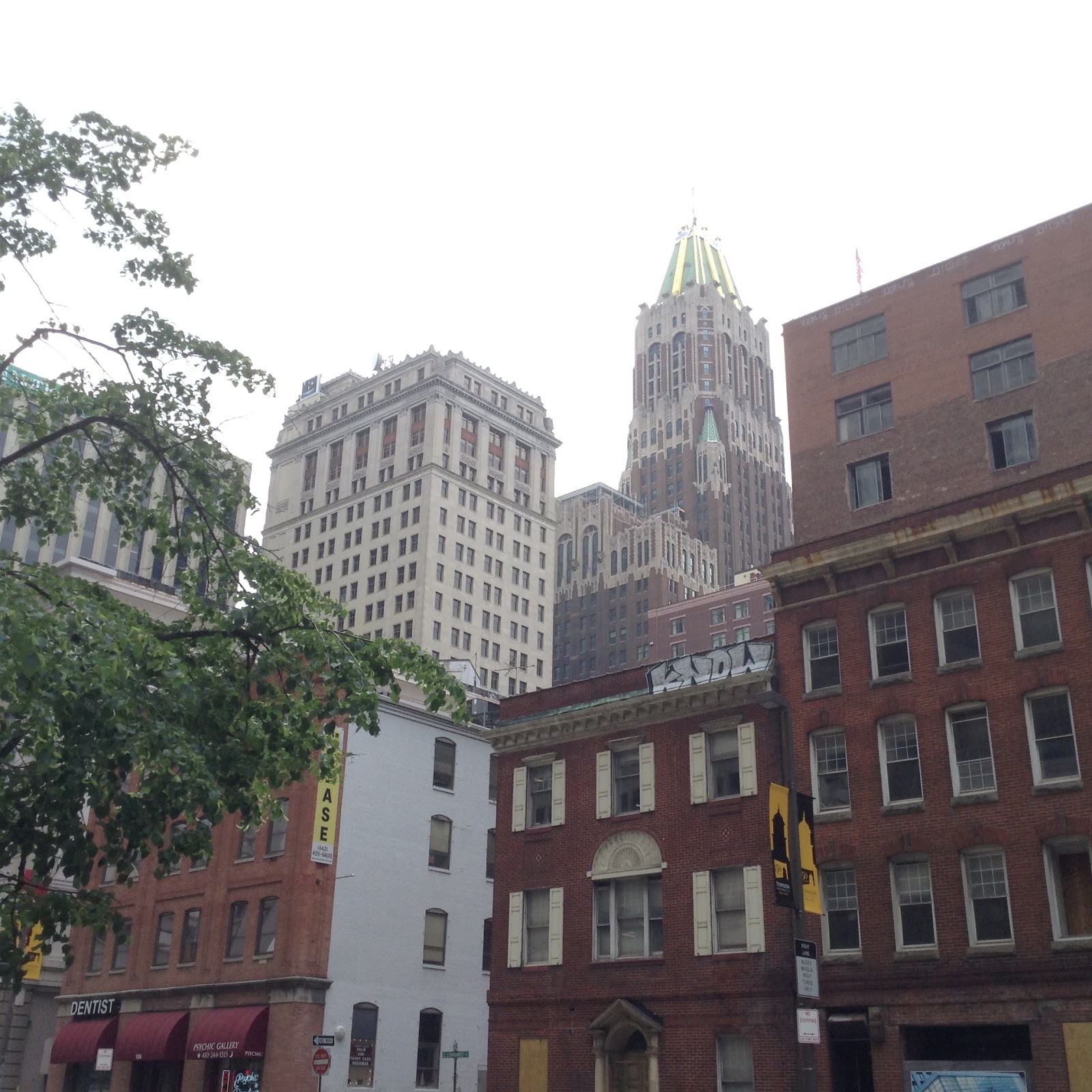
Taking a closer look at Autumn Fire on DVD, freeze-framing the fragmentary shots, it suddenly became clear: Weinberg did indeed shoot these scenes in Baltimore. Again, it was the skyline that provided the clue. In the shot below, I recognized the unmistakable structure of the Baltimore Trust Company Building (at one time the tallest building in the city and today the Bank of America building, built in 1929 and located at 10 Light Street). Immediately to its left in this shot is another building that remains today, the First National Bank Building (formerly the Legg Mason Building, built in 1924).

The next question was determining which area of the city this shot was taken from. Based on the angle of the buildings, it appeared to be taken in the spot where the USS Constellation is currently docked, at Pier 1 in the Inner Harbor.
With this evidence, I headed to Baltimore to take photos of the area today. Knowing how much the skyline has built up over the years, I doubted I would be able to get a picture of the buildings from the same angle. I was correct -- this particular view is no longer visible from the Inner Harbor, but I was able to find a view of the buildings from a similar angle, further up on Pratt Street:


Though born in Manhattan and based in New York for many years, Weinberg's early career in film can be traced to Baltimore, where he managed The Little Theater, opened in 1927 and located at 523 North Howard Street (it has since been demolished, and is now a parking lot). Incidentally, several short biographical sketches of Weinberg that I've looked at online state that he was the manager of "a little theater" in Baltimore, apparently not realizing that "The Little" was actually the name of the theater. The Little was known as a venue for what would today be termed art house fare, including important foreign films and independent films (my grandfather, an avid moviegoer in Baltimore at the time, recalls seeing the Technicolor production of The Mikado there in 1939).
But Weinberg's contributions to Baltimore's film culture extended beyond his curatorial role as the manager of the Little Theater. In 1931, he wrote and directed an important film in the American avant garde movement, Autumn Fire. This 15-minute lyrical film poem follows two lovers who are separated by distance -- the man in the city, the woman in the country -- and are finally reunited in New York. The silent film tells its story entirely through images, aided occasionally by the text of written letters. The beauty of Weinberg's compositions demonstrate a real eye for setting and detail, making it a pity that this was the only film he completed. It borrows aspects of the "City Symphonies" of the 1920s, with its montages of a modern industrial metropolis, and contains elements of what P. Adams Sitney in Visionary Film calls the "trance film", in its dreamlike unfolding of narrative events and emphasis on the relationship between the characters and their respective environments.
According to Robert A. Haller's article on the film (originally published in Field of Vision, Nos. 9-10, Winter-Spring 1980, and reprinted in Unseen Cinema: Early American Avant Garde Film 1893-1947, ed. Bruce Posner), Autumn Fire grew out of an earlier film project that Weinberg began but never finished, called A City Symphony, and notes that Weinberg was influenced by filmmakers such as Eisenstein (Romances-Sentimentale), Dimitri Kirsanoff (Brumes d'Autome), and Walter Ruttman (Berlin). He also mentions a charming anecdote about the production, that it was intended as a kind of cinematic love letter to Erna Bergman, who played the girl in the film.
Knowing that Weinberg was based in Baltimore at the time he made Autumn Fire, I became interested in the possibility that he had filmed at least some of it there. As a native of Maryland as well as a filmmaker myself, I was intrigued by this previously-unexplored link between Autumn Fire and its possible connection to the city.
Having seen the film several times, I knew the final scenes were shot, or at least set, in New York, as indicated by an on-screen note that refers to the "Central Station". Haller notes that the Manhattan footage Weinberg shot for A City Symphony in the late '20s was cut up and edited into Autumn Fire, which would explain the later "city" scenes taken in New York.
However, it is the earlier "city" scenes that interested me, and I revisited those with an eye toward looking for any identifiable signs that they might have been shot in Baltimore. Although the sequences consisted mostly of brief glimpses of the ships, piers, harbor, etc., there were a couple of shots that contained a view of the city skyline. I realized upon closer inspection that the skyline was all wrong for it to be New York, due to the lack of towering skyscrapers and other recognizable landmarks that would have been present even in 1931.
Taking a closer look at Autumn Fire on DVD, freeze-framing the fragmentary shots, it suddenly became clear: Weinberg did indeed shoot these scenes in Baltimore. Again, it was the skyline that provided the clue. In the shot below, I recognized the unmistakable structure of the Baltimore Trust Company Building (at one time the tallest building in the city and today the Bank of America building, built in 1929 and located at 10 Light Street). Immediately to its left in this shot is another building that remains today, the First National Bank Building (formerly the Legg Mason Building, built in 1924).

With this evidence, I headed to Baltimore to take photos of the area today. Knowing how much the skyline has built up over the years, I doubted I would be able to get a picture of the buildings from the same angle. I was correct -- this particular view is no longer visible from the Inner Harbor, but I was able to find a view of the buildings from a similar angle, further up on Pratt Street:
Here is what the view from Pier 1 looks like today. The area has been built up considerably, between the skyscrapers and the construction of Harbor Place:

Many of the shots in the film appear to have been taken on or around piers that no longer exist. I have been unable to identify the precise locations of which piers might have been used. However, one shot shows a boat docking, clearly marked "Balto, MD", evidence that these scenes were at least taken in Baltimore's harbor:

There is one shot of the harbor taken from a high vantage point, which was possibly filmed from Federal Hill, located across from Harbor Place:

From atop Federal Hill, this was the only view I could get that resembled that in the film at all, though it is difficult to be certain, again, considering how much the area has been developed over the years. The only distinctive elements to go on were the height of the vantage point from which it was taken, which suggested Federal Hill, and the fact that the harbor veers off to the right at an angle:

Presumably, Weinberg shot these scenes in Baltimore due to the need to incorporate the character of "The Man" (played by non-professional actor Willy Hildebrand) into the story, and to supplement the Manhattan footage that he was recycling from A City Symphony (the majority of which seems to focus on the towering skyscrapers, trains, and bustling traffic). Haller notes that the scenes with Erna Bergman were shot first, which suggests that they were filmed somewhere in rural Maryland, though without further research, it is impossible to be sure.
This discovery of Baltimore's role in Autumn Fire establishes a link between the city and the early American avant garde film movement of the 1930s, and provides a starting point in continuing to examine Weinberg's contributions to Baltimore's film culture both as a filmmaker and exhibitor.
Herman G. Weinberg's papers are held in the collection of the Billy Rose Theatre Division of the New York Public Library for the Performing Arts at Lincoln Center. I plan to continue my research using the materials held in his archive and to hopefully be able to shed new light onto Weinberg's time in Baltimore.
*Update: Read about the filming location in Preston Gardens Park here.
References:
Freedman, Samuel G. "Herman G. Weinberg, Writer and Foreign Film Translator." The New York Times. 8 November, 1983. NYTimes.com. Web. Accessed 26 May, 2015. <http://www.nytimes.com/1983/11/08/obituaries/herman-g-weinberg-writer-and-foreign-film-translator.html>
Haller, Robert A. "Herman G. Weinberg, Autumn Fire (1930-1933)", originally published in Field of Vision, Nos. 9-10, Winter-Spring 1980, pp. 6-7, reprinted in Unseen Cinema: Early American Avant Garde Film 1893-1947, ed. Bruce Posner. Filmmakers Showcase, 2001. pp. 137-138.
Herman G. Weinberg Collection, Biographical/Historical Information. The New York Public Library Archives and Manuscripts. Web. Accessed 20 May, 2015. <http://archives.nypl.org/the/22482#bioghist>
Levin, Michael. "The Little Theatre in Baltimore". CinemaTreasures.org. Web. Accessed 20 May, 2015 <http://cinematreasures.org/theaters/7923>
Tuesday, April 07, 2015
Movie Miniatures
I recently watched Carol Reed's 1940 British wartime thriller NIGHT TRAIN TO MUNICH. I love the stylized artifice of these miniatures, which look like they could have come right over from Hitchcock's THE LADY VANISHES, and have a certain charm and character lacking from slicker, big-budget miniatures or today's CGI models.
THE LADY VANISHES opens with a similarly charming miniature town. A crane shot passes over the model trains (complete with miniature human figures next to it). It then passes in front of a quaint little model house before moving on to a side street, where a model car passes by.
These models, which probably seemed palpably artificial even to contemporary audiences, contain the imagination and skill of the artisans who created them, lending these films a distinctly human touch.
Subscribe to:
Posts (Atom)