Showing posts with label Avant Garde. Show all posts
Sunday, November 05, 2017
Monterey Pop and the Avant Garde
I watched D.A. Pennebaker's film of MONTEREY POP a few weeks ago at the Senator Theatre in Baltimore for the first time, and hadn't jotted down any thoughts on it yet, perhaps because it is such an "experience" beyond being just a filmed record of the concert.
However, something that I have found myself thinking about quite a bit since then is the way that the film, and indeed, much of the Direct Cinema movement, fuses the concepts and energies of both the documentary and avant garde traditions. There are sequences in MONTEREY POP show the direct influence (and directly influenced?) the techniques of Jonas Mekas' diary film shooting style, for example.
Similarly, if you look at an earlier film by Pennebaker, DAYBREAK EXPRESS (1953), it's difficult to even classify -- is it a documentary of a morning train commute, or an avant garde city symphony (or jazz riff, in this case), animated in light and shadow? Why can't it be both?
Labels:
Avant Garde,
D.A. Pennebaker,
Documentary,
Monterey Pop
Thursday, August 11, 2016
Book Review: Jonas Mekas' "Movie Journal: The Rise of the New American Cinema, 1959-1971"
Among the literature written on the subject of film, there are a few works that I would consider absolutely "essential". Movie Journal: The Rise of the New American Cinema, 1959-1971, by Jonas Mekas, is certainly one of them. Representing nearly a third of the columns that Mekas wrote for the Village Voice over a period of about 15 years, it provides a vivid, first-hand account of the films and filmmakers of the New York avant garde cinema, written "as it happened" by the movement's most passionate champion.
It is really quite staggering to think about the scope of what Mekas' writings cover here -- really the entire rise and development of one the most creatively fertile movements in the history of cinema, offering impassioned defenses of some of its most notable participants including Stan Brakhage, Jack Smith, Ken Jacobs, Gregory Markopolous, Harry Smith, and Marie Menken. Mekas traces not only the films and the people who made them, but also how they were distributed, exhibited, and received. He provides a vibrant portrait of the New York underground art scene in which these films were shown, and the increasingly ambitious ways in which they were presented, such as interactive, live "happenings". His descriptions of the challenges in dealing with New York's film licensing and censorship laws of the time reminds us of how courageous these artists were in fighting for the right to make the films they wanted. Most significant in this respect is Mekas' account of his arrest over the showing of Jack Smith's highly controversial Flaming Creatures, which was released in 1963 and found to be obscene.
Then there are the accounts of the development of the Filmmakers' Co-op, which served as a distribution network for avant garde cinema, and the Anthology Film Archives, created as a place to preserve and screen the films for future generations. The stories behind these two landmark cultural institutions deserve volumes of their own; their inclusion here reminds us how prolific (and tireless) Mekas has been in his quest to champion alternative forms of cinema.
Mekas is also a prescient visionary, particularly when it comes to his ideas about making cinema available in the home (to be collected and consumed like books), and in his idea of using 8mm (home movie) cameras in the service of social justice. The advent of home video, and the prevalence of consumer camcorders (as well as online video on which to share the footage) have proven him right with time.
Mekas has said that everything he did, he did because there was a real necessity for it. That is what comes through most strongly in his writing. One gets the sense that this is not a man with any time for trivia; his vision was (and remains) astoundingly clear and focused on the task at hand. The post-war American avant garde cinema flourished thanks to the critical context provided by Mekas, along with the institutions for distribution and exhibition that he was instrumental in creating. Mekas is an inspiration to anyone who cares about the possibility of cinema as a tool for personal expression rather than as a commercial business. This collection of his writings is a testament to that. As a critic, he has that most important of gifts: the ability to inspire his readers to seek out for themselves the films about which he wrote.
Movie Journal was originally published in 1972, and has been long out of print until this 2016 reissue by Columbia University Press. The new edition contains a foreword by Peter Bogdanovich.
It is really quite staggering to think about the scope of what Mekas' writings cover here -- really the entire rise and development of one the most creatively fertile movements in the history of cinema, offering impassioned defenses of some of its most notable participants including Stan Brakhage, Jack Smith, Ken Jacobs, Gregory Markopolous, Harry Smith, and Marie Menken. Mekas traces not only the films and the people who made them, but also how they were distributed, exhibited, and received. He provides a vibrant portrait of the New York underground art scene in which these films were shown, and the increasingly ambitious ways in which they were presented, such as interactive, live "happenings". His descriptions of the challenges in dealing with New York's film licensing and censorship laws of the time reminds us of how courageous these artists were in fighting for the right to make the films they wanted. Most significant in this respect is Mekas' account of his arrest over the showing of Jack Smith's highly controversial Flaming Creatures, which was released in 1963 and found to be obscene.
Then there are the accounts of the development of the Filmmakers' Co-op, which served as a distribution network for avant garde cinema, and the Anthology Film Archives, created as a place to preserve and screen the films for future generations. The stories behind these two landmark cultural institutions deserve volumes of their own; their inclusion here reminds us how prolific (and tireless) Mekas has been in his quest to champion alternative forms of cinema.
Mekas is also a prescient visionary, particularly when it comes to his ideas about making cinema available in the home (to be collected and consumed like books), and in his idea of using 8mm (home movie) cameras in the service of social justice. The advent of home video, and the prevalence of consumer camcorders (as well as online video on which to share the footage) have proven him right with time.
Mekas has said that everything he did, he did because there was a real necessity for it. That is what comes through most strongly in his writing. One gets the sense that this is not a man with any time for trivia; his vision was (and remains) astoundingly clear and focused on the task at hand. The post-war American avant garde cinema flourished thanks to the critical context provided by Mekas, along with the institutions for distribution and exhibition that he was instrumental in creating. Mekas is an inspiration to anyone who cares about the possibility of cinema as a tool for personal expression rather than as a commercial business. This collection of his writings is a testament to that. As a critic, he has that most important of gifts: the ability to inspire his readers to seek out for themselves the films about which he wrote.
Movie Journal was originally published in 1972, and has been long out of print until this 2016 reissue by Columbia University Press. The new edition contains a foreword by Peter Bogdanovich.
Tuesday, June 02, 2015
An "Autumn Fire" Update
In my recent post on the Baltimore filming locations of Herman G. Weinberg's 1931 short film, Autumn Fire, I wrote about the city's appearance in this important early work from the American avant garde film movement, and identified some of the locations used in the film, specifically the view of the Baltimore Trust Company and First National Bank buildings as seen from the Inner Harbor. However, there were a few other locations used in the film that I was not able to identify, though the presence of the actors in those shots suggested that these, too, had been filmed in Baltimore.
I'm pleased to report that one more location has been identified. The credit for this ID must go to my mother, Pamela Barry, who recognized the distinctive stairs leading into the Preston Gardens Park, located at the corner of Saratoga Street and St. Paul Street. Knowing of my interest in identifying the locations that appear in Autumn Fire, she visited Preston Park to take photos of the stairs as they appear today, which I have included below, and also sent me the following notes:
"While I was watching Autumn Fire, I was struck by those sweeping stone stairways. I knew that I had seen them somewhere before. When I was a girl, my mother would drive us into the city by way of St.Paul Street as there was no Jones Falls Expressway or 83 South at that time. My favorite part of the drive came when we passed that little green space known as Preston Park. I thought those stairs were beautiful and the image always stayed with me."
The steps used in the film appear to be on the right side of this unique staircase (if you're facing it as in the photo above). Here is the staircase as it appears in the film:
Of the photos my mother sent me, it was this one that provided the positive ID when we looked at them together:
It is taken from a slightly different angle than the one from the film reproduced above, but a look at the spot where the two adjoining staircases meet provides the clue: the slight, straight ledge where actor Willy Hildebrand rests his arm in the film. Immediately to the right is the adjoining staircase banister, with its distinctive L-shape at the top, and to the left is the wavy banister that is clearly visible in front of Hildebrand in the screenshot from the film above.
Here is another view of the staircase from the film, which matches a bit more clearly the one in the present day photo, as it is taken from a similar perspective:
Below is a cropped version of the present day photo to match more closely the above screenshot from the film:
I'm pleased to report that one more location has been identified. The credit for this ID must go to my mother, Pamela Barry, who recognized the distinctive stairs leading into the Preston Gardens Park, located at the corner of Saratoga Street and St. Paul Street. Knowing of my interest in identifying the locations that appear in Autumn Fire, she visited Preston Park to take photos of the stairs as they appear today, which I have included below, and also sent me the following notes:
"While I was watching Autumn Fire, I was struck by those sweeping stone stairways. I knew that I had seen them somewhere before. When I was a girl, my mother would drive us into the city by way of St.Paul Street as there was no Jones Falls Expressway or 83 South at that time. My favorite part of the drive came when we passed that little green space known as Preston Park. I thought those stairs were beautiful and the image always stayed with me."
The steps used in the film appear to be on the right side of this unique staircase (if you're facing it as in the photo above). Here is the staircase as it appears in the film:
Of the photos my mother sent me, it was this one that provided the positive ID when we looked at them together:
It is taken from a slightly different angle than the one from the film reproduced above, but a look at the spot where the two adjoining staircases meet provides the clue: the slight, straight ledge where actor Willy Hildebrand rests his arm in the film. Immediately to the right is the adjoining staircase banister, with its distinctive L-shape at the top, and to the left is the wavy banister that is clearly visible in front of Hildebrand in the screenshot from the film above.
Here is another view of the staircase from the film, which matches a bit more clearly the one in the present day photo, as it is taken from a similar perspective:
Below is a cropped version of the present day photo to match more closely the above screenshot from the film:
Here is another screenshot from the film, taken from the top of the stairs:
The steps today (seen from a different angle than in the film):
These glimpses of Baltimore, as seen in Herman G. Weinberg's Autumn Fire in 1931, are valuable for providing a filmed record of the city for posterity. In the previous post, the comparison between the "then and now" photos demonstrated how much the city's skyline and Inner Harbor area has changed and developed in the intervening 85 years. These photos from Preston Park reveal a unique piece of architecture that has survived intact to the present day.
Autumn Fire, in addition to being an important work in the early American avant garde film movement, also serves as a record of the architecture and urban development (as so many early films inadvertently do) of Baltimore, and is a precious filmed snapshot of the city from a time when so few moving images of it survive.
Present day photos of Preston Gardens Park courtesy of Pamela Barry.
Update July 5, 2015:
I took additional photos of the locations, including the exact staircase from the same angles as in the film, and have provided these shots here for then-and-now comparison:
Labels:
Autumn Fire,
Avant Garde,
Baltimore,
Herman G. Weinberg
Tuesday, May 26, 2015
Baltimore City in Herman G. Weinberg's "Autumn Fire" (1931)
Of the figures who have contributed to Baltimore City's rich regional film culture, one who must be mentioned is Herman G. Weinberg (1908-1983). Weinberg -- a noted film historian, critic, translator, and instructor -- is probably best known by cinephiles today for his film column "Coffee, Brandy and Cigars" and for his numerous books which include Stroheim: A Pictorial Record, The Complete "Greed", and The Lubitsch Touch. Weinberg was also instrumental in the importing and exhibition of foreign-language films in the US, translating subtitles for more than 300 films in a variety of languages.
Though born in Manhattan and based in New York for many years, Weinberg's early career in film can be traced to Baltimore, where he managed The Little Theater, opened in 1927 and located at 523 North Howard Street (it has since been demolished, and is now a parking lot). Incidentally, several short biographical sketches of Weinberg that I've looked at online state that he was the manager of "a little theater" in Baltimore, apparently not realizing that "The Little" was actually the name of the theater. The Little was known as a venue for what would today be termed art house fare, including important foreign films and independent films (my grandfather, an avid moviegoer in Baltimore at the time, recalls seeing the Technicolor production of The Mikado there in 1939).
But Weinberg's contributions to Baltimore's film culture extended beyond his curatorial role as the manager of the Little Theater. In 1931, he wrote and directed an important film in the American avant garde movement, Autumn Fire. This 15-minute lyrical film poem follows two lovers who are separated by distance -- the man in the city, the woman in the country -- and are finally reunited in New York. The silent film tells its story entirely through images, aided occasionally by the text of written letters. The beauty of Weinberg's compositions demonstrate a real eye for setting and detail, making it a pity that this was the only film he completed. It borrows aspects of the "City Symphonies" of the 1920s, with its montages of a modern industrial metropolis, and contains elements of what P. Adams Sitney in Visionary Film calls the "trance film", in its dreamlike unfolding of narrative events and emphasis on the relationship between the characters and their respective environments.
According to Robert A. Haller's article on the film (originally published in Field of Vision, Nos. 9-10, Winter-Spring 1980, and reprinted in Unseen Cinema: Early American Avant Garde Film 1893-1947, ed. Bruce Posner), Autumn Fire grew out of an earlier film project that Weinberg began but never finished, called A City Symphony, and notes that Weinberg was influenced by filmmakers such as Eisenstein (Romances-Sentimentale), Dimitri Kirsanoff (Brumes d'Autome), and Walter Ruttman (Berlin). He also mentions a charming anecdote about the production, that it was intended as a kind of cinematic love letter to Erna Bergman, who played the girl in the film.
Knowing that Weinberg was based in Baltimore at the time he made Autumn Fire, I became interested in the possibility that he had filmed at least some of it there. As a native of Maryland as well as a filmmaker myself, I was intrigued by this previously-unexplored link between Autumn Fire and its possible connection to the city.
Having seen the film several times, I knew the final scenes were shot, or at least set, in New York, as indicated by an on-screen note that refers to the "Central Station". Haller notes that the Manhattan footage Weinberg shot for A City Symphony in the late '20s was cut up and edited into Autumn Fire, which would explain the later "city" scenes taken in New York.
However, it is the earlier "city" scenes that interested me, and I revisited those with an eye toward looking for any identifiable signs that they might have been shot in Baltimore. Although the sequences consisted mostly of brief glimpses of the ships, piers, harbor, etc., there were a couple of shots that contained a view of the city skyline. I realized upon closer inspection that the skyline was all wrong for it to be New York, due to the lack of towering skyscrapers and other recognizable landmarks that would have been present even in 1931.
Taking a closer look at Autumn Fire on DVD, freeze-framing the fragmentary shots, it suddenly became clear: Weinberg did indeed shoot these scenes in Baltimore. Again, it was the skyline that provided the clue. In the shot below, I recognized the unmistakable structure of the Baltimore Trust Company Building (at one time the tallest building in the city and today the Bank of America building, built in 1929 and located at 10 Light Street). Immediately to its left in this shot is another building that remains today, the First National Bank Building (formerly the Legg Mason Building, built in 1924).
The next question was determining which area of the city this shot was taken from. Based on the angle of the buildings, it appeared to be taken in the spot where the USS Constellation is currently docked, at Pier 1 in the Inner Harbor.
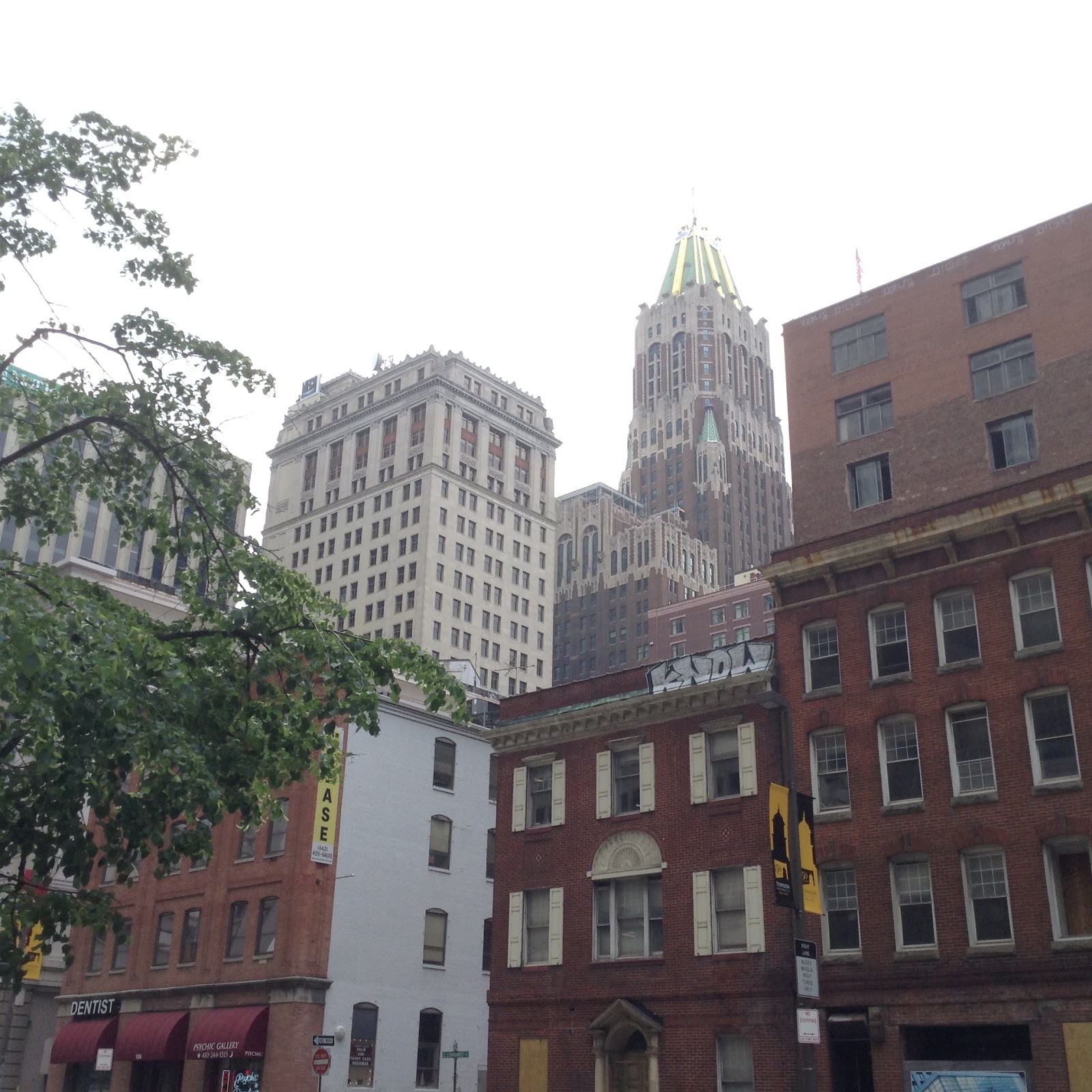
With this evidence, I headed to Baltimore to take photos of the area today. Knowing how much the skyline has built up over the years, I doubted I would be able to get a picture of the buildings from the same angle. I was correct -- this particular view is no longer visible from the Inner Harbor, but I was able to find a view of the buildings from a similar angle, further up on Pratt Street:
Though born in Manhattan and based in New York for many years, Weinberg's early career in film can be traced to Baltimore, where he managed The Little Theater, opened in 1927 and located at 523 North Howard Street (it has since been demolished, and is now a parking lot). Incidentally, several short biographical sketches of Weinberg that I've looked at online state that he was the manager of "a little theater" in Baltimore, apparently not realizing that "The Little" was actually the name of the theater. The Little was known as a venue for what would today be termed art house fare, including important foreign films and independent films (my grandfather, an avid moviegoer in Baltimore at the time, recalls seeing the Technicolor production of The Mikado there in 1939).
But Weinberg's contributions to Baltimore's film culture extended beyond his curatorial role as the manager of the Little Theater. In 1931, he wrote and directed an important film in the American avant garde movement, Autumn Fire. This 15-minute lyrical film poem follows two lovers who are separated by distance -- the man in the city, the woman in the country -- and are finally reunited in New York. The silent film tells its story entirely through images, aided occasionally by the text of written letters. The beauty of Weinberg's compositions demonstrate a real eye for setting and detail, making it a pity that this was the only film he completed. It borrows aspects of the "City Symphonies" of the 1920s, with its montages of a modern industrial metropolis, and contains elements of what P. Adams Sitney in Visionary Film calls the "trance film", in its dreamlike unfolding of narrative events and emphasis on the relationship between the characters and their respective environments.
According to Robert A. Haller's article on the film (originally published in Field of Vision, Nos. 9-10, Winter-Spring 1980, and reprinted in Unseen Cinema: Early American Avant Garde Film 1893-1947, ed. Bruce Posner), Autumn Fire grew out of an earlier film project that Weinberg began but never finished, called A City Symphony, and notes that Weinberg was influenced by filmmakers such as Eisenstein (Romances-Sentimentale), Dimitri Kirsanoff (Brumes d'Autome), and Walter Ruttman (Berlin). He also mentions a charming anecdote about the production, that it was intended as a kind of cinematic love letter to Erna Bergman, who played the girl in the film.
Knowing that Weinberg was based in Baltimore at the time he made Autumn Fire, I became interested in the possibility that he had filmed at least some of it there. As a native of Maryland as well as a filmmaker myself, I was intrigued by this previously-unexplored link between Autumn Fire and its possible connection to the city.
Having seen the film several times, I knew the final scenes were shot, or at least set, in New York, as indicated by an on-screen note that refers to the "Central Station". Haller notes that the Manhattan footage Weinberg shot for A City Symphony in the late '20s was cut up and edited into Autumn Fire, which would explain the later "city" scenes taken in New York.
However, it is the earlier "city" scenes that interested me, and I revisited those with an eye toward looking for any identifiable signs that they might have been shot in Baltimore. Although the sequences consisted mostly of brief glimpses of the ships, piers, harbor, etc., there were a couple of shots that contained a view of the city skyline. I realized upon closer inspection that the skyline was all wrong for it to be New York, due to the lack of towering skyscrapers and other recognizable landmarks that would have been present even in 1931.
Taking a closer look at Autumn Fire on DVD, freeze-framing the fragmentary shots, it suddenly became clear: Weinberg did indeed shoot these scenes in Baltimore. Again, it was the skyline that provided the clue. In the shot below, I recognized the unmistakable structure of the Baltimore Trust Company Building (at one time the tallest building in the city and today the Bank of America building, built in 1929 and located at 10 Light Street). Immediately to its left in this shot is another building that remains today, the First National Bank Building (formerly the Legg Mason Building, built in 1924).
With this evidence, I headed to Baltimore to take photos of the area today. Knowing how much the skyline has built up over the years, I doubted I would be able to get a picture of the buildings from the same angle. I was correct -- this particular view is no longer visible from the Inner Harbor, but I was able to find a view of the buildings from a similar angle, further up on Pratt Street:
Here is what the view from Pier 1 looks like today. The area has been built up considerably, between the skyscrapers and the construction of Harbor Place:
Many of the shots in the film appear to have been taken on or around piers that no longer exist. I have been unable to identify the precise locations of which piers might have been used. However, one shot shows a boat docking, clearly marked "Balto, MD", evidence that these scenes were at least taken in Baltimore's harbor:
There is one shot of the harbor taken from a high vantage point, which was possibly filmed from Federal Hill, located across from Harbor Place:
From atop Federal Hill, this was the only view I could get that resembled that in the film at all, though it is difficult to be certain, again, considering how much the area has been developed over the years. The only distinctive elements to go on were the height of the vantage point from which it was taken, which suggested Federal Hill, and the fact that the harbor veers off to the right at an angle:
Presumably, Weinberg shot these scenes in Baltimore due to the need to incorporate the character of "The Man" (played by non-professional actor Willy Hildebrand) into the story, and to supplement the Manhattan footage that he was recycling from A City Symphony (the majority of which seems to focus on the towering skyscrapers, trains, and bustling traffic). Haller notes that the scenes with Erna Bergman were shot first, which suggests that they were filmed somewhere in rural Maryland, though without further research, it is impossible to be sure.
This discovery of Baltimore's role in Autumn Fire establishes a link between the city and the early American avant garde film movement of the 1930s, and provides a starting point in continuing to examine Weinberg's contributions to Baltimore's film culture both as a filmmaker and exhibitor.
Herman G. Weinberg's papers are held in the collection of the Billy Rose Theatre Division of the New York Public Library for the Performing Arts at Lincoln Center. I plan to continue my research using the materials held in his archive and to hopefully be able to shed new light onto Weinberg's time in Baltimore.
*Update: Read about the filming location in Preston Gardens Park here.
References:
Freedman, Samuel G. "Herman G. Weinberg, Writer and Foreign Film Translator." The New York Times. 8 November, 1983. NYTimes.com. Web. Accessed 26 May, 2015. <http://www.nytimes.com/1983/11/08/obituaries/herman-g-weinberg-writer-and-foreign-film-translator.html>
Haller, Robert A. "Herman G. Weinberg, Autumn Fire (1930-1933)", originally published in Field of Vision, Nos. 9-10, Winter-Spring 1980, pp. 6-7, reprinted in Unseen Cinema: Early American Avant Garde Film 1893-1947, ed. Bruce Posner. Filmmakers Showcase, 2001. pp. 137-138.
Herman G. Weinberg Collection, Biographical/Historical Information. The New York Public Library Archives and Manuscripts. Web. Accessed 20 May, 2015. <http://archives.nypl.org/the/22482#bioghist>
Levin, Michael. "The Little Theatre in Baltimore". CinemaTreasures.org. Web. Accessed 20 May, 2015 <http://cinematreasures.org/theaters/7923>
Subscribe to:
Posts (Atom)