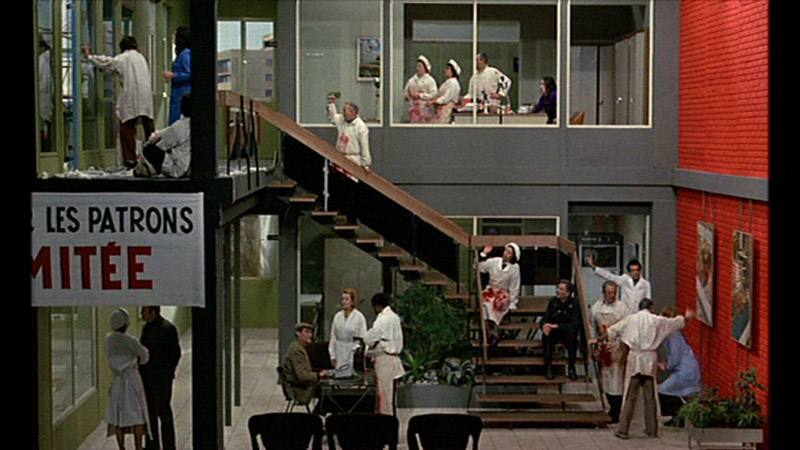
I watched a silent Laurel & Hardy comedy last night, Two Tars (1928), which finds the boys as sailors on shore leave who get involved in a nightmare of a traffic jam that turns into a violent battle between the frustrated motorists. I was particularly struck by the influence this film must have had on Jean-Luc Godard when he staged the similarly violent traffic jam in Weekend (1967).
Thursday, August 27, 2020
Sunday, August 23, 2020
Slippery Jim (1910)
This is an amazing trick film made by Ferdinand Zecca in France in 1910. The premise involves a prisoner who is also a master escape artist and finds the most unusual ways of eluding his captors. One of the exuberant, gloriously free-spirited comedies produced by the Pathe Studio in the early years of the 20th century.
Saturday, August 22, 2020
BUtterfield 8 (1960)
Monday, August 17, 2020
Lockdown Filmmaking: "Scared 2 Death II"
New short film, Scared 2 Death II: 2 Scared 2 Live:
This is a sequel to the short film I made this past spring, Scared 2 Death. Like many filmmakers, I found myself wanting to create something even though we were still in a strict lockdown period. As I've written elsewhere on this blog, I made a film back in January called Unknown Number, which had taken a great deal of preparation and a full day of shooting to pull off. While I was certainly happy with how it turned out, I also realized that the requirements of making a film even on that scale, with the limited resources I had, had sucked a lot of the joy out of the filmmaking process for me.
Several months later, I had the idea to make Scared 2 Death, a simple idea that I'd thought up about a decade ago while I was still living in Brooklyn. The situation is a horror film cliche -- the woman walking alone at night down a dark street, followed by an unseen menace. But the whole point of making the film for me was to take this situation and have fun with it. The fact that it was ultra-short and a very simple scenario to film made it all the more enjoyable to shoot.
Scared 2 Death is maybe my favorite of the movies I've made, because it got me back to the basics of what I love about making little films, and allowed me to re-connect with the joy I get just from filming a simple situation like that.
So, after a few more micro-shorts that I've made over the summer -- Isolation, Lights Out, and Scarcity -- I decided to have some fun by re-visiting the simple premise of Scared 2 Death with a tongue-in-cheek sequel, Scared 2 Death II: 2 Scared 2 Live. In this one, I take another staple of the horror film and just had fun with my own little interpretation of it.
Thursday, August 06, 2020
Lockdown Filmmaking: "Lights Out"
Thursday, July 23, 2020
Godard and Lewis
Tuesday, July 21, 2020
Gloria (1980)
Cowboy (1956)
Monday, July 06, 2020
R.I.P. Ennio Morricone (1928-2020)
https://www.hollywoodreporter.com/news/ennio-morricone-dead-prolific-italian-composer-was-91-858358
I was just listening to the soundtrack from Salo last night and thinking about Morricone's versatility as a composer. This theme was such a brilliant choice to contrast with Pasolini's shocking images that follow in the film.
Saturday, June 13, 2020
Quarantine Filmmaking: "Isolation"
Tuesday, June 09, 2020
"Scared 2 Death" -- Quarantine Filmmaking
I haven't felt this energized by making films in years.
This is the first of these that I put together back in May, called Scared 2 Death. It's based on an idea that I had a few years ago, when I was living in Brooklyn. I thought of this idea again recently and realized it would make a perfect small project that I could film under the current restrictions.
Friday, May 15, 2020
5 Against the House (1955)
Monday, May 11, 2020
Saskatchewan (1954)
Convicted (1938)
![]() |
| Rita Hayworth, age 19, in CONVICTED (1938) |
"Quota Quickie" produced in Victoria B.C. for the British market, with American stars Charles Quigley and Marc Lawrence.
Hayworth plays a nightclub singer whose brother is framed for a murder, and must hunt down the real killer. Otherwise routine crime drama (based on the Cornell Woolrich story "Face Work") enhanced by the presence of Hayworth in an early role right before coming to the attention of Hollywood.
Playboy of Paris (1930)
Roadhouse Nights (1930)
I strongly suspect that little of Hecht's original script ended up on the screen, because it's an utterly bizarre mixed bag. The film tells the story of a reporter (Charlie Ruggles, in a dramatic role) who is sent to a small town outside of Chicago to investigate the disappearance of a fellow reporter, who went MIA while investigating a mob of rum-runners operating out of the town. We know that the reporter was bumped off by the mob leader when he got a little too close to uncovering the operation.
The plot finds time for music numbers by Helen Morgan, as the gangster's moll who also turns out to have been an old sweetheart of Ruggles, and some energetic comedy singing and dancing from the team of Clayton, Jackson & Durante (with Jimmy making his film debut in a role that also calls for some dramatic support).
It all runs out of steam by the end, with the absurdity of the situations working against the dramatic tension, but it's all oddly fascinating in its strangeness. The performances and direction have a stilted and lugubrious quality that give the impression of a bad dream.
Detective Story (1951)
This was right around the time that Douglas was essaying some really dark, intense roles (notably ACE IN THE HOLE), and his Jim McCleod here is one of the best of those. McCleod is angry and vengeful, uncompromising in his tough-as-nails attitude toward crime. He is anchored only by his love for his wife as his growing bitterness threatens to destroy him both personally and professionally.
The set design of the police station perfectly captures the claustrophobic atmosphere and the resulting high tensions of all who work within it. Special mention should also be made of the fine cinematography by Lee Garmes and John F. Seitz. Screenplay by Robert Wyler and Philip Yordan from Kingsley's 1949 play of the same name.
Saturday, May 09, 2020
Night Owls (1930)
I watched this Laurel and Hardy short on TV this morning. I've seen it probably close to a dozen times over the years, and it's never been one of my favorites. I've always found it a little too slow and plodding, even clumsily-staged compared to their best work. I had chalked this up partly due to the lack of fluidity in the early talkies, but even then, Laurel and Hardy had achieved a more relaxed, smooth pace in even earlier films like The Perfect Day and The Hoosegow (1929), so I wasn't sure I could explain my reaction to Night Owls based purely on the challenges of adapting their comedy to early sound film.
For whatever reason, when I watched Night Owls again this morning, I thoroughly enjoyed it, and found my estimation of it much higher than before. The version shown on the "Laurel and Hardy Show" features new musical under-scoring of the familiar LeRoy Shield tunes, arranged by Ronnie Hazlehurst, so perhaps that added to my enjoyment and smoothed over the flow of the action. But beyond that, the antics of the Boys' repeated attempted break-ins struck me as much funnier this time around. What had struck me as one of their weaker shorts in the past now had me in stitches.
Maybe it was just the laughs I needed this morning.
Tuesday, May 05, 2020
Sven Nykvist on working with Ingmar Bergman
"I am grateful to Bergman’s scripts that his photographic goal always changes with each one. There is no possibility for his cameraman to just alter his ordinary routine lighting technique or to shoot production after production in the same manner. All easy-come effects must be sacrificed for the simplicity which does not disturb. Although public acclaim in cinematography often can be achieved by instantaneous effects, it is in the long run only the true light which is interesting and which I strive for more and more in my work."Full article here:
https://ascmag.com/articles/photographing-the-films-of-ingmar-bergman
Thursday, April 30, 2020
Godard Instagram Interview with subtitles
I've been re-watching some of his films lately, including A Married Woman and Pierrot Le Fou, so it was a good time to watch this:
Wednesday, April 22, 2020
The Squeaker (1937)
I watched the 1937 British crime drama The Squeaker (aka Murder on Diamond Row) last night. This was a stylish Korda production starring Edmund Lowe as an alcoholic detective who has to bring down a prominent citizen at the center of a smuggling ring. Two terrific supporting performances by the great Alastair Sim and Robert Newton.
It's based on a story by Edgar Wallace and directed by William K. Howard. Also featuring Sebastian Shaw, Ann Todd, and Tamara Desni.
Friday, April 17, 2020
Allen Daviau R.I.P.
Thursday, April 16, 2020
Roger Corman on Battleship Potemkin
As Roger Ebert said in his review of Potemkin:
"If today it seems more like a technically brilliant but simplistic 'cartoon' (Pauline Kael's description in a favorable review), that may be because it has worn out its element of surprise--that, like the 23rd Psalm or Beethoven's Fifth, it has become so familiar we cannot perceive it for what it is." (https://www.rogerebert.com/reviews/great-movie-the-battleship-potemkin-1925)
Wednesday, April 15, 2020
Peter Greenaway interview
I had just recently watched Greenaway's film about Eisenstein's time in Mexico.
Seymour Stern on "Way Down East"
Tuesday, April 14, 2020
Metropolis Medley by Gottfried Huppertz
Simple pleasures
It was fun watching His Musical Career again after recently looking at Laurel and Hardy's The Music Box. I'd forgotten how much the latter owes to the Chaplin film beyond just the basic premise of two moving men carrying the piano up a flight of steps. There's a great sight gag of the moving cart being pulled by a donkey, who is lifted off the ground by the top-heavy weight of the piano. And there's a hilarious moment when the heavy piano is dropped down on to Mack Swain's back. Maybe my favorite bit is when Chaplin is carrying the piano on his back, and he is so bent over and stiff that he can't straighten back up again. And of course there's the gag involving drinking a can of varnish by mistake!
I could go on...but these are the great little moments that makes films like this such reliable and inexhaustible pleasures.
Now sit back and enjoy them for yourselves!
Monday, April 13, 2020
On Adaptations and Swiss Family Robinson
I'm currently reading Swiss Family Robinson by Johann Wyss. I love re-visiting the classics, and have fond memories reading this story as a kid (albeit in an abridged version). I also greatly enjoyed the 1960 Disney film adaptation, starring John Mills. Re-reading the novel now, I am struck by how much the script for the Disney film adapts the story in to a much more traditional narrative. There is a great amount of detail in the book describing the plants and wildlife found on the island, along with meticulous descriptions of how the family adapts to their new surroundings.
The book presents a much more methodical document of the survival process, even if it does take a great deal of liberties with the realistic availability of supplies and resources on the island, as well as the father's knowledge of them and how to utilize them. In contrast, the screenplay adapts the family's adventures in to a much more concise story, punctuated with memorable set-pieces of the kind that tend to run together amid the many details in the book.
Purely as drama, the Disney film is far more satisfying for me. There is also a 1940 version, narrated by Orson Welles, which I have yet to see.
Sunday, April 12, 2020
Mack Sennett Studio Tour
Camera Moves in Osaka Elegy (1936)
Here is a clip from the film that provides an example of how gracefully Mizoguchi moves his camera:
Bruce Baillie R.I.P.
https://www.nytimes.com/2020/04/10/movies/bruce-baillie-essential-avant-garde-filmmaker-dies-at-88.html
This seems a good time to share one of my favorite short films, All My Life, made by Baillie in 1966. A beautiful, poetic film set to a recording by Ella Fitzgerald.
His obituary in Artforum has this to say about All My Life:
"The impetus behind his three-minute, Ella Fitzgerald–soundtracked short All My Life (1966), which slowly pans on a wooden picket fence framed by blue skies and red roses, was 'the quality of the light for three summer days' on the Northern California coastline. After days of admiring the light, he and a friend had started driving back to San Francisco, when suddenly he decided 'No, I cannot turn my back on this!' and took out his tripod." (source: https://www.artforum.com/news/bruce-baillie-1931-2020-82729)
Saturday, April 11, 2020
David Lynch and Lumiere Camera
The Flying Deuces
This one also has one of my favorite Laurel and Hardy scenes, when Stan keeps bumping his head on the low ceiling of their hotel room. When Oliver admonishes him for being so stupid as to stand there and continue to bump his head, you know it's only a matter of time before Hardy's head hits the ceiling!
Friday, April 10, 2020
Color in Cries and Whispers (1972)
Turner Classic Movies used to (and may still, for all I know) air foreign films in the wee hours of the morning on Saturdays. As a teenager just immersing myself in all of the world cinema I could find, this was an excellent opportunity to see a lot of movies that I couldn't find elsewhere at the time, and to see many landmark films for the first time. One of these was Bergman's Cries and Whispers. I just re-watched the film last night for the first time in over twenty years. What I remember about seeing it for the first time on TV late that night was the color. That's what everyone talks about with this film, of course -- the stunning, deep reds. Watching it through bleary eyes at 2:00 in the morning, I just remember being so taken with the color and the compositions. I had seen a still from the scene above (not this exact still, but from the same scene) in Gilbert Adair's book Flickers: An Illustrated Celebration of 100 Years of Cinema, in which he selected Cries and Whispers as the representative film for 1972. It still makes quite an impression on me.
A modern silent comedy
When I saw this at the Orpheum, it was shown on a double bill with Buster Keaton's The Cameraman, and a live vaudeville show featuring local performers. One of my favorite moviegoing experiences.
Thursday, April 09, 2020
Tarkovsky Shooting "Stalker" (1979)
Sylvia and the Phantom (1946)
It's the kind of farce plot that could have been way too silly, but it's played with an earnestness and sweetness that takes it into another realm (no pun intended).
Wednesday, April 08, 2020
David Lean
He was working as an assistant at the studio, having worked his way up from teaboy, serving the tea during the afternoon break. One day, when the studio was making its first sound film, he learned that the film editor didn't know how to synchronize dailies. The only person who could do that was the newsreel editor, who spared two hours to show the editor the basics of syncing dailies. Lean watched intensely and learned the entire process from seeing the demonstration. The film editor continued to struggle with the process, and since the newsreel editor was occupied with his own responsibilities, Lean -- who had the whole process down pat -- stepped up to do the job and instantly rose to position of film editor.
It's like Mardik Martin said, "If you're a shrinking violet who sits in the corner, no one's going to give a shit about you. You've got to present yourself."
The Devil and Daniel Webster (1941)
Directed by William Dieterle, who appeared in Murnau's 1926 film of Faust, the style here is heavily infused with the influence of German Expressionism, particularly in the shots of the light falling across the farm at night which recalls Murnau's Sunrise. The rural Gothic horror element also looks forward to The Night of the Hunter, especially the eerie image of the devil as seen by the farmer from his window at night.
Tuesday, April 07, 2020
Laurel and Hardy Home Movie Footage
https://cdna.memoirefilmiquenouvelleaquitaine.fr/films/laurel-et-hardy
Godard Interviewed on Instagram
Made in U.S.A. (1966)
It's also a very difficult film to appreciate in translation, and it seemed to me to be a film that one really needs to experience in the native language to get the full effect. It's filled wall-to-wall with endless wordplay, much of it silly, but nonetheless the kind of thing that would be almost impossible to effectively translate into another language. Sort of like the Marx Bros.
The premise involves Anna Karina going to the fictional "Atlantic City" and ends up getting involved in an investigation in to the death of her lover. She refers to the investigation as being like a Walt Disney movie with Humphrey Bogart. That gives you an idea of what to expect.
The Hour of the Wolf (1968)
Watched this one for the first time last night. It's from a period of Bergman's career I greatly admire, with Persona being my favorite of these. The Hour of the Wolf is a horror psychodrama about an artist (Max von Sydow) and his wife (Liv Ullman) living on a remote island whose relationship becomes strained as the artist is haunted by bizarre visions. Bergman creates a thoroughly unsettling, haunting atmosphere, heightened by the sense of isolation on the island and the growing sensation that nothing is quite what it seems.
The Cameraman's Revenge (1912)
Monday, April 06, 2020
Eisenstein and Disney
Eisenstein in Guanajuato (2015)
In 1931, after an aborted attempt at making a film in Hollywood, acclaimed Soviet director Sergei Eisenstein received funding from author Upton Sinclair to go to Mexico and make a film there with his regular collaborators, co-director Grigori Alexandrov and cinematographer Eduard Tisse. That resulting film, Que Viva Mexico, was never completed (a version was edited together in 1979 by Alexandrov, to give an approximation of Eisenstein's vision). At the time, Eisenstein was riding high on the worldwide success of his trio of revolutionary films Strike, Battleship Potemkin, and October, and the trip across the European and American continents provided an opportunity to meet with luminaries in all fields across multiple countries.
However, his stay in Mexico proved to be a transformative experience for Eisenstein, as he immersed himself in the culture thousands of miles from Soviet Russia and Stalin. It is this experience that Peter Greenaway explores in his avant garde biopic, Eisenstein in Guanajuato (2015). Greenaway focuses not on the making of Que Viva Mexico, which quickly becomes almost a footnote to Eisenstein's trip. Rather, he examines Eisenstein the man (played by Finnish actor Elmer Back in a splendid performance), whom we initially see as a flamboyant, bombastic man in total charge of his public image. As production on his film continues to drag out, Eisenstein becomes intoxicated on the local culture and his admiration for the country's own recent revolution, but is also revealed to have extreme self-doubt about his body and his sexuality. It is through his relationship with his Mexican guide, the intellectual and academic Palomino Canedo (Luis Alberti), that Eisenstein goes through this personal transformation coming to terms with himself.
I had not heard of this film until doing some recent digging on the web about Eisenstein, and decided to watch it after just having viewed the entirety of Eisenstein's filmography. I wanted to see it while his films were fresh in my mind. Greenaway's avant garde approach is very well-suited to the subject of the revolutionary filmmaker, and conveys the swirling events that Eisenstein experiences as a stranger in a strange land.
It's interesting how this brief period of Eisenstein's life continues to hold such a fascination. Several years ago, film scholar Mark Cousins made a documentary video essay about his own stay in Mexico City, called What is This Film Called Love (2011), in which he walked around the city with a photograph of Eisenstein, attempting to experience something of Mexico as Eisenstein experienced it.
Sunday, April 05, 2020
WWII Archival Footage of Bletchley Park Uncovered
https://www.cnn.com/2020/04/03/uk/bletchley-park-footage-scli-intl-gbr/index.html
"The 11-minute video is thought to be a compilation of footage shot at the Whaddon Hall facility used by communication staff from the UK's Special Intelligence Service (SIS) -- also known as MI6 -- from 1939 to 1945, according to a press release from the Bletchley Park Trust published Friday."
Adaptation (2002)
I remember back in the early 2000s, in the wake of the success of Being John Malkovich, there was a great deal of interest in the work of Charlie Kaufman. I haven't heard much about him lately, and couldn't tell you the last film that he wrote. I had seen Eternal Sunshine of the Spotless Mind in theaters, but had missed Adaptation, which I recall was released with a great deal of anticipation after all the interest in Being John Malkovich (just looking up his filmography, I realize I do not recall the film Human Nature, which he wrote in between Malkovich and Adaptation).
When I saw Adaptation was available on the Criterion Channel, I decided to finally give it a watch. After 18 years(!) it was about time that I caught up with this film. It's a quasi-autobiographical story of screenwriter Charlie Kaufman (played by Nicolas Cage) struggling to write an adaptation of a book, "The Orchid Thief" by Susan Orlean (Meryl Streep). In between flashbacks of Susan's experiences with the subject of her book, John Laroche (Chris Cooper), Kaufman works under great stress, anxiety and self-doubt as he tries to unlock the key to bringing the book to the screen. Meanwhile, his twin brother (also played by Cage) has decided to dip his toe into the screenwriting pool as well, and Charlie watches with a mixture of frustration and amazement as his brother, after attending a single screenwriting seminar, churns out a highly marketable screenplay for his first effort, which immediately gets optioned for a big movie deal.
Adaptation left me with a lot of think about. It's one of the most vivid depictions of the self-doubt and questions that so often arise during the creative process.
The Crimson Kimono (1959)
I'd been wanting to see this film for years since it played at the Orpheum Cinema here in Baltimore back in the '90s. I missed it then but the description of it in the local paper made me want to see it. It lived up to expectations. I remember it was shown on a double bill with Edgar Ulmer's Ruthless (1948), which I see is available on YouTube. Maybe I'll have to watch that one next...
"Unknown Number" on YouTube
Wednesday, April 01, 2020
The Thief of Bagdad (1940)
Monday, March 23, 2020
It was 125 Years Ago...
Although not the first film, nor the first film publicly exhibited, nor even the first film publicly exhibited on a screen, Workers Leaving the Lumiere Factory has become seen as the symbolic moment that "the movies" -- as we think of them today -- were born.
In his book Flickers, Gilbert Adair writes of Workers Leaving the Lumiere Factory:
"La Sortie des usines Lumiere is, after all, a work of art. It demonstrates, no less than the Lascaux cave drawings of which it may be said to be the exact filmic equivalent, the axiomatic truth that art is, ultimately, whatever lasts."
Thursday, March 05, 2020
Networking
I'm very pleased with the response I've been getting to Unknown Number so far. I've submitted it to a festival that I'm waiting to hear back from. Whether I decide to submit it to further film festivals will depend on how it fares in this one. The cost is just too high for me to submit widely if the responses just aren't there. But we'll see.
I really enjoy the experience of meeting and chatting with other filmmakers, actors, or just anyone who wants to be involved in the experience of making a movie. I immediately get that sense of being among kindred spirits. It's very encouraging to experience that when it sometimes feels like I'm off in my own little corner of the world doing my own thing in solitude. It's nice to know there are other folks out there working toward the same goals, aspirations, and dreams, and to have a chance to connect with them.
Sunday, March 01, 2020
Once Upon a Time in Hollywood (2019)
It's just so evocative of the attitude and spirit of the movie, and conveys so much of the magic of Hollywood that Tarantino captures in this movie.
Sunday, February 23, 2020
Cuban Rebel Girls (1959)
This is the final film of Errol Flynn, effectively playing himself as a Hollywood star who goes to Cuba to write about the revolution. It's based on a story by Flynn, which he apparently conceived of as a vehicle for his girlfriend, Beverly Aadland, who co-stars with him. The pro-Castro story follows two American women, sympathetic to Castro's revolution, who travel to Cuba and become involved with a group of rebels, raising money to buy guns to be used in the revolution.
Cuban Rebel Girls was produced and directed by Barry Mahon, and photographed by Merrill Brody (who would go on to shoot Baron's Blast of Silence). The movie is a fascinating study in guerilla-style low-budget filmmaking, being shot on location in Cuba. Much of the film is shot silent and accompanied by voice-over narration, a good technique to save money and time shooting sync-sound sequences.
Saturday, February 22, 2020
Magic Hour & Filmmaker Dreams
It reminded me of a couple things:
I had recently watched Visions of Light, the 1992 documentary about the art of cinematography. Nestor Almendros was talking about shooting Days of Heaven, and how much of the distinctive look of that film was achieved by filming during "magic hour". He made the point that, despite its name, it's really more like a 20 minute time window that you have to capture your shot.
It also reminded me of a dream I had about filmmaking. This was a few years ago. I dreamed I was in Brooklyn, at the edge of the water where you can get a really spectacular view of the sunset. It was "magic hour", and was an stunningly beautiful sight. However, I had left the camera and tripod in the car, and I couldn't remember where I had parked. I had to frantically search for the car to get the camera before the light was gone.
That reminds me of another filmmaking dream I had. This was about ten years ago when I was directing the first episode of a straight-to-DVD series. We had a six day schedule to shoot the entire film. After we wrapped, I began to have a recurring dream that I was going over the script for the film and kept finding some scene that I'd forgotten to schedule and shoot.
Friday, February 21, 2020
Director's Favorite Films
I came across a couple of such lists from No Film School. One is the 100 favorite films of Akira Kurosawa:
https://nofilmschool.com/2017/06/kurosawa-master-list-akiras-100-favorite-films-all-time
The other is a list of Kubrick's 93 favorite films:
https://nofilmschool.com/Stanely-kubricks-favorite-movies
It's interesting to see the mix of expected titles, and the surprises. I like to see what the individual choices say about each filmmaker.
Thursday, February 20, 2020
Black & White vs Color
I watched an interview with Peter Bogdanovich tonight, in which he shared an anecdote I've heard before. When he was preparing to shoot The Last Picture Show in black and white, Orson Welles told him that black and white was the actor's friend, that all performances were better in black and white, and challenged Bogdanovich to name him one great performance that had been filmed in color. He couldn't.
Bogdanovich speculated that black & white strips away all the distractions -- you don't notice the color of the actor's eyes, for example, and thus can focus entirely on their performance.
Bogdanovich would go on to film Paper Moon in black and white (which he felt was appropriate given the 1930s Depression-era setting), and had intended to shoot Nickelodeon that way, too, but the producer insisted on color. Bogdanovich told his cinematographer to light for black and white anyway, though, because he always intended to return to the film at some point and re-release it minus the color. He said that it made sense to shoot it in black and white since it's a film about the silent era, and made the comment that in color, it looked like a movie made in 1975.
He did later release a black and white version of the film, but I haven't seen it. It's one of my favorite Bogdanovich pictures, and one of my favorite films-about-film, so I really should try and track it down, for comparison to the color version if nothing else.
"The Interview"
Monday, February 17, 2020
Kurosawa, Spielberg, and Lucas
I found Kurosawa's speech especially moving. He said that he did not feel that he had earned this Oscar yet, because he feels he does not yet understand cinema, and has not yet discovered the essence of cinema. But now that he has the Oscar, he promises that he will keep working at it and do his best to earn the award. It's a good reminder that even someone as accomplished as Kurosawa, undoubtedly one of the very finest film artists the medium has ever produced, continued to grapple with these questions about the art of cinema and pushing himself to reach new heights.
You can watch his full speech on YouTube:
Netflix Viewing: "Brain on Fire" and "To the Bone"
Afterward, I watched To the Bone (2017), about a young woman recovering from anorexia. She's an aspiring artist and had gained some attention for her self-portraits on her blog, but is now placed into a recovery center for people struggling with eating disorders. Lily Collins stars along with Keanu Reeves, Carrie Preston, Lili Taylor, Alex Sharp and Liana Liberato.
One thing that struck me about both films is the degree to which either one would have felt right at home as a TV movie of the week on network television in years past. I admire the craftsmanship and economy of storytelling in these productions. They can also serve as a good actors' showcase. Moretz in Brain on Fire and Collins in To the Bone both did excellent work, largely carrying the film through their respective performances.
TV movies and their various iterations get a bad rap in some quarters for their predictability or formulaic qualities, but I find them inspiring from the perspective of the opportunity they offer to practice the craft of directing.
I think what draws me to the idea of directing professionally for TV/streaming/web is that the process of it reminds me of what I've read about the Hollywood studio system of the '30s and '40s. I now watch a lot of TV shows in the evenings, old programs like "Hogan's Heroes" and "Perry Mason" as well as newer ones, both on TV and on Netflix, and find myself drawn to the way they're staged, shot, edited. It's funny, because I never paid that much attention to them before, but as of late, I've really taken notice.
Saturday, February 15, 2020
DIY Dolly
Wish I'd thought of that...
Peter Bogdanovich on Film Technology
"Because I think amateur filmmakers, or wannabe filmmakers, will discover from using that equipment that it isn't as easy to make a movie as sometimes people think it is.
And it might actually invigorate the art of the movies, because younger people who want to make movies can get the materials, the technical materials necessary to make the movies, much more easily." (source: https://www.reddit.com/r/IAmA/comments/38kdsr/i_am_peter_bogdanovich_an_actor_film_historian/)
The ease of access to technology and the low cost of production have laid bare the realities of moviemaking for even the most entry-level amateur. For those willing to put in the work and who have the dedication and discipline to see the project through, it is indeed easier than ever before at a purely technical level to get the movie made. However, these same advantages have made it more difficult for wannabes to make excuses about why they aren't making anything.
It strikes me that at the beginning of the digital revolution, there was this idea that anyone could make a movie and indeed it seemed like everyone with even a passing interest in it was giving it a try. Now, to some extent, it might be that -- as with anything -- digital filmmaking has simply become more professionalized in a way that it wasn't 20 years ago, back when digital was viewed largely as the purview of the amateur or DIY hobbyist. Now that Hollywood has gone digital, and the professional level equipment has become so much more costly and sophisticated, it could be that it has opened up a lot of the same insecurities and disparities that existed before with film.
But I tend to agree with Bogdanovich -- that when wannabes who think that it will be "easy" to make a movie get their hands on digital tools that they think will make the movie for them, they're going to be in for a surprise that it's still not that easy.
Thursday, February 13, 2020
Releases and Permits
When the film was picked up for distribution by Universal, the owner of the barge evidently saw the film and successfully sued the studio for a small sum because he hadn't given permission for the barge to be used.
I remember reading an interview with Kevin Brownlow somewhere. He said that when United Artists picked up his film It Happened Here for distribution, they asked him to get talent releases for all of the people involved. Since there was a cast of hundreds, most of whom were non-professional volunteers, it took something like two years to fully track down every last one of them and get them to sign off.
Observations on Film Art
These are fascinating for budding filmmakers to understand how some of these films are put together and how they work. It's like a master class in the construction of different film elements. These videos really make you appreciate how the techniques are used, and the effects that they create.
I keep thinking what an incredible time it must be to be a budding filmmaker. There is so much material out there to learn from. I was watching the 1992 documentary Visions of Light the other night, about the art of cinematography, and thinking back to how inspiring I found that film when I saw it as a kid in the '90s. There are so many great videos out there now on YouTube and streaming sites like Criterion that a young filmmaker could learn from. It really is like having a whole, virtual film school at your fingertips.
The great thing, to me, about this "Observations on Film Art" series is that it is of value to both scholars and filmmakers. If you're interested in learning about the theoretical and conceptual aspects of making a film, the videos do a good job of illustrating that angle. And as a filmmaker, you can learn how the films are put together and achieve the effects that they have on audiences. Learning this way provides a more comprehensive experience for both -- learning not just how something was done, but why.
Wednesday, February 12, 2020
The Art of Subtitling
I was glad to see Herman G. Weinberg mentioned in the video, as a pioneer of the subtitling process back in the '30s. It was Weinberg who was responsible for helping to bring many foreign-language classics to US audiences for the first time. I've long been interested in Weinberg's work in cinema. He was really a jack-of-all-trades, working as a music arranger for silent film scores and as a manager of the Little Theater in Baltimore, an early arthouse theater. He also made the avant garde short film, Autumn Fire, while he was living in Baltimore in 1931.
Monday, February 10, 2020
Film music
It was a delightful concert. They also performed selections of classical music that either influenced Chaplin, or which show his influence in the art of film scoring, such as the themes from Schindler's List and Cinema Paradiso.
Saturday, February 08, 2020
Son of Kong (1933) on Svengoolie
For as quickly as this must have been produced, the stop-motion animation is still quite good, even if it is a bit less memorable than that in the original Kong. And of course, it's also lacking Fay Wray. But otherwise, it's a fun excursion back to the magical world of Skull Island.
Big Studio Backing
It hit me how much things have changed in the film industry that a unique, provocative, and personal film like Do the Right Thing could get big studio backing.
It reminds me of a good article published in Flavorwire a few years ago, "How the Death of Mid-Budget Cinema Left a Generation of Iconic Filmmakers MIA":
https://www.flavorwire.com/492985/how-the-death-of-mid-budget-cinema-left-a-generation-of-iconic-filmmakers-mia
The article cites directors like David Lynch and John Waters as examples of the really distinctive, personal filmmakers who are finding it increasingly difficult to get their projects off the ground given the shifting expectations of mid-budget cinema.
Thankfully, things have improved somewhat since that article was published in 2014, largely due to new opportunities afforded by streaming platforms like Netflix and independent studios like A24.
Friday, February 07, 2020
Indie Filmmaker in Hollywood
I've been reading the Allen Barron memoir Blast of Silence. I knew he'd directed many episodes of TV shows from the '60s-'80s, and decided to look some of them up to see which of his episodes I could find online. I saw that Roku was offering three seasons of "Charlie's Angels", which included at least a couple directed by Barron.
I watched one last night called "Angels at Sea", from 1977. The plot found the Angels on a cruise ship being menaced by a madman. The climax finds them having to diffuse a series of bombs that have been planted around the ship. It was fun seeing an example of Barron's Hollywood directing work. It made me think about the career trajectory of filmmakers who direct an independent movie and then go on to work in the Hollywood film industry making commercial, mainstream films or TV shows.
For someone who loves directing and the process of making movies, it seems like it would be a great way to spend your career, because of the sheer amount of experience you could get with a steady stream of work. Some filmmakers take the approach that they only want to direct projects over which they have complete creative control, that they've developed from scratch, etc. But it seems to me that commercial work in directing film and television would provide a lifetime of learning about the medium, similar to the working methods of studio contract directors of Hollywood's golden age. I remember in Martin Scorsese's Personal Journey through American Movies, he mentions that Michael Curtiz directed something like 60 films in the 1930s alone, and points out what an incredible opportunity this must have been for him to perfect his craft.
Thursday, February 06, 2020
Obsessing over gear
![]() |
| Victor Kemper in Light and Shadow -- Greatest Cinematographers of the World, Interviewed. |
I watched a good documentary on YouTube while at the gym last night, Light and Shadow -- Greatest Cinematographers of the World, Interviewed. It features short interviews with many of the top cinematographers discussing their art and craft. It makes a nice supplemental companion piece to Visions of Light.
One comment, made by Victor Kemper, particularly stood out to me:
"I feel very strongly about this for kids who are just trying to get in to the industry. If you think for one moment that Hollywood gives a damn about what camera you used on a job, they don't even know, and I bet you couldn't even find three people who would even ask. So nobody should be worried about what camera they're using. The tool is there -- if you know how to use it, and you've got the talent, and you've got the drive, you can shoot a damn good movie."
I'm always struck by how the further up the chain you go, the less people seem to care about issues of gear and equipment. I certainly agree with the view that he expresses here, as someone who has always been dogged by criticism over not using the latest and greatest cameras and gear for my own shoots, for the simple fact that I am unable to afford them.
At the same time, I can't help wondering if this is a little bit of wishful thinking. Although we hear lots of stories about movies shot on iPhones or what have you, there's still the reality that Netflix, for example, has certain requirements about what cameras can be used to shoot original productions for their streaming service. So they most definitely care.
And of course, there's the reality that were you to try and shoot a Hollywood movie with a consumer level camcorder (like the one I used on Unknown Number), it would never fly.
Still, though, it's interesting that I've heard this sentiment expressed by professionals before. I find that among amateurs or non-professionals I encounter, they are often a lot more hung up on the gear being used, rather than the ideas you're working toward expressing. I've never understood this mindset. If you get so hung up on the equipment you're using that you freeze up and never produce anything, then what good is it doing you?
The issue of cameras and gear becomes a convenient excuse for why someone isn't producing anything, and can also be used as a way of marking by degrees the "serious" non-professional from the amateur hobbyist. At the end of the day, none of these distinctions should matter. But now that the means of production are now theoretically available to anyone, I suppose it's inevitable that new barriers to entry should be put up.
I'm reminded of something I noticed about 10 or 12 years ago, right after YouTube had really started to become big. Now that anyone could put their films out there for a worldwide audience to see, it took some of the power away from small film festivals that had previously been the only way for filmmakers to have their work shown. I remember reading an interview with a programmer from a local, DIY film festival who was bemoaning the fact that it was getting more difficult to find filmmakers interested in even showing their work at the festival, because they were now able to post their films to YouTube. I don't think it's surprising that film festivals came back with a vengeance around this time, because -- as with the fixation on gear -- it provides a further barrier to entry in an age when those barriers are continually being demolished by new possibilities.
Wednesday, February 05, 2020
The odds of indie success
Blast of Silence turned out to be Baron's ticket to Hollywood success. He got his big break when the film was acquired by Universal Studios for distribution, launching him in to a directing career in Hollywood, where he worked mostly on TV shows, directing dozens of episodes from the '60s to the '80s.
I've been interested in Baron's story ever since seeing Blast of Silence, a movie that I love and that has fueled my own desire to keep making low-budget, DIY movies. I was excited to see that he'd published a memoir detailing his life and career. I just started reading it but am already learning a lot about independent filmmaking in the 1950s.
Baron wrote an interesting article for Filmmaker Magazine a few years ago, around the time his memoir was published, detailing the differences between making an independent feature film in 1959 vs. today:
https://filmmakermagazine.com/77144-blast-of-silence-independent-filmmaking-then-and-now/#.Xjso7mhKiUk
Aside from all of the technical issues that would be much cheaper and simpler to handle today, he also discusses the difference in the odds of finding success with your film once it is completed:
"Attempting to make an independent film today as opposed to 1959 would present a far different set of problems. For one thing, in 1959 I doubt if more than a half-dozen independent movies were attempted to be made. Today, because of the use of a digital camera, literally thousands of independent movies are being made. While I’m sure that among the many thousands there are probably some very excellent movies, the crowded field makes it very difficult for distributors to make a selection. Today, anybody can go into a store, purchase a digital video camera and start shooting a movie. This was absolutely impossible in 1959 because of the use of film and expensive equipment that was necessary to shoot a movie. An additional point that emphasizes the difference between then and now is the fact that in 1959 I doubt if there were more than half a dozen film festivals in the world. Today there are literally hundreds." (Allen Baron, "Blast of Silence: Independent Filmmaking, Then and Now", Filmmaker Magazine).
This is the dilemma of reaching for success in indie film today. Yes, it's much easier than ever to actually get a film made. People are making movies on their smartphones. I shot a short documentary on my Android phone that has played on the big screen and looked great up there.
But what do you do when there are so many films being made out there, all competing for attention at the countless film festivals around the world? (And I think Mr. Baron is being conservative when he says there are "hundreds" of festivals out there. Judging by what I see on websites like Film Freeway, that number now has to be in the thousands, at least).
I find myself taking the attitude that just putting your film out on YouTube, Vimeo, etc. and doing whatever you can to get it in front of people is perhaps the most productive strategy we can take today, depending on what your goals are. I've been thinking about this with Unknown Number, because my ultimate hope for it is that it will serve as a calling card short. Would I love for the right person in Hollywood to see it? You bet! But I'm happy to have anyone watch it and enjoy it. And as far as I can tell, that can only really happen if I just put it out there to be seen.
This gets back to the point I made in a previous post, that it seems like if you really want to have film festival success above all else, you have to really want to have film festival success above all else. You have to do whatever it takes to get your film in shape that it will get on the radar of festival screening committees, panels, judges, etc. With the thousands of submissions that these festivals likely receive, it's a long shot just to get in. Personally, my take on it is that since it's such a long shot anyway, you might as well make the film you want to make and stick true to your vision for it, rather than trying to shape it into something else just because it might, supposedly, increase its chances of getting into a festival.
As Allen Baron points out, back in 1959, the odds were a lot better that your film -- if you overcame all of the obstacles and challenges in getting it made, that is -- would rise to the surface and get on the radar of film festivals and distributors. Since that seems not to be the case anymore today, you might as well focus on making the film you want to make, any way that you can.
Tuesday, February 04, 2020
Good advice from Mardik Martin
"If you're a shrinking violet who sits in the corner, no one's going to give a shit about you. You've got to present yourself."
Monday, February 03, 2020
Prepping for festival submissions
Sunday, February 02, 2020
The Big Easy (1986) & Sundance
I can't recall what prompted it, but last night I was thinking about Jim McBride's 1983 remake of Breathless, which I'd recently seen for the first time on one of the free Roku channels (I think it was Tubi) and enjoyed quite a bit. I saw that The Big Easy was available on there, and decided to give it a watch. Dennis Quaid plays a corrupt cop in New Orleans who is being investigated by an agent with the DA's office (played by Ellen Barkin). The film appeared to be shot entirely on location, capturing the atmosphere of the city quite nicely with an energy and vitality characteristic of McBride's filmmaking style. John Goodman, Ned Beatty and Grace Zabriskie all put in good supporting performances.
I read that Robert Redford recalled The Big Easy to be the first film to be sold at the Sundance Film Festival. Apparently, it was thanks to Redford's insistence that the head of Columbia Pictures saw the film at the festival, which resulted in it getting picked up for distribution by the studio.
Saturday, February 01, 2020
Uncut Gems (2019)
Sandler plays a jeweler with a gambling addiction. Just as he manages to pull himself out of one bad situation, he gets pulled right back in to another. This is a very high-energy, intense movie. There's one scene, early on, when Sandler is in his shop surrounded by chaos that almost brings to mind the madcap energy of the stateroom scene from the Marx Brothers' A Night at the Opera. We follow Sandler through one scrape after another, as his debts mount and tension builds, until he comes up with one final scheme that might save the day.
I saw that Martin Scorsese was one of the executive producers. That makes sense. This felt like the kind of film Scorsese might have made back in the '70s.