Showing posts with label Film Reviews. Show all posts

Thursday, October 11, 2018

Lawrence of Arabia (1962): An Appreciation

I wrote this article in November 2015 for a friend's independent film zine in Brooklyn. It is an account of my re-visiting David Lean's film Lawrence of Arabia (1962) in 70mm -- for the eighth time -- at the Museum of the Moving Image in Queens, during the summer of 2015.

***

On a warm summer night in August, I made the trek out to the Museum of the Moving Image in Queens for what would be my eighth time seeing David Lean's Lawrence of Arabia projected in 70mm. The Museum of the Moving Image was having a festival of 70mm films called “See it Big!” and even after having seen Lawrence seven times previously in that format over the years, I knew that I could not pass up the chance to see it again.

I settled into my seat and as the opening timpani beats of Maurice Jarre's overture rolled out across the theater, I was overcome with a sense of familiarity toward the experience. Even though I was sitting in a theater in Queens in 2015, mentally I was transported back to my very first viewing -- which remains perhaps the single most powerful moviegoing experience of my life.

I had come across Lawrence of Arabia almost by chance in the fall of 2002. I was still living in Maryland, just 18 years old and recently enrolled college. Living only an hour away, I began to get out and explore more of the movie options that Baltimore City had to offer. The Senator showed mostly first-run movies, but occasionally played classics. An historic theater dating from 1939, it remains a beautiful venue and a great place to see movies on the big screen. I saw that Lawrence of Arabia was playing there soon and so I ventured down to the theater to check it out. I had never seen the film before, aside from a few snippets here and there, and I felt that I owed it to myself to see it properly, since it was being shown in 70mm.

I was not prepared for what a totally overwhelming experience it would be. I had never seen a movie that big before, one that seemed to present a larger-than-life world that existed beyond the confines of the screen. As a budding filmmaker, I was in awe of David Lean's direction – in fact, I had difficulty imagining how one man could “direct” such a massive production. I still do, actually. Imagine looking through the viewfinder of the camera and seeing the seemingly endless desert landscapes and thousands of extras! I was so moved by the experience that I went back to see the film four more times during its run, dragging everyone I could get to come along with me to see it.

Flash forward five years to the fall of 2007. By this time I had graduated from film school and started making films of my own. I saw that Lawrence of Arabia would be returning to the Senator, in all its 70mm glory. I ended up going to see it twice during this run, remaining just as overwhelmed by it as I had been the first five times. It was an experience that felt very familiar to me – especially seeing it in the same theater – but this did not lessen the impact film had on me. If anything, it strengthened it and I found myself thinking about how much the film meant to me -- how much it inspired me.

These thoughts ran through my mind as I prepared to see Lawrence of Arabia for the eighth time. A lot had changed in my own life in the eight years since I had last seen the film. I had moved to New York and was working in the distribution end of the film business, while continuing to make my own films. I couldn't help reflecting on all the changes that had occurred in my own life as I listened, with my eyes closed, to the familiar music of the overture booming throughout the theater. As the house lights came down and the curtain opened, I found myself once again drawn into David Lean's masterpiece.

This time, however, it played like a familiar memory rather than the totally overwhelming, visceral experience it had been for me in the past. The film is certainly just as impressive as ever. I don't mean to suggest that my opinion of it has lessened in the intervening years. After all, the film hasn't changed; I have. It's difficult to put my finger on, but perhaps the experience of seeing the film has dulled somewhat due to my familiarity with it. But my reaction did serve to remind me how our circumstances, and the place that we are at in our lives at the time we see a certain movie, can affect our reactions as much as anything about the film itself. I look forward to my next encounter with Lawrence of Arabia at some future date so that I may see how it holds up for me at that point of my life.

One thing is certain: when I do re-visit the film, it will have to wait until I have the opportunity to see it projected in 70mm again. Seeing Lawrence of Arabia in that format remains one of the defining moments of my life, giving me a whole new appreciation for the presentation of movies, and inspiring me in my own work. Even though I own copies of the film on DVD and Blu-ray, it is one movie that I cannot imagine watching anywhere than on the big screen – the way it was meant to be seen. To see it any other way would be like watching a different film.


***
Thanks to Ben Hozie for permission to re-print this article here.

Friday, March 23, 2018

Mystery Liner (1934)


I came across this little Monogram thriller -- based on an Edgar Wallace story about an ocean liner that is being controlled remotely -- last night on one of the public domain Roku channels. It was just over an hour long and looked like the perfect thing to watch late at night before bed.

One thing that always strikes me about these Poverty Row productions of the '30s is how often it appears that every scene was shot only in a master shot, presumably due to scheduling issues. And not only that, but that you can sometimes see the actors hesitating or pausing between lines, or starting to speak over each other, as if a re-take was called for but the time and budget didn't allow for one. It gives these movies a pace and feel all their own, one that is really accentuated when watching them late at night.


Friday, January 05, 2018

The April Fools (1969)


I had never heard of this 1969 comedy starring Jack Lemmon and Catherine Deneuve until last night, when I came across a DVD copy while browsing at the video store. I always enjoy Jack Lemmon, especially in his films from around this era, when he seemed to specialize in playing uptight middle-class white-collar types who undergo a personal transformation, often as a result of his relationship with a free-spirited type who opens him to new experiences. From the plot description, it was also clear that this would be one of those films from that transitional period in Hollywood when the movies were dealing with the changing times, new freedoms and permissiveness of the post-Production Code era. And the pairing of Lemmon with Catherine Deneuve was intriguing enough in itself for me to check it out.

The April Fools is steeped in late-60s New York chic. The film begins swiftly as Wall Street broker Howard Brubaker (Lemmon) is arriving at a big Manhattan office building to accept a new promotion. His boss (Peter Lawford) is in the process of throwing a big office party, filled with beautiful people. Lemmon awkwardly tries to ingratiate himself with the crowd, but things only start to pick up when he meets a young French woman, Catherine (Deneuve) -- who, unbeknownst to Lemmon, also happens to be the boss's wife. The two leave the party together and spend the night wandering around Manhattan, enjoy an evening with a freewheeling, funloving older married couple (Myrna Loy and Charles Boyer, who are an absolute delight to watch). By morning, the unhappily married Brubaker and the unhappily married Catherine have fallen in love with each other. In fact, they are so deeply in love that both immediately take steps to quit their jobs and leave their spouses to run off to Paris together.

There is much to enjoy in The April Fools. Lemmon and Deneuve give fine performances, and are ably supported by a strong cast including Sally Kellerman (as Lemmon's distant and selfish wife), Jack Weston (as Lemmon's alcoholic friend), Harvey Korman (as an oversexed suburban lothario), and Kenneth Mars and Melinda Dillon (as a "sensitive" New Age couple). Unfortunately, these supporting characters are a little too one-note, with too little screen time, to really make much of them, but these performers all shine whenever they are on-screen. The film also features the Burt Bacharach-Hal David classic "I Say a Little Prayer" (although Dionne Warwick performs the film's title tune, she does not perform this song here, which was a hit for her when she recorded it).

Where The April Fools falls apart is in its superficial treatment of its premise. The events transpire entirely too quickly, and with only the flimsiest of motivation, resulting in an unsatisfactory conclusion that feels both rushed and empty. The implications of such major decisions as leaving one's career and family behind are largely unexplored, and the script seems to be in such a hurry for Lemmon and Deneuve to pair up and fly off to Paris together that it never fully manages to convince us that there is necessarily much potential in the relationship.

The avoidance of dealing with these issues in any depth is perhaps necessary for the romance to resolve itself within the expectations of light romantic comedy. The hollowness of this romantic triumph reveals the underlying desperation of the protagonists -- successful people surrounded by all the trappings and excesses of material culture, but frantically searching for something real in their lives.

Thursday, January 04, 2018

Re-visiting "It's A Wonderful Life" (1946)

This past Christmas Eve, looking for something to do, I saw that a local megaplex theater was showing Frank Capra's It's A Wonderful Life. I decided to go see it on the big screen, as I had just missed an earlier screening of the film at another theater the previous day, and although the film is hardly a "holiday tradition" for me the way it is for some people, it's still a film I like to re-visit every few years.

To be honest, it's a film that I always approach with some trepidation, because it packs such an emotional wallop that I know I cannot possibly go in to see it (or come out of seeing it) casually. In contrast to the hip cynicism (or outright cluelessness) from some quarters that chide the film as saccharine or sappy, It's A Wonderful Life is instead one of the most achingly honest, sincere films Hollywood has ever produced. That it was made at all is, frankly, a wonder. It ranks alongside Leo McCarey's Make Way for Tomorrow (1937) as one of the most emotionally mature films of the Classic Hollywood era.

Its message, that a man's life has inherent value beyond the monetary, is an extremely radical one, certainly a radical one in the Hollywood of 1946, and one unthinkable in our current age of unbridled Capitalism and consumerism run amok. It's not surprising that the FBI cited the film as subversive, anti-American, Communist propaganda at the time of its release (for reference, you can read the full report here). Lionel Barrymore's Mr. Potter is the very personification of the scourge of money, of valuing the almighty dollar above the well-being of humanity. His mean, petty theft of the money that means the difference between survival and disaster to the Bailey Building & Loan perfectly encapsulates the real danger of money: the power that it brings with it, and the ability to wield that power for the sole purpose of furthering one's own gain.

As I suspected, the final third of the film left me an emotional wreck. The celebrated fantasy sequence is an incredibly brutal and emotionally exhausting depiction of the dark night of the soul. There is a moment toward the end that I consider to be one of the very most beautiful in any. It occurs just after Stewart has returned to the spot on the bridge where earlier he had intended to end his life. After experiencing a harrowing vision of the impact his life has had on others around him, he pleads with God to let him live again. At that moment, the snow begins to fall again, silently, an indication of the affirmative answer to his prayer. It's A Wonderful Life is, indeed, a powerful celebration of life and humanity.

Sunday, December 03, 2017

Cabaret (1972)


Given his background in theater, it is remarkable just how cinematic Bob Fosse's directorial efforts in film were. Indeed, he began directing films at a time when the musical genre had largely become passe, ossified by over-produced, stiff and lifeless works that were a far cry from the glory days of the genre a couple decades prior.

Enter Fosse and Cabaret (1972), which re-defined the genre and breathed real vitality and verve into the musical film. What is remarkable about Fosse's direction is how he uses the camera and editing as another part of his choreography -- not through cute or clever gimmicks but rather by integrating them so completely that they are all really of a piece. His style is at once electric and explosive, and yet, somehow, never calls attention to itself in a way that makes anything seem out of place. The performance of Liza Minnelli is central to the film's style, her physicality so perfectly in-tune with Fosse's visual approach that their collaboration achieves a kind of synergy.

Cabaret follows the relationship between Sally Bowles (Liza Minnelli), an American cabaret singer in Weimar-era Berlin, and British student Brian Roberts (Michael York), who is in Berlin as part of his doctoral research. The cabaret itself, the Kit Kat Klub, serves as a kind of communal spot in a city that is beginning to become overrun with Nazis, whose rise to power parallels the events in the lives of Sally and Brian over the course of the film.

Although based on the hit Broadway show of the same name, for his film Fosse returned to the original source material (The Berlin Stories by Christopher Isherwood) for inspiration, and songwriters John Kander and Fred Ebb jettisoned all but one of the tunes from their Broadway score, and wrote new songs for the film. The result is a remarkably rich, poignant, and stylish film that has lost none of its power.

Friday, October 06, 2017

Dinner at Eight (1933)


Wonderful, sharply-written ensemble comedy-drama following the individual stories of different characters attending a high-society dinner party, which interweave to create an alternately witty and funny, solemn and even tragic tapestry of the human condition.

Directed by George Cukor. Screenplay by Frances Marion and Herman J. Mankiewicz, from the play by George S. Kaufman and Edna Ferber, with additional dialogue by Donald Ogden Stewart. Starring Marie Dressler, John Barrymore, Wallace Beery, Jean Harlow, Lionel Barrymore, Lee Tracy, Edmund Lowe and Billie Burke. Exquisitely photographed by William Daniels.

Thursday, October 05, 2017

Merrily We Go To Hell (1932)


Pre-code melodrama about an alcoholic writer -- played by Fredric March -- and his disastrous marriage to Sylvia Sidney that leads to tragedy but ultimately redemption. March delivers a fine performance that prefigures his performance as Norman Maine in A STAR IS BORN five years later. Directed by Dorothy Arzner.

Monday, July 24, 2017

The Maltese Falcon (1941)


Great big-screen showing of THE MALTESE FALCON at the Charles tonight. The model of Classical Hollywood economic storytelling. It's a film that cries out to be seen on the big screen -- you become aware of the subtle but masterful technique Huston uses to keep things visually interesting even through pages of dialogue. Great performances all around -- everyone makes an impression and makes the most of their roles, especially Greenstreet, who comes in somewhat late in the picture but commands attention in every scene in which he appears. It's a watershed Hollywood film in some ways -- helping to usher in the era of the writer-director in the early '40s, and pushing the hardboiled detective genre film into new territory, with Spade's torn conscience about turning in the woman he has fallen for while remaining bound by honor and duty to his partner whom she killed. Spade's sarcastic kidding about Brigid O'Shaughnessy's compulsive lying masks an uncertainty and even insecurity about his feelings for her and whether she can be trusted, whether she will ultimately hurt him. His shield of cynicism toward her at the end betrays his vulnerability. A brilliant and even beautiful film...mysterious, evocative...the stuff that dreams are made of.

Tuesday, July 18, 2017

Unfaithfully Yours (1948)


Preston Sturges' final classic was this farce comedy about a temperamental symphony conductor (Rex Harrison) who suspects his wife (Linda Darnell) has been unfaithful to him, and his overheated imagination gets the better of him as he concocts various schemes to exact revenge on his wife and her supposed lover.

An interesting blend of Sturges' characteristic comedy-of-manners laced with slapstick, and a strong dose of dark comedy, UNFAITHFULLY YOURS is an uneven but highly interesting and often quite funny film. It is filled with Sturges' sharp observations about human behavior, offering a wry commentary on how the best laid plans often go awry.


Sunday, July 09, 2017

Shoot the Piano Player (1960)


One of Truffaut's lightest (and most enjoyable) films, a clever homage to Hollywood crime films. A brilliant concert pianist (Charles Aznavour) who has fallen on hard times and is playing in a small-time club runs afoul of a pair of gangsters who are after his brother, while pursuing a romance with the club's waitress (Marie Dubois). Truffaut deftly creates a film that works both as a crime thriller on its own and as a playful riff on the genre at the same time, expertly balancing suspense and comedy from one moment to the next, enlivened by the director's stylistic flourishes, especially his use of cutaways.

Friday, June 09, 2017

Round About Hollywood (1931)


This 1931 travelogue of Hollywood is notable for having been shot in the Cinecolor process, providing rare color glimpses of the Movie Capital in the early '30s. Highlights include nighttime footage from the premiere of Frank Capra's Dirigible at Grauman's Chinese Theater, aerial views of the Hollywood Bowl, and the Hollywood Chamber of Commerce building. Perhaps due to time and budgetary constraints (the film was made by the British company Wardour Films), the travelogue refreshingly offers fewer views of the iconic sights of Hollywood typically found in these types of scenic films, instead presenting quotidian views of the town's houses, streets and churches that serve as a valuable cinematic time capsule.

Friday, June 02, 2017

Murmur of the Heart (1971)


MURMUR OF THE HEART (1971, dir. Louis Malle) -- Finally got around to seeing this controversial but powerful coming-of-age story about a precocious middle class boy in 1950s France. His burgeoning adolescent escapades are cut short by a heart murmur, and he is sent off to a sanatorium with his mother, where things take a much darker and unexpected turn. Sensitively directed by Louis Malle (whose films I always find worthwhile), I was struck by the honesty in his handling of the material, especially in the film's painful and shocking climactic scene. The film's low-key energy is enhanced by an excellent jazz score featuring Charlie Parker, Henri Renaud, and Gaston Frèche. Starring Lea Massari, Benoît Ferreux, and Daniel Gélin; written and directed by Louis Malle.

Wednesday, May 24, 2017

Bonnie Scotland (1935)


Laurel and Hardy come to Scotland to collect an inheritance and through a series of misunderstandings find themselves enlisted in the Scottish regiment of the British Army and sent off to India. This one contains at least three classic scenes: Hardy's sneezing fit at the bottom of a lake that leaves it completely dry, the Boys cooking a fish in their hotel room ("it shrizzled"), and their dancing to "The Hundred Pipers" while sweeping up trash, much to the ire of Sergeant James Finlayson.

Sunday, May 14, 2017

Eraserhead (1977)

Last night, I saw that the newly-renovated and re-opened Parkway Film Center in Baltimore was going to be showing David Lynch's Eraserhead, a film I have never seen all the way through. I had previously begun watching it when it was available on Netflix or one of the various streaming platforms, but found that the small-screen format made it difficult to immerse myself in the alternate universe that Lynch creates.

Seeing it on the big screen, in a new 4K digital restoration, sounded more like the proper way to experience this film, which has such a devoted following that I have to confess I wondered if it would be able to live up the hype I've heard surrounding it for so long.

I arrived at the Parkway just in time for the 9:45 show on Saturday night, which these days is about as close to a "midnight movie" screening as you're going to find in the area. I purchased my ticket at the counter, and took my seat inside Theater 1, the largest of the three theaters at the Parkway.


Finally seeing Eraserhead, I can understand its appeal to those looking for something different, for viewers interested in alternative possibilities for narrative cinema. Lynch creates a surreal hallucination following a night in the life of a young man who experiences a strange series of events after being left to tend after his newborn "baby", filled with nightmarish imagery, and a surprising number of moments of real humor. It fits well with the kind of uncanny cinematic universe that Lynch has created in other films, though it is perhaps less even, less consistent than his mature films. Here, the moments of self-conscious "strangeness" stand out a little too sharply. But Lynch still conjures up a real sense of dread and unease, masterfully demonstrating early on the hallmarks of his mature cinematic style.

I am glad that I finally saw Eraserhead, and under good conditions, because it really is a unique and highly original film that retains its power even after inspiring many imitations, and it's still exciting to see the movie that heralded David Lynch as a major new filmmaking force at the time of its release.

Friday, April 14, 2017

Fatal Attraction (1987)

Gloriously stylish, melodramatic late-'80s erotic thriller about a Manhattan attorney's (Michael Douglas) relationship with a dangerous stalker (Glenn Close) who threatens to destroy his entire life. Director Adrian Lyne keeps the tension mounting, though it loses steam a bit in the final third, especially once Close's carefully-developed character devolves into a slasher movie-level killer.

Friday, March 24, 2017

Submarine Patrol (1938)

A minor John Ford film, especially in relation to his classics Stagecoach and Young Mr. Lincoln that he would make the following year. It's a lightweight adventure yarn about a ragtag group of sailors on a Navy sub chaser during WWI. Richard Greene and Preston Foster head up a fine ensemble cast that includes Nancy Kelly, George Bancroft, Slim Summerville, John Carradine, Elisha Cook Jr., and Henry Armetta, among others.

Ford's direction keeps the pace energetic and lively throughout, embellished with a characteristic sense of humor. There are some exciting action sequences, such as the sea battle and sinking of a German sub, which are impressively staged and heightened by excellent model work, especially in the undersea shots.

This is the kind of material John Ford could do so well, and though he would return to the settings and themes again, this seems to mark a turning point in his career. The light, freewheeling tone places it among his earlier work, specifically among his other Navy films like Salute (1929), Men Without Women (1930), and Seas Beneath (1931), rather than the films he would make during and after the war.

Thursday, March 23, 2017

Patterns (1956)


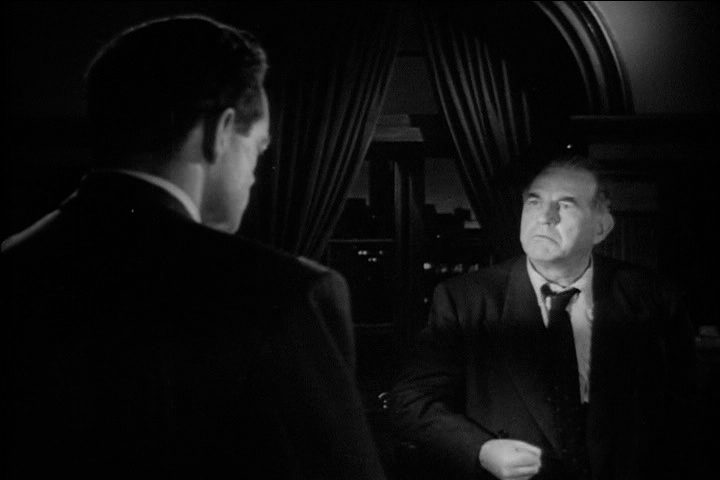
A powerful and at times excruciating drama -- written by Rod Serling from his own teleplay -- about the cutthroat office politics inside a big New York industrial firm, where the tension runs so thick one could cut it with a knife. Van Heflin plays a brilliant young executive from the company's Ohio office, who accepts a top position in New York, but soon finds himself being used as a pawn in a power play by the big boss (Everett Sloane) to force a principled, aging executive (Ed Begley) into resigning.

Directed by Fielder Cook with stark minimalism, and filmed on location in New York (in striking black and white by Boris Kaufman), Serling's screenplay boils with tension and anxiety, only occasionally becoming too self-conscious, and impaired by an ending that doesn't ring entirely true, but that does not negate the astonishing degree of honesty and poignancy that Serling establishes leading up to it.

Tuesday, February 14, 2017

All Quiet on the Western Front - Silent and Sound Versions


Universal's recent Blu-ray release of All Quiet on the Western Front is a notable effort, presenting a beautifully restored version of this powerful anti-war film, which is also frequently cited as one of the greatest achievements of the early sound era.

Like many transitional sound films, All Quiet was also released in a silent version, which has recently been restored by the Library of Congress and is presented as a special feature on the Blu-ray edition. These silent versions of sound films were typically prepared for theaters that were not yet wired for sound (though, curiously, many of them contained soundtracks with music and effects), or for foreign markets, where the intertitles could be replaced with translations in different languages.

All Quiet on the Western Front is unique in that, unlike many early talkies, it features a great deal of action, shot with a sweeping, fluid camera freed from the restrictions and limitations of recording sync sound. Director Lewis Milestone shot most of the battle scenes silent, with the soundtrack created in post-production, resulting in a vivid, dynamic rhythm of images that matches the best of those found in silent cinema.


It's not surprising, then, that All Quiet could be adapted fairly smoothly as a silent film, without losing too much of its impact. Calling this alternate version "silent", however, is a bit of a misnomer. There is remarkably little music on the soundtrack throughout, as there would be in a traditional silent film accompaniment. Instead, the images are complemented with the sound effects of machine gun fire, screaming, crowd noises and often -- quite effectively -- long stretches of silence, that only underline the sense of dread and terror in the scenes in the trenches.

There is a contingent that considers this silent version to be superior to the sound version, an argument I've read in more than one source suggesting that the pacing flows better when unencumbered by the sometimes declamatory and stilted dialogue. I would disagree; however. All Quiet on the Western Front is already fundamentally a silent film, its ideas conveyed through the power of its images. To strip it of its dialogue and turn it into a literal silent film is redundant.

It is certainly a wonderful thing that Universal has done in presenting both versions on Blu-ray, allowing viewers to make the comparison for themselves. I am glad the silent version is now available, but I view it as more of a curiosity, with the sound version remaining a powerful and impressive achievement.

Monday, December 26, 2016

One Hour Photo (2002)


Robin Williams has one of his finest dramatic roles in this offbeat thriller about a lonely, psychologically disturbed photo developer, who becomes obsessed with the family of one of his regular customers, and turns dangerously unhinged when he learns that there is a dark side to the family's seemingly picture-perfect existence. This premise makes for a gripping and effective character study and suspense thriller, building an understated but deeply unsettling tension through Williams' pathetic efforts to ingratiate himself with the family, though it runs out of steam during the last half hour or so. Williams' performance is at once chilling and heartbreaking. Good supporting performances by Connie Nielsen, Michael Vartan, and Gary Cole as Williams' unsympathetic boss.

Thursday, December 22, 2016

Midnight Cowboy (1969)


One of the truly great American films of the 1960s, as uncompromising and honest a film as has ever been produced by Hollywood. Director John Schlesinger draws on his experience with British "Kitchen Sink" dramas, deliriously combining a New Wave sensibility with the influence of underground, experimental filmmaking, to create a landmark of the New Hollywood cinema. Jon Voight and Dustin Hoffman give perhaps the finest performances of their careers as two men who form an unlikely bond on the gritty streets of late '60s New York. Greatly enhanced by a beautiful John Barry score and the haunting theme song by Nilsson.