Tuesday, September 15, 2020

Lenny (1974)

I'm not normally a fan of these types of biopics, but the combination of the subject, Dustin Hoffman's performance, and the fact that it's directed by Bob Fosse intrigued me. I'd actually been meaning to see this one since watching Fosse's All that Jazz about 15 years ago, which contains a film-within-a-film modeled on Lenny. For whatever reason, Lenny eluded me over the years -- either I wasn't able to find a copy when I was looking for one, or I didn't think to look for it when it might have been available.

Either way, I recently learned that it was available over on the Criterion Channel, and finally watched it last night. It reminded me a bit of Raging Bull in tracking its self-destructive character's rise and fall, not to mention the evocative B&W cinematography (by Bruce Surtees).

Fosse's direction is always fascinating, and he skillfully blends the pseudo-documentary approach with Hoffman's intense re-creations of Bruce's stand-up act. Hoffman delivered so many fine performances during the 1970s that it can be easy to overlook some of them. I rarely see this one mentioned when listing his great roles during that decade, but to me it ranks up there with the best of them.


Monday, September 14, 2020

Woody Allen Interviewed by Alec Baldwin

A recent interview with Woody Allen and Alec Baldwin, recorded back in June around the time of the publication of Allen's memoir, Apropos of Nothing. There is some interesting discussion here about his approach to making films, writing scripts and directing:


Memento (2000)

 I always joke that I'm about 20 years behind the times when it comes to catching up with movies. I watch so many older films that by the time I catch up with "current" releases of any given year, they're already a decade or two in the past. I'm making more of an effort to see films when they're new, but with so much to catch up on from years past, I find myself just trying to keep ahead of what's coming out. 

I finally caught up with Christopher Nolan's Memento, a film I remember hearing a great deal about when it was first released. I was familiar with the film's intriguing premise, which I'd heard discussed so often that it almost felt like I'd already seen the movie. While the premise of the film is indeed intriguing, I couldn't help feeling that there just wasn't enough beyond that to sustain the entire film. Perhaps if I'd seen it when it was new it would have made more of an impact on me. This was another one of those films from the late '90s-early 2000s that operated from an unusual narrative angle, similar to Charlie Kaufman's films like Being John Malkovich or Adaptation. There seemed to be a real vogue for that kind of storytelling for a while.

Rescued by Rover (1905)


Early "dog" movie and one of the most popular silents from England's "Brighton School" of filmmakers. The young daughter of a wealthy couple is kidnapped by gypsies and the family dog races to the rescue to get help. It's a simple story -- D.W. Griffith used the basic premise for his first film The Adventures of Dollie (1908) -- but it's expertly constructed and provides some genuine suspense. Produced by British film pioneer Cecil Hepworth, who cast his own daughter, Barbara, and the family dog, Blair, in the lead roles. Kevin Brownlow talks about this film in his documentary Cinema Europe (1995).

William K. Everson at Pacific Film Archive

The Pacific Film Archive in Berkeley, Cal. has uploaded a series of recordings of film historian William K. Everson's introductions to his film screenings at PFA in the 1970s and 80s. The selection is available to stream at the Internet Archive here.

Everson was a big champion of the unsung gems of film history, including silent film at a time when few took it really seriously. These recordings are a good opportunity to hear more of his insights into some rarely-discussed films.

Sunday, September 13, 2020

The Two of Us (1967)

In Nazi-occupied Paris, a young Jewish boy (Alain Cohen) is sent to live in the countryside with the parents of a family friend, who are deeply anti-Semitic but unaware of the boy's identity. The old man, played by Michel Simon, takes the boy in, and forms a deep bond with him, never learning the truth about the boy's background. From this deep tension emerges a beautifully human story of different people finding solace in each other. The boy, aware of the old man's prejudices, finds ways of gently pushing back against them, having the effect of the man questioning some of his prejudices for the first time. But this is not a film that offers simple or trite solutions. The boy's Jewishness is never revealed to his new guardian, though the bond that they form is real and strong. 

There is an especially poignant scene that stands out: with the old man's urging, the boy has written a love letter to his sweetheart, which is intercepted by the girl's father and held up at school to punish the boy. The boy, humiliated and in tears, runs home to the old man, who comforts him like a father would. 

Director Claude Berri never hits a false note with the material, and the performances are equally pitch-perfect, which adds up to a powerful experience.

Herschell Gordon Lewis, Blood Feast and Two Thousand Maniacs

I've been watching some of the Herschell Gordon Lewis films currently streaming on the Criterion Channel. I thought I'd seen Blood Feast on TV years ago, late at night on TCM, but now I'm not sure. I watched that one first, then Two Thousand Maniacs. I remember years ago, reading John Waters' book Shock Value, he devoted a chapter to his interview with Herschell Gordon Lewis, one of his cinematic heroes. I can see why Lewis' films would have appealed to him.

Although I was certainly familiar with Lewis' contributions to the gore genre, this has been the first time I've really gone through his filmography. Blood Feast is the one that started it all. John Waters used excerpts from it in his Serial Mom. A local caterer kidnaps and kills women for sacrifice to the goddess Ishtar. Though its influence is immeasurable, this premise isn't really enough to support the long stretches between the splatter scenes, but at least the whole thing runs just over an hour.

I preferred the zanier Two Thousand Maniacs. A town in the deep South is celebrating the centennial of a battle that laid waste to the entire town at the end of the Civil War, and hold hostage some Northern tourists who have been diverted off the main highway, proceeding to kill them off as revenge for the defeat suffered one hundred years earlier. It's social commentary, of a sort. Again, Waters paid tribute to this one with the title of his own film, Multiple Maniacs.

These are the kind of movies that have their own style, their own pace, and a distinctly unique sensibility, and you have to go with their flow to really get into them.

Friday, September 04, 2020

Short Film: "The Call"

 This is the new short comedy I just released on my YouTube channel today:


Monday, August 31, 2020

Screamplay (1985)


An aspiring screenwriter (co-writer/director Rufus B. Seder) arrives in Hollywood with his typewriter and sets out to write the script that will help him make it big in Tinseltown. He takes up residence in the Welcome Apartments, where he encounters an eccentric cast of characters that inspire the series of gruesome killings he writes in his script, but soon life begins to imitate art, and the writer finds himself at the center of a police investigation as the other tenants begin meeting the same grisly ends as the characters in his screenplay.

Filmed on sound stages in Boston, this is a remarkably evocative independent film that pays homage to the Hollywood B-movies and German Expressionist silent films that clearly served as its inspiration. Underground film legend George Kuchar plays the sleazy hotel manager, and it's great to see him in a starring role here.

This is a good behind-the-scenes documentary on the making of Screamplay. It's a model of what you can do with a lot of imagination on a small budget.


The low-rent, stylized B&W evocation of Hollywood reminded me of what Tim Burton did with a similar approach in Ed Wood, though of course he had far more of a budget to work with. Screamplay has a home-made quality to it that adds immeasurably to its atmosphere.

Streamed on Troma Now.

Thursday, August 27, 2020

Laurel & Hardy, Godard


I watched a silent Laurel & Hardy comedy last night, Two Tars (1928), which finds the boys as sailors on shore leave who get involved in a nightmare of a traffic jam that turns into a violent battle between the frustrated motorists. I was particularly struck by the influence this film must have had on Jean-Luc Godard when he staged the similarly violent traffic jam in Weekend (1967).

Sunday, August 23, 2020

Slippery Jim (1910)

This is an amazing trick film made by Ferdinand Zecca in France in 1910. The premise involves a prisoner who is also a master escape artist and finds the most unusual ways of eluding his captors. One of the exuberant, gloriously free-spirited comedies produced by the Pathe Studio in the early years of the 20th century.


Saturday, August 22, 2020

BUtterfield 8 (1960)

This is the kind of lurid Hollywood melodrama I love. It follows the torrid love affair between a Manhattan call girl (Elizabeth Taylor, in one of her finest performances), and a tormented businessman (Laurence Harvey). 

There's an interesting subplot with Eddie Fisher as Taylor's long-time closest friend, and the film spends a good deal of time examining their relationship and the tension that it causes with Fisher's fiancee.

I'd been meaning to see this one for a while. I'd heard in an interview that George Kuchar cited it as a big influence on his own films, which made me even more curious to see it.


Monday, August 17, 2020

Lockdown Filmmaking: "Scared 2 Death II"

New short film, Scared 2 Death II: 2 Scared 2 Live:


This is a sequel to the short film I made this past spring, Scared 2 Death. Like many filmmakers, I found myself wanting to create something even though we were still in a strict lockdown period. As I've written elsewhere on this blog, I made a film back in January called Unknown Number, which had taken a great deal of preparation and a full day of shooting to pull off. While I was certainly happy with how it turned out, I also realized that the requirements of making a film even on that scale, with the limited resources I had, had sucked a lot of the joy out of the filmmaking process for me.

Several months later, I had the idea to make Scared 2 Death, a simple idea that I'd thought up about a decade ago while I was still living in Brooklyn. The situation is a horror film cliche -- the woman walking alone at night down a dark street, followed by an unseen menace. But the whole point of making the film for me was to take this situation and have fun with it. The fact that it was ultra-short and a very simple scenario to film made it all the more enjoyable to shoot.

Scared 2 Death is maybe my favorite of the movies I've made, because it got me back to the basics of what I love about making little films, and allowed me to re-connect with the joy I get just from filming a simple situation like that.

So, after a few more micro-shorts that I've made over the summer -- Isolation, Lights Out, and Scarcity -- I decided to have some fun by re-visiting the simple premise of Scared 2 Death with a tongue-in-cheek sequel, Scared 2 Death II: 2 Scared 2 Live. In this one, I take another staple of the horror film and just had fun with my own little interpretation of it.

Thursday, August 06, 2020

Lockdown Filmmaking: "Lights Out"

This is another short film that I made under the lockdown restrictions, back in late June, called Lights Out. I premiered it on YouTube on June 26.

This one was born out of some of the darker ideas I wanted to explore about the idea of a character holed up in a single location during a catastrophe. I'd made a film along similar lines a few years, called Aftermath, so I was reluctant to tread too familiar territory. But I had the idea of a character alone in a house on the hottest night of the summer, when the power is suddenly knocked out during an electrical storm, and the dangers that await him in the dark.

I shot this one over the course of two nights -- a comparative luxury compared to the many one-day shoots I've done over the past several years. The Canon Powershot camera that I was shooting with handled the low-light situations very well, which made it possible for me to shoot in the darkness using only a flashlight as the lighting source. I liked the effect it produced, because it allowed me to highlight the little objects that are completely ordinary in the daylight, but at the same time take on menacing new implications in the dark.

This is also a good example of inspiration striking as a result of unexpected conditions. The lightning storm that I captured at the beginning of the film was not planned for -- but the storm came up the evening of the shoot and I knew it would be the perfect way to open the film.

I hope you enjoy Lights Out!

Thursday, July 23, 2020

Godard and Lewis

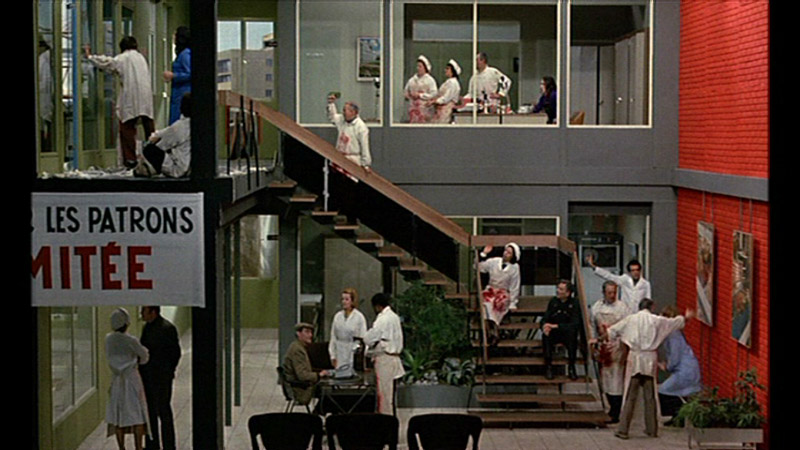
Watched Godard's TOUT VA BIEN (1972) the other night. His large-scale, multi-level set for the meat-packing plant brought to mind Jerry Lewis' similarly impressive "dollhouse" set from THE LADIES MAN (1961). I love the photo of Lewis directing on the camera crane.


Tuesday, July 21, 2020

Gloria (1980)

John Cassavetes wrote and directed this story of a woman with mob ties who takes on the role of protector to a little boy after his family is murdered. Gena Rowlands is excellent in the title role, bringing the right combination of charm and toughness to the character. Cassavetes manages to make the film suspenseful and touching in equal measures without hitting a false note.

Cowboy (1956)

This was an offbeat Western about greenhorn Jack Lemmon teaming up with seasoned cowboy Glenn Ford to learn the ropes of riding the trail and herding cattle. Ford appeared in so many films for Columbia Pictures around this time; it seems he was called on to portray virtually any kind of character they needed filled. He's effective here in the quieter, more introspective moments. Lemmon gives a typically excellent performance as the greenhorn who has his eyes opened to the realities of life on the trail. The beautiful color cinematography is a highlight.

Monday, July 06, 2020

R.I.P. Ennio Morricone (1928-2020)

The great composer Ennio Morricone has passed away at 91:
https://www.hollywoodreporter.com/news/ennio-morricone-dead-prolific-italian-composer-was-91-858358

I was just listening to the soundtrack from Salo last night and thinking about Morricone's versatility as a composer. This theme was such a brilliant choice to contrast with Pasolini's shocking images that follow in the film.


Saturday, June 13, 2020

Quarantine Filmmaking: "Isolation"

This is another short film I recently made under the current restrictions. Called Isolation, it is about a man reflecting on his experiences under quarantine.


Tuesday, June 09, 2020

"Scared 2 Death" -- Quarantine Filmmaking

Since the lockdown began, I've found myself inspired to start creating short films. I'd made a short film backed in January, Unknown Number, whose production I have detailed on this blog. I was certainly pleased with how that film had turned out, but I found myself wanting to return to making smaller-scale films, that could be written and filmed quickly and cheaply with minimal resources (even smaller than what I'd worked with on Unknown Number). It's liberating and invigorating to make films this way -- just small-scale, down 'n' dirty filmmaking.

I haven't felt this energized by making films in years.

This is the first of these that I put together back in May, called Scared 2 Death. It's based on an idea that I had a few years ago, when I was living in Brooklyn. I thought of this idea again recently and realized it would make a perfect small project that I could film under the current restrictions.