Too often, the films of Louis Lumiere and other early cinema pioneers are discussed as primitive artifacts, a kind of cinematic equivalent of cave paintings that marked the beginning of an art form. This documentary, directed by Eric Rohmer, takes a formal approach, discussing the photographic qualities of the Lumiere films through interviews with Jean Renoir and Henri Langlois. Both men offer eloquent commentary on the beauty and historical value of the Lumiere films, revealing why these pioneering works should be viewed as sophisticated, fully realized motion pictures on their own terms, rather than as merely a precursor of things to come.
Watching The King of Comedy (1983) last night, I remembered reading that Scorsese had been influenced by Edwin S. Porter's Life of an American Fireman (1903) in thinking about his approach to making the film. I watched it partly with that in mind, thinking about how he might have drawn on that film for inspiration. One of the things I find most interesting about Scorsese is how he ingests the whole of film history and brings those influences to bear in such unexpected but effective ways.
This is what Scorsese had to say about the influence of Porter's film on The King of Comedy:
"People had reacted in such a way to Raging Bull, saying it was a beautiful film - like Days of Heaven, you could take every frame and put it on the wall - that I decided my next picture was going to be 1903 style, more like Edwin S Porter's The Life of an American Fireman, with no close-ups. So in King of Comedy that's what I tried to do." (quoted in Scorsese on Scorsese).
A minor John Ford film, especially in relation to his classics Stagecoach and Young Mr. Lincoln that he would make the following year. It's a lightweight adventure yarn about a ragtag group of sailors on a Navy sub chaser during WWI. Richard Greene and Preston Foster head up a fine ensemble cast that includes Nancy Kelly, George Bancroft, Slim Summerville, John Carradine, Elisha Cook Jr., and Henry Armetta, among others.
Ford's direction keeps the pace energetic and lively throughout, embellished with a characteristic sense of humor. There are some exciting action sequences, such as the sea battle and sinking of a German sub, which are impressively staged and heightened by excellent model work, especially in the undersea shots.
This is the kind of material John Ford could do so well, and though he would return to the settings and themes again, this seems to mark a turning point in his career. The light, freewheeling tone places it among his earlier work, specifically among his other Navy films like Salute (1929), Men Without Women (1930), and Seas Beneath (1931), rather than the films he would make during and after the war.
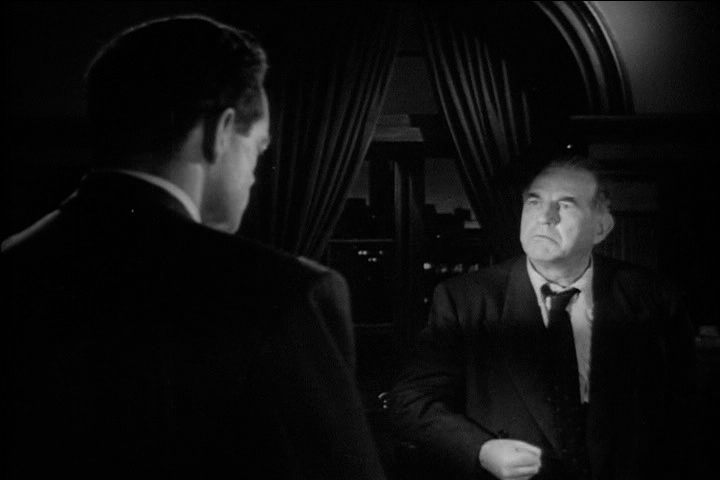
A powerful and at times excruciating drama -- written by Rod Serling from his own teleplay -- about the cutthroat office politics inside a big New York industrial firm, where the tension runs so thick one could cut it with a knife. Van Heflin plays a brilliant young executive from the company's Ohio office, who accepts a top position in New York, but soon finds himself being used as a pawn in a power play by the big boss (Everett Sloane) to force a principled, aging executive (Ed Begley) into resigning.
Directed by Fielder Cook with stark minimalism, and filmed on location in New York (in striking black and white by Boris Kaufman), Serling's screenplay boils with tension and anxiety, only occasionally becoming too self-conscious, and impaired by an ending that doesn't ring entirely true, but that does not negate the astonishing degree of honesty and poignancy that Serling establishes leading up to it.
In to a small town high in the Alps, riding in a mule-drawn sleigh, arrive Laurel and Hardy. This time they are mousetrap salesmen, and have come to Switzerland because, according to Laurel's logical thinking, where there is more cheese than anywhere else in the world, there will be more mice. Like two comic vagabonds, the boys are seemingly as much at home in this fantasy version of a Tyrolean village as they are in the old west or the suburbs of Los Angeles, a testament to their universality and timelessness. During their stay in Switzerland, Oliver Hardy will endure the usual trials and tribulations against his dignity, most of them innocently precipitated upon him by his friend, Stan Laurel.
From the moment they appear, you find it impossible to take your eyes off of them. The boys' masterful comic interplay, which they make look so deceptively simple, astounds with its perfect rhythm and timing, every gesture, every glance and every pratfall performed with expert precision. Every facet of their screen characters is so thoroughly and richly defined to the point where they seem so real, so human that we feel like we are spending time with old friends when we see their films.
Numerous episodes stand out for their comic ingenuity. Spotting a Saint Bernard with a keg of brandy strapped around its neck, Laurel feigns exhaustion in order to obtain the rescue dog's emergency supply of liquor, on which he becomes hopelessly intoxicated. Indentured to work in the hotel kitchen an extra day for every dish they break, the boys find innumerable ways to add to their misfortune with one new dinnerware disaster after another until it seems that they will spend all of eternity in that kitchen. And there is the moment when Hardy serenades the object of his romantic affection with a rendition of the tender ballad "Let Me Call You Sweetheart", accompanied by Laurel on an oversize tuba, the incongruous booming tones of the instrument oddly complementing the pomp and splendor of Hardy's musical declarations of love.
There are also the delightfully surreal moments that exist free from the constraints of realistic narrative logic. At one moment, animated soap bubbles escape from a pipe organ that produce the notes of a song as they burst, and at another, a punctured gas pipe under the floor causes infernal flames to shoot forth wherever poor Oliver Hardy happens to be standing.
At one point, the boys find themselves trapped on a rickety wooden mountain bridge, perilously high across the Alps, with a piano and a gorilla -- a comic image for the ages. Ours is not to wonder how they got there, or what a gorilla is doing in the Swiss Alps. Laurel and Hardy approach any task with a kind of bullheaded determination and literal single-mindedness, which keep them in pursuit of achieving their goal even when logic or common sense would give anyone else pause for thought, and this is no exception. Suspended high above the gaping mountainous chasm, every twist and turn of the bridge -- swaying to and fro like some kind of insane fun-house attraction -- risks plunging them into the abyss.
Yet they view this predicament as they would any other and, despite the momentary terror of the situation, somehow all seems right in the world when Hardy, left by the oblivious Laurel to dangle from the collapsed bridge on the side of a mountain, gets knocked on the head by a falling rock, expressing mere annoyance at this latest inconvenience. Their universe has regained equilibrium, and they are on to their next misadventure, perhaps to attend Oxford, or join the Foreign Legion.
Universal's recent Blu-ray release of All Quiet on the Western Front is a notable effort, presenting a beautifully restored version of this powerful anti-war film, which is also frequently cited as one of the greatest achievements of the early sound era.
Like many transitional sound films, All Quiet was also released in a silent version, which has recently been restored by the Library of Congress and is presented as a special feature on the Blu-ray edition. These silent versions of sound films were typically prepared for theaters that were not yet wired for sound (though, curiously, many of them contained soundtracks with music and effects), or for foreign markets, where the intertitles could be replaced with translations in different languages.
All Quiet on the Western Front is unique in that, unlike many early talkies, it features a great deal of action, shot with a sweeping, fluid camera freed from the restrictions and limitations of recording sync sound. Director Lewis Milestone shot most of the battle scenes silent, with the soundtrack created in post-production, resulting in a vivid, dynamic rhythm of images that matches the best of those found in silent cinema.
It's not surprising, then, that All Quiet could be adapted fairly smoothly as a silent film, without losing too much of its impact. Calling this alternate version "silent", however, is a bit of a misnomer. There is remarkably little music on the soundtrack throughout, as there would be in a traditional silent film accompaniment. Instead, the images are complemented with the sound effects of machine gun fire, screaming, crowd noises and often -- quite effectively -- long stretches of silence, that only underline the sense of dread and terror in the scenes in the trenches.
There is a contingent that considers this silent version to be superior to the sound version, an argument I've read in more than one source suggesting that the pacing flows better when unencumbered by the sometimes declamatory and stilted dialogue. I would disagree; however. All Quiet on the Western Front is already fundamentally a silent film, its ideas conveyed through the power of its images. To strip it of its dialogue and turn it into a literal silent film is redundant.
It is certainly a wonderful thing that Universal has done in presenting both versions on Blu-ray, allowing viewers to make the comparison for themselves. I am glad the silent version is now available, but I view it as more of a curiosity, with the sound version remaining a powerful and impressive achievement.
Robin Williams has one of his finest dramatic roles in this offbeat thriller about a lonely, psychologically disturbed photo developer, who becomes obsessed with the family of one of his regular customers, and turns dangerously unhinged when he learns that there is a dark side to the family's seemingly picture-perfect existence. This premise makes for a gripping and effective character study and suspense thriller, building an understated but deeply unsettling tension through Williams' pathetic efforts to ingratiate himself with the family, though it runs out of steam during the last half hour or so. Williams' performance is at once chilling and heartbreaking. Good supporting performances by Connie Nielsen, Michael Vartan, and Gary Cole as Williams' unsympathetic boss.
One of the truly great American films of the 1960s, as uncompromising and honest a film as has ever been produced by Hollywood. Director John Schlesinger draws on his experience with British "Kitchen Sink" dramas, deliriously combining a New Wave sensibility with the influence of underground, experimental filmmaking, to create a landmark of the New Hollywood cinema. Jon Voight and Dustin Hoffman give perhaps the finest performances of their careers as two men who form an unlikely bond on the gritty streets of late '60s New York. Greatly enhanced by a beautiful John Barry score and the haunting theme song by Nilsson.
A loving, spirited tribute to the rough-and-tumble early days of picture-making, Peter Bogdanovich's NICKELODEON is a flawed but interesting and often entertaining film based partly on the colorful experiences of pioneering filmmakers Allan Dwan and Raoul Walsh.
Ryan O'Neal stars as a Chicago lawyer who gets mixed up with an independent motion picture company and reluctantly takes over as director of their latest production shooting out west, and Burt Reynolds as a jack-of-all-trades who reluctantly becomes the company's new star after being sent by the Patents Trust to shut the production down. The fine ensemble cast includes Tatum O'Neal, Brian Keith, John Ritter, Stella Stevens, and Jane Hitchcock.
The film drags in spots, not helped by some laboriously-executed slapstick scenes that go on too long, but overall it's a great deal of fun, clearly made with a great deal of affection and knowledge of the period. The bittersweet ending, taking place at the premiere of The Birth of a Nation, beautifully encapsulates the emotional rollercoaster of the filmmaking process. After witnessing such a brilliant film, O'Neal is simultaneously enthusiastic about the artistic triumph it represents, and dejected by the realization that he will never make anything as good himself. But just as soon as he's contemplating giving it all up, he witnesses a film company making the movie, and the excitement all comes back to him. Not quite up to the standards of Bogdanovich's best films of the early '70s (particularly The Last Picture Show and Paper Moon), NICKELODEON is nonetheless an admirable and ambitious effort, and certainly one of the best films-about-filmmaking.
A tense, deliberately-paced thriller, directed and co-written by Kelly Reichardt, about a trio of environmentalists who blow up a dam, and the resulting moral dilemmas they face in the days following the act, dealing with the consequences of their actions and the unexpected effects it has on each them.
Reichardt is one of the most interesting filmmakers working today, and NIGHT MOVES may be my favorite of her films. From the outset, she establishes a great sense of atmosphere and pacing, which builds to increasingly heightened tension as the plot takes unexpected turns, invested with well-drawn characters acted by a fine cast including Jesse Eisenberg and Dakota Fanning. NIGHT MOVES is both a penetrating character study and a surprisingly gripping suspense drama.
I had the opportunity to see the new BFI restoration of Barry Lyndon at the Charles Theater in Baltimore on December 2nd. This is a film that absolutely cries out to be seen on the big screen, where the rich, painterly qualities of Kubrick's detailed compositions can be fully appreciated. There is not a dull moment in the film's 184 minute running time, telling the thoroughly riveting story of a young Irishman's fortuitous rise to the top of the British aristocracy, and his equally steep downfall. Ryan O' Neal gives one of his finest performances in the title role, and the film can rightly be called a masterpiece thanks to the singular vision of Stanley Kubrick, who directed, produced and wrote the script (from the Thackeray novel).
Gillo Pontecorvo's historical drama about the resistance movement against the French occupation of Algiers in the 1950s remains one of the most explosive, powerful films of its kind. Filmed with a documentary-like realism, Pontecorvo fills the film with unforgettable, disturbing images that hold nothing back. It's an absolutely bold, fearless film that is also remarkable for its objectivity in presenting the perspectives of both the French military and the FLN. Pontecorvo creates a heightened sense of dread and terror, of violence and catastrophe about to erupt at any minute, most effective in the expertly-timed, highly suspenseful sequence in which a series of bombs are planted in various public places throughout the city, and detonate in short order (recalling the similarly anxiety-inducing sequence of an anarchist's bomb exploding on a crowded London bus in Hitchcock's Sabotage).
Stylistically, the film resembles the post-war Italian NeoRealist cinema, especially recalling the films of Rossellini such as Open City, and at times feels like it could be a kind of late entry in that tradition of filmmaking in terms of its masterful combination of powerful filmic and political ideas.
Epic in its scope and scale and timely as ever, The Battle of Algiers, is rightly called a masterpiece.
Caught this one at the Senator Theatre tonight in a nice restoration from Lowry Digital. It's always more fun seeing these Bond flicks on the big screen, so I usually wait until one comes around to the revival theater rather than watching them on video. This one, the second in the series, is one of the best, owing in particular to a great performance by the always-superb Robert Shaw as the killer, Grant. Colorful locations, thrilling action scenes (including some incredibly dangerous-looking stunts) and a rare-but-memorable screen appearance by Lotte Lenya add to the fun.
Possibly Hawks' finest Western, rivaled only by RIO BRAVO, it tells the epic story of the first cattle drive on the Chisholm Trail. John Wayne has one of his finest roles as the financially devastated cattle rancher who must move his entire herd from Texas to Kansas, while slowly losing his authority and gradually breaking under the strain of the difficult journey. Montgomery Clift, in a remarkably assured screen debut, is the young ranch hand who defies Wayne in order to assume command and, in true Hawksian fashion, to get the job done right. A rousing score by Dimitri Tiomkin and breathtaking cinematography by Russell Harlan contribute greatly to the film's deservedly high reputation.
Delirious musical fantasy, conceived and designed by Dr. Seuss, produced by Stanley Kramer, and directed with real flair by Roy Rowland. A boy, bored with his piano lessons, falls asleep and dreams that his piano teacher is actually a mad supervillain and that he is being held captive in a labyrinthine lair. This set-up is a backdrop for a series of colorful, surreal set pieces and songs. This is undoubtedly the best role that Hans Conried ever had, delivering a delightfully madcap performance as the piano teacher. Tommy Rettig delivers a fine performance as the boy, and usband-and-wife vaudeville team Peter Lind Hayes and Mary Healy are good if somewhat bland as the adults in the story. Although often an uneven film, it is nevertheless entertaining and is superior to, and truer in spirit than, the more recent film adaptations of Dr. Seuss stories.
This past Saturday (August 13), I took a trip to the Edison National Historic Site in West Orange, New Jersey. I've visited here a number of times over the years, and each time I visit I am struck by the sense of wonder I feel at being the very spot where (depending on which version of the history you read) motion pictures were born.
This time, I visited the museum with my friend Jim Gisriel, a fellow film enthusiast who shares my interest in the early years of cinema. We arrived on a scorching hot Saturday morning, right before noon. After checking in at the visitors center, we made our way in to the small theater where a selection of early Edison films were playing on a monitor. After watching a couple minutes of THE GREAT TRAIN ROBBERY (we walked in just as the bandits were forcing the passengers to disembark from the train), Jim and I made our way out the back of the theater and over to the Black Maria.
Or rather, a replica of it. Originally built in 1893, the Black Maria is recognized as the world's first dedicated film studio, and although it was torn down only a decade later, this replica was constructed in 1954 by the U.S. National Park Service and stands as a tribute to the place where America's earliest films were made. The Black Maria is quite a striking building -- covered in tarpaper, it got its name from the knickname given to police paddy wagons, which it resembled.
With the scorching hot noonday sun beating down on us, Jim and I observed the Black Maria for about 20 minutes before heading inside for a presentation on Edison's contributions to the motion picture. While we were outside, we took in all the little details of the structure, from its wooden tracks that allowed the studio to turn and face the sun, to its hatch roof that could open to allow the sunlight to shine in. Several bees swarmed around, apparently having nested inside a pipe fixture on the side of the building.
Unfortunately, we were not able to actually go inside the Black Maria, but the side door was open, allowing us a look at a replica of the Chinese Laundry set from Edison's 1895 film of that same name, as well as what appeared to be a replica of an Edison camera, though it was difficult to tell from the angle that it was positioned at. What is most striking about this replica -- which is the same size as the original studio -- is how small it can look from the outside. And yet, the interior was large enough to house not only the performers, technical crew, and equipment, but also a small dressing room on the end for visiting talent. The studio was described by some of those who worked there as hot and cramped, the most uncomfortable building in which to work. On a hot day like this, it was easy to see why they might feel that way...
But imagine the larger-than-life personalities who set foot in this little studio more than a century ago! It gives me chills to stand out there at the site of the original studio, and think of the icons of late 19th/early 20th century American show business -- Annie Oakley, Buffalo Bill, and Sandow, among them -- who stepped before Edison's camera one afternoon and achieved immortality on film. It's thrilling to stand in that spot where they once stood, and realize we are only separated by time.
With the lecture about to start, we headed inside and up to the second floor of the factory, where a tour guide gave a short talk on the invention of the movies. A small but appreciative audience was gathered, and it was fun watching the kids in the group as they looked at photos of the Kinetoscope and small strips of film that were passed around. I couldn't help thinking how excited I would have been, as a budding film enthusiast, to attend a presentation like this at their age!
The second floor of the Edison factory is where W.K.L. Dickson built his first motion picture camera, and also where the very earliest camera tests were shot. In the far corner of the second floor is a wall with a placard that designates it as the spot where Dickson's invention took place. To stand and look at this little corner of an industrial factory in suburban New Jersey, in the exact spot where the art form of motion pictures was born, is a humbling experience. Imagine being able to see the first cave wall where the first painting was created, or to stand in the exact spot where the first musical note was played. And think of all the dreams that sprang forth from Dickson's invention that day...
On display was an original Edison Kinetoscope, though it was not up and running. In a glass case was an early film repair kit consisting of a splicer and glue, used for patching up broken prints. As Jim observed, this little kit represents the birth of film editing. Next to it was a prototype cylinder viewer, one of the methods for playback of moving images that was abandoned early on. This method involved tiny individual frames that would be viewed on a turning cylinder to create the illusion of movement. I peered at the little frames and recognized the image to be from "Monkeyshines", one of the earliest surviving camera tests said to date from 1890, which features an Edison employee waving his arms about before the camera.
Jim and I proceeded to tour the rest of the museum, which includes rooms dedicated to music, sound recording, and photography, as well as Edison's impressive personal library (which takes up three floors). But the highlight of the visit was certainly the chance to spend some time in the place where the motion picture first came to light some 125 or more years ago. I think of those people who were there at the very
moment of the birth of the art form, and wonder whether they had any idea of
the power and the potential of the tool they had created. It is awe-inspiring to
think of the artistic heights the cinema has reached in just its first
century of existence, and what still lies ahead.
Among the literature written on the subject of film, there are a few works that I would consider absolutely "essential". Movie Journal: The Rise of the New American Cinema, 1959-1971, by Jonas Mekas, is certainly one of them. Representing nearly a third of the columns that Mekas wrote for the Village Voice over a period of about 15 years, it provides a vivid, first-hand account of the films and filmmakers of the New York avant garde cinema, written "as it happened" by the movement's most passionate champion.
It is really quite staggering to think about the scope of what Mekas' writings cover here -- really the entire rise and development of one the most creatively fertile movements in the history of cinema, offering impassioned defenses of some of its most notable participants including Stan Brakhage, Jack Smith, Ken Jacobs, Gregory Markopolous, Harry Smith, and Marie Menken. Mekas traces not only the films and the people who made them, but also how they were distributed, exhibited, and received. He provides a vibrant portrait of the New York underground art scene in which these films were shown, and the increasingly ambitious ways in which they were presented, such as interactive, live "happenings". His descriptions of the challenges in dealing with New York's film licensing and censorship laws of the time reminds us of how courageous these artists were in fighting for the right to make the films they wanted. Most significant in this respect is Mekas' account of his arrest over the showing of Jack Smith's highly controversial Flaming Creatures, which was released in 1963 and found to be obscene.
Then there are the accounts of the development of the Filmmakers' Co-op, which served as a distribution network for avant garde cinema, and the Anthology Film Archives, created as a place to preserve and screen the films for future generations. The stories behind these two landmark cultural institutions deserve volumes of their own; their inclusion here reminds us how prolific (and tireless) Mekas has been in his quest to champion alternative forms of cinema.
Mekas is also a prescient visionary, particularly when it comes to his ideas about making cinema available in the home (to be collected and consumed like books), and in his idea of using 8mm (home movie) cameras in the service of social justice. The advent of home video, and the prevalence of consumer camcorders (as well as online video on which to share the footage) have proven him right with time.
Mekas has said that everything he did, he did because there was a real necessity for it. That is what comes through most strongly in his writing. One gets the sense that this is not a man with any time for trivia; his vision was (and remains) astoundingly clear and focused on the task at hand. The post-war American avant garde cinema flourished thanks to the critical context provided by Mekas, along with the institutions for distribution and exhibition that he was instrumental in creating. Mekas is an inspiration to anyone who cares about the possibility of cinema as a tool for personal expression rather than as a commercial business. This collection of his writings is a testament to that. As a critic, he has that most important of gifts: the ability to inspire his readers to seek out for themselves the films about which he wrote.
Movie Journal was originally published in 1972, and has been long out of print until this 2016 reissue by Columbia University Press. The new edition contains a foreword by Peter Bogdanovich.
In researching the life and work of pioneering film exhibitor, subtitler, critic, and avant garde filmmaker Herman G. Weinberg, I came across a copy of his memoir, A Manhattan Odyssey, which was published in 1982. I hoped that it would contain information about his time in Baltimore, when he served as the manager of the Little Theatre, an early arthouse cinema that was the city's sole outlet for foreign and avant garde films at the time.
I was pleasantly surprised to find that Weinberg devotes an entire chapter of his book to his time in Baltimore. He recounts being sent there by the operators of the 55th Street Playhouse, an art cinema in Manhattan, to oversee the opening of the Little Theatre. He ended up staying in the city for six years (from 1929 to 1936), living off of Mount Vernon Square and even meeting his first wife, Erna Bergman, who worked at the Little and was the star of his landmark experimental film Autumn Fire.
Beyond that, however, Weinberg's memoir is a fascinating evocation of a time and place that no longer exists. Most of the book focuses on his many years spent living in Manhattan, from his early childhood (a particularly tragic story involves the death of his young sister), to his years as a luminary of New York's arthouse film scene (during which time he authored a long-running column, "Coffee, Brandy, and Cigars", which ran at various times in publications such as Film Culture and Variety). Unlike our current age, in which every film enthusiast is expected to develop a specialized area of expertise in the most niche, unexplored aspect of the medium, Weinberg was a generalist, bringing his talents to bear in several different areas of the cinema.
Weinberg entered the film world through his musical training, after writing a trio of articles on silent film scoring that brought him to the attention of the burgeoning arthouse scene in Manhattan in the late 1920s. He developed the process of subtitling foreign films that has become the standard (superimposing the translated dialogue at the bottom of the screen), wrote pioneering studies of directors including Lubitsch and Sternberg, and in his later years, was a regular presence on the film festival circuit for many years, where he rubbed elbows with many Hollywood greats.
The chief delight in reading Weinberg's memoir, however, is his eloquent style, and wide-ranging references to literature, art and poetry. He re-produces a number of poems throughout the book (including one by his daughter Gretchen) that reflect a real appreciation for that art form. Like the best critics, Weinberg's enthusiasm for the subjects about which he writes is infectious.
The second screen adaptation (after the tantalizingly lost 1926 silent version) of F. Scott Fitzgerald's celebrated novel, this 1949 version -- directed by Elliott Nugent -- is an offbeat film, with its '40s post-war sensibility striking an uneasy balance with the '20s Jazz Age setting. Fitzgerald's novel is re-worked here as a rise-and-fall narrative more typical of the '30s gangster film, combined with elements of post-war crime dramas. Gatsby is portrayed as a hardworking young man who develops a thirst for wealth and the power it brings. But his meteoric success is ultimately undone by his misguided devotion to the woman for whom he has carried a torch over the years. It's no wonder that this version is often talked about in terms of '40s film noir, both for its emphasis on Gatsby's tragic rise and fall, and for its often shadowy, high-contrast visual style.
Alan Ladd is an interesting choice for Gatsby. He is able to convey the naive, almost childlike qualities of the character, as well something darker, even somewhat sinister, under the surface. The casting of Ladd, a staple of Paramount's series of dark crime dramas of the decade (This Gun For Hire, The Glass Key, The Blue Dahlia), further places the film's interpretation of Gatsby within post-war noir's long line of tragic protagonists. One of the more frustrating results of this approach, however, is a reductive morality imposed on the story, which undermines some its power. Nowhere is this more glaringly obvious than in the frankly trite and unnecessary prologue, which has Nick Carraway and Jordan Baker (now married) visiting Gatsby's grave in the present day, and reflecting back on the tragic events that led to his downfall.
Paramount's 1949 version of The Great Gatsby ultimately, and perhaps inevitably, fails to convey the spirit of the Jazz Age zeitgeist that Fitzgerald captured so well in his novel, but it is, also inevitably, revealing as a glimpse of that era as viewed through the very different sensibilities of the time in which it was produced.
Of the major silent film comedians, Harold Lloyd's transition to sound was in some ways the most seamless. Whereas Chaplin continued making silents throughout the 1930s, and Keaton was assigned by MGM to a series of increasingly uncharacteristic (albeit financially successful) farce comedies, Lloyd took something of a middle-ground approach, gradually adapting his character and scripts to better suit changing tastes in screen humor, without sacrificing the best qualities of his silent work. This approach resulted in such superb films as The Cat's-Paw and The Milky Way, both of which demonstrated that Lloyd still had what it took to remain a top comedy star in the '30s.
Professor Beware was Lloyd's final independently-produced feature, and marked his retirement from film acting (with the exception of his return in Preston Sturges' nostalgic The Sin of Harold Diddlebock a decade later). Lloyd plays Dean Lambert, a timid Egyptologist who becomes convinced he is the victim of an ancient curse, and sets off on a cross-country chase from Los Angeles to New York in order to join an expedition departing to Egypt, where he hopes to find the missing tablet that will remove the curse.
This picaresque plot provides an excuse for lots of fun if loosely-connected sequences built around the professor's misadventures on his cross-country journey, peppered with a colorful cast of character actors such as Raymond Walburn, Lionel Stander, William Frawley, Thurston Hall, Cora Witherspoon, Sterling Holloway, and many other familiar faces. There is also a pleasant romantic plot involving Harold and a young heiress (Phyllis Welch) on the run that, as others have pointed out, bears more than a passing resemblance to It Happened One Night.
Often cited as a highlight of the film is the extended chase scene in which Lloyd and his traveling hobo companions (Raymond Walburn and Lionel Stander) have to keep running along the top of a moving train headed toward a low tunnel. Perhaps in 1938, when there was such a dearth of good visual comedy on the screen, this sequence would have seemed like a welcome throwback to the best of silent comedy, but seen today, it feels rather clumsy and is marred by the overuse of unconvincing back-projection.
Much more satisfying is the action-packed climax, in which a newly-invigorated Harold finds the courage to rescue the heiress from her father's yacht. The scene is like a throwback to the ending of his silent comedies such as For Heaven's Sake and Speedy. Harold rounds up a gang of various tough guys by taunting them and egging them on to give chase, which they do -- following him right on to the yacht and unwittingly acting as Harold's personal army as they engage in an all-out brawl with the yacht's crew. It's a well-timed and expertly-constructed sequence that demonstrates Lloyd's still-considerable skills for physical comedy even at this late point in his career.
Other highlights include a sequence with Harold hiding a stolen chicken under his coat and being forced to engage in some amateur ventriloquism to assuage the sheriff's suspicions, and a memorable sight gag of a frost-bitten Harold emerging from a refrigerated train car in which he has just spent the past several hours traveling across the state.
Overall, however, Professor Beware is far from Lloyd's best work. Too often the pacing lags between set-pieces, some scenes (particularly the clothes-changing sequence with William Frawley) go on too long, and Lloyd himself is just a bit long-in-the-tooth to be playing the overeager young professor getting worked up over superstitions around an ancient curse. But it's hard to dislike the pleasant, silly humor of it all, and there are still enough flashes of brilliance, particularly in the exciting climax, to make it a worthwhile and enjoyable effort from a master comedian.