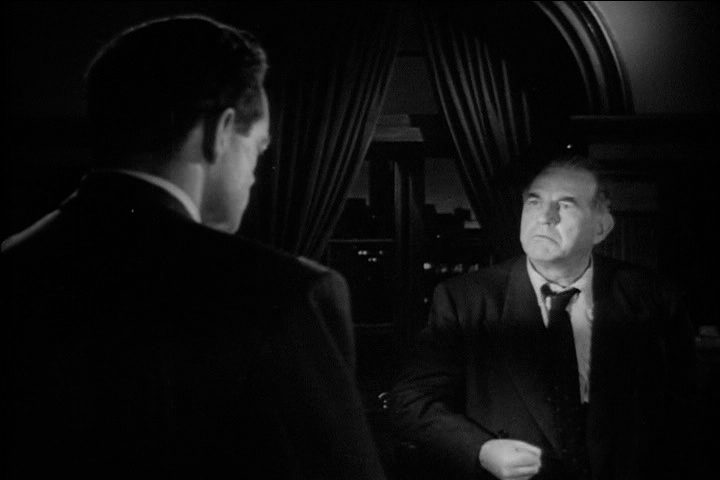
Great big-screen showing of THE MALTESE FALCON at the Charles tonight. The model of Classical Hollywood economic storytelling. It's a film that cries out to be seen on the big screen -- you become aware of the subtle but masterful technique Huston uses to keep things visually interesting even through pages of dialogue. Great performances all around -- everyone makes an impression and makes the most of their roles, especially Greenstreet, who comes in somewhat late in the picture but commands attention in every scene in which he appears. It's a watershed Hollywood film in some ways -- helping to usher in the era of the writer-director in the early '40s, and pushing the hardboiled detective genre film into new territory, with Spade's torn conscience about turning in the woman he has fallen for while remaining bound by honor and duty to his partner whom she killed. Spade's sarcastic kidding about Brigid O'Shaughnessy's compulsive lying masks an uncertainty and even insecurity about his feelings for her and whether she can be trusted, whether she will ultimately hurt him. His shield of cynicism toward her at the end betrays his vulnerability. A brilliant and even beautiful film...mysterious, evocative...the stuff that dreams are made of.
Preston Sturges' final classic was this farce comedy about a temperamental symphony conductor (Rex Harrison) who suspects his wife (Linda Darnell) has been unfaithful to him, and his overheated imagination gets the better of him as he concocts various schemes to exact revenge on his wife and her supposed lover.
An interesting blend of Sturges' characteristic comedy-of-manners laced with slapstick, and a strong dose of dark comedy, UNFAITHFULLY YOURS is an uneven but highly interesting and often quite funny film. It is filled with Sturges' sharp observations about human behavior, offering a wry commentary on how the best laid plans often go awry.
One of the great curiosities of the early sound film period are the foreign-language versions of Hollywood films made for overseas markets. Long unseen in the US, many of these were shot simultaneously, often with a different director and supporting cast, on the same sets as the domestic version. These multi-lingual versions were produced to fill the void left by the demise of Hollywood silent films that were highly popular in foreign markets.
Examples include a German-language version of ANNA CHRISTIE (1930), directed by Jacques Feyder and starring Greta Garbo and Salka Viertel; a German-language MOBY DICK (1930), directed by Michael Curtiz and William Dieterle (who also replaced John Barrymore as the star); and perhaps most famously, the Spanish-language version of DRACULA (1931), directed by George Melford and starring Carlos Villarias, which some critics consider to be superior to the Bela Lugosi version for its comparatively fluid camera movement.
Especially popular in foreign markets were the comedians. Hal Roach produced foreign-language versions of short comedies starring Laurel and Hardy, Charley Chase and Our Gang, often with the stars reading their lines phonetically off a blackboard. In the case of Laurel and Hardy, who enjoyed great popularity in Spain and South America, the team not only made Spanish-language versions of their two-reel comedies, they were even sometimes expanded to four or five reels in length (often by combining the plots of two or more shorts) in order to market them as features and charge higher rental fees in those markets. These foreign language versions are thus not simply carbon copies of the domestic version, but often differ significantly.
At MGM, Buster Keaton -- the studio's star comedian in the early days of sound -- was struggling to adapt not only to the new medium of sound film, but the constraints imposed on him by the corporate hierarchy of the studio system. Accustomed to the creative freedom that he'd enjoyed working for Joseph M. Schenck during the 1920s, Keaton found himself increasingly reined in after his expensive comedy epic THE GENERAL under-performed at the box office in 1927, and the subsequent combined factors of his signing with MGM and the end of the silent film form in which he had perfected his art marked a massive change in his working methods and the kind of comedies that he could make.
Keaton's struggles at MGM are well-documented, but they are worth reiterating here when one
considers that not only was he forced to make these films not just once, but often multiple times, each in different languages. Following a non-speaking appearance in MGM's THE HOLLYWOOD REVUE OF 1929, a variety-show style film in which most of the studio's major talent performed musical numbers and sketches to show off their voices, Keaton appeared in the musical comedy FREE AND EASY (1930), in which he was required to sing and dance as well as engage in uncharacteristically labored verbal humor. To top it off, the film was simultaneously shot in a Spanish-language version titled ESTRELLADOS.
Subsequent foreign-language versions of Keaton's early MGM talkies include De Frente, Marchen (a Spanish version of DOUGHBOYS [1930]), Buster se Marie and Casanova wider Willen (French and German versions, respectively, of PARLOR, BEDROOM AND BATH [1931]), and Le plombier amoureux (a French version of THE PASSIONATE PLUMBER [1932]). The advent of dubbing and subtitling helped bring an end to the practice of shooting separate foreign-language versions of Hollywood films around 1932.
Distinctive from the other foreign-language versions that Keaton appeared in, however, is WIR SCHALTEN UM AUF HOLLYWOOD (1931, We Switch to Hollywood, a reference to the radio broadcast report from Hollywood that serves as the set-up for the movie). Sometimes described as a German-language version of THE HOLLYWOOD REVUE OF 1929, WIR SCHALTEN UM AUF HOLLYWOOD is instead an entirely unique film. This is where WIR SCHALTEN UM AUF HOLLYWOOD differs from the typical foreign-language version of the period, rather than simply re-creating the domestic version shot-for-shot but in a different language.
The main draw of THE HOLLYWOOD REVUE OF 1929 was in being able to hear many of MGM's biggest stars talk on-screen for the first time. But WIR SCHALTEN UM AUF HOLLYWOOD was released a full two years later, in 1931, by which time these same stars had already been talking on the screen for quite a while, so the novelty of hearing their voices had presumably worn off. Whereas HOLLYWOOD REVUE was a standard variety-style presentation of the studio's top talent, similar to Warners' SHOW OF SHOWS or PARAMOUNT ON PARADE, WIR SCHALTEN UM AUF HOLLYWOOD takes an entirely different approach.
Paul Morgan in 1906
Subtitled "Eine reportage revue" ("a reportage revue"), the premise finds a German reporter (played by Austrian cabaret performer Paul Morgan) coming to Hollywood with a wireless hand-held radio transmitter to give audiences back home a report of his experiences in Tinseltown. He arrives at MGM, and meets a deposed German nobleman, now working as an extra at the studio, and together, the two tour the lot, interviewing stars along the way and culminating with attending a red carpet movie premiere. Sprinkled throughout are musical numbers lifted from THE HOLLYWOOD REVUE OF 1929, as well as the unfinished 1930 musical revue THE MARCH OF TIME (sequences shot for this never-completed production were used in a number of MGM films of the period, and the All Talking! All Singing! All Dancing! blog features a thorough history of the production and a breakdown of its recycled music numbers)
Directed by German actor Frank Reicher (best remembered by audiences today as the Skipper in KING KONG), the cast includes the famous Austrian cabaret star Paul Morgan (who also wrote the screenplay and dialogue), Buster Keaton (who receives second billing among the all-star cast, an indicator of his box office clout abroad at the time), Ramon Novarro, Nora Gregor, Oscar Straus, Adolphe Menjou, Heinrich George, the Dodge Sisters, John Gilbert, Egon von Jordan, and the Albertina Rasch Ballet. Uncredited appearances include Wallace Beery, Joan Crawford, Gustav Froehlich, Hoot Gibson, Anita Page, Dita Parlo, Norma Shearer and, perhaps most unexpectedly, Russian filmmaker Sergei M. Eisenstein (who was in Hollywood at the time).
Also worth noting is that the film was photographed by special effects cameraman Ray Binger (though the cinematography throughout is visually unremarkable), and is the earliest known film to have been edited by Adrienne Fazan, who would become one of MGM's most highly-valued and long-time cutters, working on such productions as SINGIN' IN THE RAIN, AN AMERICAN IN PARIS, and SOME CAME RUNNING, among many others.
Buster Keaton appears in two scenes in the film, totaling just under five minutes of screentime. In the first, he is spotted in a restaurant by Paul Morgan, who tries to interview him, but Buster is unresponsive to him (with the exception of borrowing the wireless radio transmitter to crack some walnuts). Buster only shows attention when he spots a pretty waitress, and follows her out of the restaurant. At this point he is able to engage in some characteristic physical humor. He is first seen reclining in a doorframe, holding himself up by pressing his feet on the opposite side of the frame (re-creating a pose he had used in a publicity still for his 1922 short THE ELECTRIC HOUSE). Next, he steps out of the doorway, which we now see is quite high off the ground, and onto the roof of his car underneath. He nonchalantly jumps off the roof of his car, gets in, and tools off, much to the amusement of Morgan and his companion. Keaton's appearance here is almost completely nonverbal, with only a single line spoken in German.
Keaton's second scene occurs at the very end of the film. Following the movie premiere, Paul Morgan sends his farewell address over the radio. Buster emerges from an alley next to the theater, dressed in caveman attire and carrying a club, which he uses to knock Morgan over the head before delivering the film's final line (in stilted German) at the fade-out. His random appearance (and costume) here suggest that perhaps he appeared at another point in the film, but that it was cut. Some filmographies state that Keaton appeared as a caveman in THE MARCH OF TIME (Marion Meade in Cut to the Chase says he "had two days shooting as a caveman"), which could explain the costume here. It is possible that his footage from that earlier film could have originally been included here, but later cut, or does not survive in extant prints of the film. These two scenes give Keaton an opportunity to perform material entirely different from his scenes in THE HOLLYWOOD REVUE OF 1929.
Although it serves a similar purpose as THE HOLLYWOOD REVUE OF 1929 in giving audiences glimpses of some of MGM's biggest stars, it is inaccurate to describe WIR SCHALTEN UM AUF HOLLYWOOD as merely a German-language version of that earlier film. It is instead an entirely original creation. It is of interest to film historians today not just as an example of a unique early Hollywood foreign-language talkie, but also for the personalities it showcases, its behind-the-scenes glimpses of the MGM studio, and its inclusion of scenes from the unfinished MARCH OF TIME. It is also of great historical value as a filmed record of Paul Morgan, one of the most celebrated cabaret stars of Weimar-era Berlin before his arrest and subsequent tragic and brutal death in the Buchenwald Concentration Camp in 1938 at the hands of the Nazis.
And, as valuable filmed records go, it gives us a chance to see fresh Keaton material, however minimal, which is always a welcome and wonderful thing.
One of Truffaut's lightest (and most enjoyable) films, a clever homage to Hollywood crime films. A brilliant concert pianist (Charles Aznavour) who has fallen on hard times and is playing in a small-time club runs afoul of a pair of gangsters who are after his brother, while pursuing a romance with the club's waitress (Marie Dubois). Truffaut deftly creates a film that works both as a crime thriller on its own and as a playful riff on the genre at the same time, expertly balancing suspense and comedy from one moment to the next, enlivened by the director's stylistic flourishes, especially his use of cutaways.
This 1931 travelogue of Hollywood is notable for having been shot in the Cinecolor process, providing rare color glimpses of the Movie Capital in the early '30s. Highlights include nighttime footage from the premiere of Frank Capra's Dirigible at Grauman's Chinese Theater, aerial views of the Hollywood Bowl, and the Hollywood Chamber of Commerce building. Perhaps due to time and budgetary constraints (the film was made by the British company Wardour Films), the travelogue refreshingly offers fewer views of the iconic sights of Hollywood typically found in these types of scenic films, instead presenting quotidian views of the town's houses, streets and churches that serve as a valuable cinematic time capsule.
MURMUR OF THE HEART (1971, dir. Louis Malle) -- Finally got around to seeing this controversial but powerful coming-of-age story about a precocious middle class boy in 1950s France. His burgeoning adolescent escapades are cut short by a heart murmur, and he is sent off to a sanatorium with his mother, where things take a much darker and unexpected turn. Sensitively directed by Louis Malle (whose films I always find worthwhile), I was struck by the honesty in his handling of the material, especially in the film's painful and shocking climactic scene. The film's low-key energy is enhanced by an excellent jazz score featuring Charlie Parker, Henri Renaud, and Gaston Frèche. Starring Lea Massari, Benoît Ferreux, and Daniel Gélin; written and directed by Louis Malle.
Laurel and Hardy come to Scotland to collect an inheritance and through a series of misunderstandings find themselves enlisted in the Scottish regiment of the British Army and sent off to India. This one contains at least three classic scenes: Hardy's sneezing fit at the bottom of a lake that leaves it completely dry, the Boys cooking a fish in their hotel room ("it shrizzled"), and their dancing to "The Hundred Pipers" while sweeping up trash, much to the ire of Sergeant James Finlayson.
Last night, I saw that the newly-renovated and re-opened Parkway Film Center in Baltimore was going to be showing David Lynch's Eraserhead, a film I have never seen all the way through. I had previously begun watching it when it was available on Netflix or one of the various streaming platforms, but found that the small-screen format made it difficult to immerse myself in the alternate universe that Lynch creates.
Seeing it on the big screen, in a new 4K digital restoration, sounded more like the proper way to experience this film, which has such a devoted following that I have to confess I wondered if it would be able to live up the hype I've heard surrounding it for so long.
I arrived at the Parkway just in time for the 9:45 show on Saturday night, which these days is about as close to a "midnight movie" screening as you're going to find in the area. I purchased my ticket at the counter, and took my seat inside Theater 1, the largest of the three theaters at the Parkway.
Finally seeing Eraserhead, I can understand its appeal to those looking for something different, for viewers interested in alternative possibilities for narrative cinema. Lynch creates a surreal hallucination following a night in the life of a young man who experiences a strange series of events after being left to tend after his newborn "baby", filled with nightmarish imagery, and a surprising number of moments of real humor. It fits well with the kind of uncanny cinematic universe that Lynch has created in other films, though it is perhaps less even, less consistent than his mature films. Here, the moments of self-conscious "strangeness" stand out a little too sharply. But Lynch still conjures up a real sense of dread and unease, masterfully demonstrating early on the hallmarks of his mature cinematic style.
I am glad that I finally saw Eraserhead, and under good conditions, because it really is a unique and highly original film that retains its power even after inspiring many imitations, and it's still exciting to see the movie that heralded David Lynch as a major new filmmaking force at the time of its release.
Gloriously stylish, melodramatic late-'80s erotic thriller about a Manhattan attorney's (Michael Douglas) relationship with a dangerous stalker (Glenn Close) who threatens to destroy his entire life. Director Adrian Lyne keeps the tension mounting, though it loses steam a bit in the final third, especially once Close's carefully-developed character devolves into a slasher movie-level killer.
Too often, the films of Louis Lumiere and other early cinema pioneers are discussed as primitive artifacts, a kind of cinematic equivalent of cave paintings that marked the beginning of an art form. This documentary, directed by Eric Rohmer, takes a formal approach, discussing the photographic qualities of the Lumiere films through interviews with Jean Renoir and Henri Langlois. Both men offer eloquent commentary on the beauty and historical value of the Lumiere films, revealing why these pioneering works should be viewed as sophisticated, fully realized motion pictures on their own terms, rather than as merely a precursor of things to come.
Watching The King of Comedy (1983) last night, I remembered reading that Scorsese had been influenced by Edwin S. Porter's Life of an American Fireman (1903) in thinking about his approach to making the film. I watched it partly with that in mind, thinking about how he might have drawn on that film for inspiration. One of the things I find most interesting about Scorsese is how he ingests the whole of film history and brings those influences to bear in such unexpected but effective ways.
This is what Scorsese had to say about the influence of Porter's film on The King of Comedy:
"People had reacted in such a way to Raging Bull, saying it was a beautiful film - like Days of Heaven, you could take every frame and put it on the wall - that I decided my next picture was going to be 1903 style, more like Edwin S Porter's The Life of an American Fireman, with no close-ups. So in King of Comedy that's what I tried to do." (quoted in Scorsese on Scorsese).
A minor John Ford film, especially in relation to his classics Stagecoach and Young Mr. Lincoln that he would make the following year. It's a lightweight adventure yarn about a ragtag group of sailors on a Navy sub chaser during WWI. Richard Greene and Preston Foster head up a fine ensemble cast that includes Nancy Kelly, George Bancroft, Slim Summerville, John Carradine, Elisha Cook Jr., and Henry Armetta, among others.
Ford's direction keeps the pace energetic and lively throughout, embellished with a characteristic sense of humor. There are some exciting action sequences, such as the sea battle and sinking of a German sub, which are impressively staged and heightened by excellent model work, especially in the undersea shots.
This is the kind of material John Ford could do so well, and though he would return to the settings and themes again, this seems to mark a turning point in his career. The light, freewheeling tone places it among his earlier work, specifically among his other Navy films like Salute (1929), Men Without Women (1930), and Seas Beneath (1931), rather than the films he would make during and after the war.
A powerful and at times excruciating drama -- written by Rod Serling from his own teleplay -- about the cutthroat office politics inside a big New York industrial firm, where the tension runs so thick one could cut it with a knife. Van Heflin plays a brilliant young executive from the company's Ohio office, who accepts a top position in New York, but soon finds himself being used as a pawn in a power play by the big boss (Everett Sloane) to force a principled, aging executive (Ed Begley) into resigning.
Directed by Fielder Cook with stark minimalism, and filmed on location in New York (in striking black and white by Boris Kaufman), Serling's screenplay boils with tension and anxiety, only occasionally becoming too self-conscious, and impaired by an ending that doesn't ring entirely true, but that does not negate the astonishing degree of honesty and poignancy that Serling establishes leading up to it.
In to a small town high in the Alps, riding in a mule-drawn sleigh, arrive Laurel and Hardy. This time they are mousetrap salesmen, and have come to Switzerland because, according to Laurel's logical thinking, where there is more cheese than anywhere else in the world, there will be more mice. Like two comic vagabonds, the boys are seemingly as much at home in this fantasy version of a Tyrolean village as they are in the old west or the suburbs of Los Angeles, a testament to their universality and timelessness. During their stay in Switzerland, Oliver Hardy will endure the usual trials and tribulations against his dignity, most of them innocently precipitated upon him by his friend, Stan Laurel.
From the moment they appear, you find it impossible to take your eyes off of them. The boys' masterful comic interplay, which they make look so deceptively simple, astounds with its perfect rhythm and timing, every gesture, every glance and every pratfall performed with expert precision. Every facet of their screen characters is so thoroughly and richly defined to the point where they seem so real, so human that we feel like we are spending time with old friends when we see their films.
Numerous episodes stand out for their comic ingenuity. Spotting a Saint Bernard with a keg of brandy strapped around its neck, Laurel feigns exhaustion in order to obtain the rescue dog's emergency supply of liquor, on which he becomes hopelessly intoxicated. Indentured to work in the hotel kitchen an extra day for every dish they break, the boys find innumerable ways to add to their misfortune with one new dinnerware disaster after another until it seems that they will spend all of eternity in that kitchen. And there is the moment when Hardy serenades the object of his romantic affection with a rendition of the tender ballad "Let Me Call You Sweetheart", accompanied by Laurel on an oversize tuba, the incongruous booming tones of the instrument oddly complementing the pomp and splendor of Hardy's musical declarations of love.
There are also the delightfully surreal moments that exist free from the constraints of realistic narrative logic. At one moment, animated soap bubbles escape from a pipe organ that produce the notes of a song as they burst, and at another, a punctured gas pipe under the floor causes infernal flames to shoot forth wherever poor Oliver Hardy happens to be standing.
At one point, the boys find themselves trapped on a rickety wooden mountain bridge, perilously high across the Alps, with a piano and a gorilla -- a comic image for the ages. Ours is not to wonder how they got there, or what a gorilla is doing in the Swiss Alps. Laurel and Hardy approach any task with a kind of bullheaded determination and literal single-mindedness, which keep them in pursuit of achieving their goal even when logic or common sense would give anyone else pause for thought, and this is no exception. Suspended high above the gaping mountainous chasm, every twist and turn of the bridge -- swaying to and fro like some kind of insane fun-house attraction -- risks plunging them into the abyss.
Yet they view this predicament as they would any other and, despite the momentary terror of the situation, somehow all seems right in the world when Hardy, left by the oblivious Laurel to dangle from the collapsed bridge on the side of a mountain, gets knocked on the head by a falling rock, expressing mere annoyance at this latest inconvenience. Their universe has regained equilibrium, and they are on to their next misadventure, perhaps to attend Oxford, or join the Foreign Legion.
Universal's recent Blu-ray release of All Quiet on the Western Front is a notable effort, presenting a beautifully restored version of this powerful anti-war film, which is also frequently cited as one of the greatest achievements of the early sound era.
Like many transitional sound films, All Quiet was also released in a silent version, which has recently been restored by the Library of Congress and is presented as a special feature on the Blu-ray edition. These silent versions of sound films were typically prepared for theaters that were not yet wired for sound (though, curiously, many of them contained soundtracks with music and effects), or for foreign markets, where the intertitles could be replaced with translations in different languages.
All Quiet on the Western Front is unique in that, unlike many early talkies, it features a great deal of action, shot with a sweeping, fluid camera freed from the restrictions and limitations of recording sync sound. Director Lewis Milestone shot most of the battle scenes silent, with the soundtrack created in post-production, resulting in a vivid, dynamic rhythm of images that matches the best of those found in silent cinema.
It's not surprising, then, that All Quiet could be adapted fairly smoothly as a silent film, without losing too much of its impact. Calling this alternate version "silent", however, is a bit of a misnomer. There is remarkably little music on the soundtrack throughout, as there would be in a traditional silent film accompaniment. Instead, the images are complemented with the sound effects of machine gun fire, screaming, crowd noises and often -- quite effectively -- long stretches of silence, that only underline the sense of dread and terror in the scenes in the trenches.
There is a contingent that considers this silent version to be superior to the sound version, an argument I've read in more than one source suggesting that the pacing flows better when unencumbered by the sometimes declamatory and stilted dialogue. I would disagree; however. All Quiet on the Western Front is already fundamentally a silent film, its ideas conveyed through the power of its images. To strip it of its dialogue and turn it into a literal silent film is redundant.
It is certainly a wonderful thing that Universal has done in presenting both versions on Blu-ray, allowing viewers to make the comparison for themselves. I am glad the silent version is now available, but I view it as more of a curiosity, with the sound version remaining a powerful and impressive achievement.
Robin Williams has one of his finest dramatic roles in this offbeat thriller about a lonely, psychologically disturbed photo developer, who becomes obsessed with the family of one of his regular customers, and turns dangerously unhinged when he learns that there is a dark side to the family's seemingly picture-perfect existence. This premise makes for a gripping and effective character study and suspense thriller, building an understated but deeply unsettling tension through Williams' pathetic efforts to ingratiate himself with the family, though it runs out of steam during the last half hour or so. Williams' performance is at once chilling and heartbreaking. Good supporting performances by Connie Nielsen, Michael Vartan, and Gary Cole as Williams' unsympathetic boss.
One of the truly great American films of the 1960s, as uncompromising and honest a film as has ever been produced by Hollywood. Director John Schlesinger draws on his experience with British "Kitchen Sink" dramas, deliriously combining a New Wave sensibility with the influence of underground, experimental filmmaking, to create a landmark of the New Hollywood cinema. Jon Voight and Dustin Hoffman give perhaps the finest performances of their careers as two men who form an unlikely bond on the gritty streets of late '60s New York. Greatly enhanced by a beautiful John Barry score and the haunting theme song by Nilsson.
A loving, spirited tribute to the rough-and-tumble early days of picture-making, Peter Bogdanovich's NICKELODEON is a flawed but interesting and often entertaining film based partly on the colorful experiences of pioneering filmmakers Allan Dwan and Raoul Walsh.
Ryan O'Neal stars as a Chicago lawyer who gets mixed up with an independent motion picture company and reluctantly takes over as director of their latest production shooting out west, and Burt Reynolds as a jack-of-all-trades who reluctantly becomes the company's new star after being sent by the Patents Trust to shut the production down. The fine ensemble cast includes Tatum O'Neal, Brian Keith, John Ritter, Stella Stevens, and Jane Hitchcock.
The film drags in spots, not helped by some laboriously-executed slapstick scenes that go on too long, but overall it's a great deal of fun, clearly made with a great deal of affection and knowledge of the period. The bittersweet ending, taking place at the premiere of The Birth of a Nation, beautifully encapsulates the emotional rollercoaster of the filmmaking process. After witnessing such a brilliant film, O'Neal is simultaneously enthusiastic about the artistic triumph it represents, and dejected by the realization that he will never make anything as good himself. But just as soon as he's contemplating giving it all up, he witnesses a film company making the movie, and the excitement all comes back to him. Not quite up to the standards of Bogdanovich's best films of the early '70s (particularly The Last Picture Show and Paper Moon), NICKELODEON is nonetheless an admirable and ambitious effort, and certainly one of the best films-about-filmmaking.
A tense, deliberately-paced thriller, directed and co-written by Kelly Reichardt, about a trio of environmentalists who blow up a dam, and the resulting moral dilemmas they face in the days following the act, dealing with the consequences of their actions and the unexpected effects it has on each them.
Reichardt is one of the most interesting filmmakers working today, and NIGHT MOVES may be my favorite of her films. From the outset, she establishes a great sense of atmosphere and pacing, which builds to increasingly heightened tension as the plot takes unexpected turns, invested with well-drawn characters acted by a fine cast including Jesse Eisenberg and Dakota Fanning. NIGHT MOVES is both a penetrating character study and a surprisingly gripping suspense drama.
I had the opportunity to see the new BFI restoration of Barry Lyndon at the Charles Theater in Baltimore on December 2nd. This is a film that absolutely cries out to be seen on the big screen, where the rich, painterly qualities of Kubrick's detailed compositions can be fully appreciated. There is not a dull moment in the film's 184 minute running time, telling the thoroughly riveting story of a young Irishman's fortuitous rise to the top of the British aristocracy, and his equally steep downfall. Ryan O' Neal gives one of his finest performances in the title role, and the film can rightly be called a masterpiece thanks to the singular vision of Stanley Kubrick, who directed, produced and wrote the script (from the Thackeray novel).
Gillo Pontecorvo's historical drama about the resistance movement against the French occupation of Algiers in the 1950s remains one of the most explosive, powerful films of its kind. Filmed with a documentary-like realism, Pontecorvo fills the film with unforgettable, disturbing images that hold nothing back. It's an absolutely bold, fearless film that is also remarkable for its objectivity in presenting the perspectives of both the French military and the FLN. Pontecorvo creates a heightened sense of dread and terror, of violence and catastrophe about to erupt at any minute, most effective in the expertly-timed, highly suspenseful sequence in which a series of bombs are planted in various public places throughout the city, and detonate in short order (recalling the similarly anxiety-inducing sequence of an anarchist's bomb exploding on a crowded London bus in Hitchcock's Sabotage).
Stylistically, the film resembles the post-war Italian NeoRealist cinema, especially recalling the films of Rossellini such as Open City, and at times feels like it could be a kind of late entry in that tradition of filmmaking in terms of its masterful combination of powerful filmic and political ideas.
Epic in its scope and scale and timely as ever, The Battle of Algiers, is rightly called a masterpiece.
Caught this one at the Senator Theatre tonight in a nice restoration from Lowry Digital. It's always more fun seeing these Bond flicks on the big screen, so I usually wait until one comes around to the revival theater rather than watching them on video. This one, the second in the series, is one of the best, owing in particular to a great performance by the always-superb Robert Shaw as the killer, Grant. Colorful locations, thrilling action scenes (including some incredibly dangerous-looking stunts) and a rare-but-memorable screen appearance by Lotte Lenya add to the fun.
Possibly Hawks' finest Western, rivaled only by RIO BRAVO, it tells the epic story of the first cattle drive on the Chisholm Trail. John Wayne has one of his finest roles as the financially devastated cattle rancher who must move his entire herd from Texas to Kansas, while slowly losing his authority and gradually breaking under the strain of the difficult journey. Montgomery Clift, in a remarkably assured screen debut, is the young ranch hand who defies Wayne in order to assume command and, in true Hawksian fashion, to get the job done right. A rousing score by Dimitri Tiomkin and breathtaking cinematography by Russell Harlan contribute greatly to the film's deservedly high reputation.
Delirious musical fantasy, conceived and designed by Dr. Seuss, produced by Stanley Kramer, and directed with real flair by Roy Rowland. A boy, bored with his piano lessons, falls asleep and dreams that his piano teacher is actually a mad supervillain and that he is being held captive in a labyrinthine lair. This set-up is a backdrop for a series of colorful, surreal set pieces and songs. This is undoubtedly the best role that Hans Conried ever had, delivering a delightfully madcap performance as the piano teacher. Tommy Rettig delivers a fine performance as the boy, and usband-and-wife vaudeville team Peter Lind Hayes and Mary Healy are good if somewhat bland as the adults in the story. Although often an uneven film, it is nevertheless entertaining and is superior to, and truer in spirit than, the more recent film adaptations of Dr. Seuss stories.
This past Saturday (August 13), I took a trip to the Edison National Historic Site in West Orange, New Jersey. I've visited here a number of times over the years, and each time I visit I am struck by the sense of wonder I feel at being the very spot where (depending on which version of the history you read) motion pictures were born.
This time, I visited the museum with my friend Jim Gisriel, a fellow film enthusiast who shares my interest in the early years of cinema. We arrived on a scorching hot Saturday morning, right before noon. After checking in at the visitors center, we made our way in to the small theater where a selection of early Edison films were playing on a monitor. After watching a couple minutes of THE GREAT TRAIN ROBBERY (we walked in just as the bandits were forcing the passengers to disembark from the train), Jim and I made our way out the back of the theater and over to the Black Maria.
Or rather, a replica of it. Originally built in 1893, the Black Maria is recognized as the world's first dedicated film studio, and although it was torn down only a decade later, this replica was constructed in 1954 by the U.S. National Park Service and stands as a tribute to the place where America's earliest films were made. The Black Maria is quite a striking building -- covered in tarpaper, it got its name from the knickname given to police paddy wagons, which it resembled.
With the scorching hot noonday sun beating down on us, Jim and I observed the Black Maria for about 20 minutes before heading inside for a presentation on Edison's contributions to the motion picture. While we were outside, we took in all the little details of the structure, from its wooden tracks that allowed the studio to turn and face the sun, to its hatch roof that could open to allow the sunlight to shine in. Several bees swarmed around, apparently having nested inside a pipe fixture on the side of the building.
Unfortunately, we were not able to actually go inside the Black Maria, but the side door was open, allowing us a look at a replica of the Chinese Laundry set from Edison's 1895 film of that same name, as well as what appeared to be a replica of an Edison camera, though it was difficult to tell from the angle that it was positioned at. What is most striking about this replica -- which is the same size as the original studio -- is how small it can look from the outside. And yet, the interior was large enough to house not only the performers, technical crew, and equipment, but also a small dressing room on the end for visiting talent. The studio was described by some of those who worked there as hot and cramped, the most uncomfortable building in which to work. On a hot day like this, it was easy to see why they might feel that way...
But imagine the larger-than-life personalities who set foot in this little studio more than a century ago! It gives me chills to stand out there at the site of the original studio, and think of the icons of late 19th/early 20th century American show business -- Annie Oakley, Buffalo Bill, and Sandow, among them -- who stepped before Edison's camera one afternoon and achieved immortality on film. It's thrilling to stand in that spot where they once stood, and realize we are only separated by time.
With the lecture about to start, we headed inside and up to the second floor of the factory, where a tour guide gave a short talk on the invention of the movies. A small but appreciative audience was gathered, and it was fun watching the kids in the group as they looked at photos of the Kinetoscope and small strips of film that were passed around. I couldn't help thinking how excited I would have been, as a budding film enthusiast, to attend a presentation like this at their age!
The second floor of the Edison factory is where W.K.L. Dickson built his first motion picture camera, and also where the very earliest camera tests were shot. In the far corner of the second floor is a wall with a placard that designates it as the spot where Dickson's invention took place. To stand and look at this little corner of an industrial factory in suburban New Jersey, in the exact spot where the art form of motion pictures was born, is a humbling experience. Imagine being able to see the first cave wall where the first painting was created, or to stand in the exact spot where the first musical note was played. And think of all the dreams that sprang forth from Dickson's invention that day...
On display was an original Edison Kinetoscope, though it was not up and running. In a glass case was an early film repair kit consisting of a splicer and glue, used for patching up broken prints. As Jim observed, this little kit represents the birth of film editing. Next to it was a prototype cylinder viewer, one of the methods for playback of moving images that was abandoned early on. This method involved tiny individual frames that would be viewed on a turning cylinder to create the illusion of movement. I peered at the little frames and recognized the image to be from "Monkeyshines", one of the earliest surviving camera tests said to date from 1890, which features an Edison employee waving his arms about before the camera.
Jim and I proceeded to tour the rest of the museum, which includes rooms dedicated to music, sound recording, and photography, as well as Edison's impressive personal library (which takes up three floors). But the highlight of the visit was certainly the chance to spend some time in the place where the motion picture first came to light some 125 or more years ago. I think of those people who were there at the very
moment of the birth of the art form, and wonder whether they had any idea of
the power and the potential of the tool they had created. It is awe-inspiring to
think of the artistic heights the cinema has reached in just its first
century of existence, and what still lies ahead.
Among the literature written on the subject of film, there are a few works that I would consider absolutely "essential". Movie Journal: The Rise of the New American Cinema, 1959-1971, by Jonas Mekas, is certainly one of them. Representing nearly a third of the columns that Mekas wrote for the Village Voice over a period of about 15 years, it provides a vivid, first-hand account of the films and filmmakers of the New York avant garde cinema, written "as it happened" by the movement's most passionate champion.
It is really quite staggering to think about the scope of what Mekas' writings cover here -- really the entire rise and development of one the most creatively fertile movements in the history of cinema, offering impassioned defenses of some of its most notable participants including Stan Brakhage, Jack Smith, Ken Jacobs, Gregory Markopolous, Harry Smith, and Marie Menken. Mekas traces not only the films and the people who made them, but also how they were distributed, exhibited, and received. He provides a vibrant portrait of the New York underground art scene in which these films were shown, and the increasingly ambitious ways in which they were presented, such as interactive, live "happenings". His descriptions of the challenges in dealing with New York's film licensing and censorship laws of the time reminds us of how courageous these artists were in fighting for the right to make the films they wanted. Most significant in this respect is Mekas' account of his arrest over the showing of Jack Smith's highly controversial Flaming Creatures, which was released in 1963 and found to be obscene.
Then there are the accounts of the development of the Filmmakers' Co-op, which served as a distribution network for avant garde cinema, and the Anthology Film Archives, created as a place to preserve and screen the films for future generations. The stories behind these two landmark cultural institutions deserve volumes of their own; their inclusion here reminds us how prolific (and tireless) Mekas has been in his quest to champion alternative forms of cinema.
Mekas is also a prescient visionary, particularly when it comes to his ideas about making cinema available in the home (to be collected and consumed like books), and in his idea of using 8mm (home movie) cameras in the service of social justice. The advent of home video, and the prevalence of consumer camcorders (as well as online video on which to share the footage) have proven him right with time.
Mekas has said that everything he did, he did because there was a real necessity for it. That is what comes through most strongly in his writing. One gets the sense that this is not a man with any time for trivia; his vision was (and remains) astoundingly clear and focused on the task at hand. The post-war American avant garde cinema flourished thanks to the critical context provided by Mekas, along with the institutions for distribution and exhibition that he was instrumental in creating. Mekas is an inspiration to anyone who cares about the possibility of cinema as a tool for personal expression rather than as a commercial business. This collection of his writings is a testament to that. As a critic, he has that most important of gifts: the ability to inspire his readers to seek out for themselves the films about which he wrote.
Movie Journal was originally published in 1972, and has been long out of print until this 2016 reissue by Columbia University Press. The new edition contains a foreword by Peter Bogdanovich.
In researching the life and work of pioneering film exhibitor, subtitler, critic, and avant garde filmmaker Herman G. Weinberg, I came across a copy of his memoir, A Manhattan Odyssey, which was published in 1982. I hoped that it would contain information about his time in Baltimore, when he served as the manager of the Little Theatre, an early arthouse cinema that was the city's sole outlet for foreign and avant garde films at the time.
I was pleasantly surprised to find that Weinberg devotes an entire chapter of his book to his time in Baltimore. He recounts being sent there by the operators of the 55th Street Playhouse, an art cinema in Manhattan, to oversee the opening of the Little Theatre. He ended up staying in the city for six years (from 1929 to 1936), living off of Mount Vernon Square and even meeting his first wife, Erna Bergman, who worked at the Little and was the star of his landmark experimental film Autumn Fire.
Beyond that, however, Weinberg's memoir is a fascinating evocation of a time and place that no longer exists. Most of the book focuses on his many years spent living in Manhattan, from his early childhood (a particularly tragic story involves the death of his young sister), to his years as a luminary of New York's arthouse film scene (during which time he authored a long-running column, "Coffee, Brandy, and Cigars", which ran at various times in publications such as Film Culture and Variety). Unlike our current age, in which every film enthusiast is expected to develop a specialized area of expertise in the most niche, unexplored aspect of the medium, Weinberg was a generalist, bringing his talents to bear in several different areas of the cinema.
Weinberg entered the film world through his musical training, after writing a trio of articles on silent film scoring that brought him to the attention of the burgeoning arthouse scene in Manhattan in the late 1920s. He developed the process of subtitling foreign films that has become the standard (superimposing the translated dialogue at the bottom of the screen), wrote pioneering studies of directors including Lubitsch and Sternberg, and in his later years, was a regular presence on the film festival circuit for many years, where he rubbed elbows with many Hollywood greats.
The chief delight in reading Weinberg's memoir, however, is his eloquent style, and wide-ranging references to literature, art and poetry. He re-produces a number of poems throughout the book (including one by his daughter Gretchen) that reflect a real appreciation for that art form. Like the best critics, Weinberg's enthusiasm for the subjects about which he writes is infectious.
The second screen adaptation (after the tantalizingly lost 1926 silent version) of F. Scott Fitzgerald's celebrated novel, this 1949 version -- directed by Elliott Nugent -- is an offbeat film, with its '40s post-war sensibility striking an uneasy balance with the '20s Jazz Age setting. Fitzgerald's novel is re-worked here as a rise-and-fall narrative more typical of the '30s gangster film, combined with elements of post-war crime dramas. Gatsby is portrayed as a hardworking young man who develops a thirst for wealth and the power it brings. But his meteoric success is ultimately undone by his misguided devotion to the woman for whom he has carried a torch over the years. It's no wonder that this version is often talked about in terms of '40s film noir, both for its emphasis on Gatsby's tragic rise and fall, and for its often shadowy, high-contrast visual style.
Alan Ladd is an interesting choice for Gatsby. He is able to convey the naive, almost childlike qualities of the character, as well something darker, even somewhat sinister, under the surface. The casting of Ladd, a staple of Paramount's series of dark crime dramas of the decade (This Gun For Hire, The Glass Key, The Blue Dahlia), further places the film's interpretation of Gatsby within post-war noir's long line of tragic protagonists. One of the more frustrating results of this approach, however, is a reductive morality imposed on the story, which undermines some its power. Nowhere is this more glaringly obvious than in the frankly trite and unnecessary prologue, which has Nick Carraway and Jordan Baker (now married) visiting Gatsby's grave in the present day, and reflecting back on the tragic events that led to his downfall.
Paramount's 1949 version of The Great Gatsby ultimately, and perhaps inevitably, fails to convey the spirit of the Jazz Age zeitgeist that Fitzgerald captured so well in his novel, but it is, also inevitably, revealing as a glimpse of that era as viewed through the very different sensibilities of the time in which it was produced.
Of the major silent film comedians, Harold Lloyd's transition to sound was in some ways the most seamless. Whereas Chaplin continued making silents throughout the 1930s, and Keaton was assigned by MGM to a series of increasingly uncharacteristic (albeit financially successful) farce comedies, Lloyd took something of a middle-ground approach, gradually adapting his character and scripts to better suit changing tastes in screen humor, without sacrificing the best qualities of his silent work. This approach resulted in such superb films as The Cat's-Paw and The Milky Way, both of which demonstrated that Lloyd still had what it took to remain a top comedy star in the '30s.
Professor Beware was Lloyd's final independently-produced feature, and marked his retirement from film acting (with the exception of his return in Preston Sturges' nostalgic The Sin of Harold Diddlebock a decade later). Lloyd plays Dean Lambert, a timid Egyptologist who becomes convinced he is the victim of an ancient curse, and sets off on a cross-country chase from Los Angeles to New York in order to join an expedition departing to Egypt, where he hopes to find the missing tablet that will remove the curse.
This picaresque plot provides an excuse for lots of fun if loosely-connected sequences built around the professor's misadventures on his cross-country journey, peppered with a colorful cast of character actors such as Raymond Walburn, Lionel Stander, William Frawley, Thurston Hall, Cora Witherspoon, Sterling Holloway, and many other familiar faces. There is also a pleasant romantic plot involving Harold and a young heiress (Phyllis Welch) on the run that, as others have pointed out, bears more than a passing resemblance to It Happened One Night.
Often cited as a highlight of the film is the extended chase scene in which Lloyd and his traveling hobo companions (Raymond Walburn and Lionel Stander) have to keep running along the top of a moving train headed toward a low tunnel. Perhaps in 1938, when there was such a dearth of good visual comedy on the screen, this sequence would have seemed like a welcome throwback to the best of silent comedy, but seen today, it feels rather clumsy and is marred by the overuse of unconvincing back-projection.
Much more satisfying is the action-packed climax, in which a newly-invigorated Harold finds the courage to rescue the heiress from her father's yacht. The scene is like a throwback to the ending of his silent comedies such as For Heaven's Sake and Speedy. Harold rounds up a gang of various tough guys by taunting them and egging them on to give chase, which they do -- following him right on to the yacht and unwittingly acting as Harold's personal army as they engage in an all-out brawl with the yacht's crew. It's a well-timed and expertly-constructed sequence that demonstrates Lloyd's still-considerable skills for physical comedy even at this late point in his career.
Other highlights include a sequence with Harold hiding a stolen chicken under his coat and being forced to engage in some amateur ventriloquism to assuage the sheriff's suspicions, and a memorable sight gag of a frost-bitten Harold emerging from a refrigerated train car in which he has just spent the past several hours traveling across the state.
Overall, however, Professor Beware is far from Lloyd's best work. Too often the pacing lags between set-pieces, some scenes (particularly the clothes-changing sequence with William Frawley) go on too long, and Lloyd himself is just a bit long-in-the-tooth to be playing the overeager young professor getting worked up over superstitions around an ancient curse. But it's hard to dislike the pleasant, silly humor of it all, and there are still enough flashes of brilliance, particularly in the exciting climax, to make it a worthwhile and enjoyable effort from a master comedian.
One of Hawks' final films, Red Line 7000 is an odd and often frustrating film. It never goes quite where you expect it to. Hawks largely dispenses with any concern about story here, instead focusing on the characters -- a group of racecar drivers and the women they love -- and follows them through their triumphs and tragedies on the racing circuit. To watch Red Line 7000 is to see a director totally in command of his style, relaxed, assured and not caring one whit about pleasing anyone other than himself with the results. That alone makes it worth checking out.
An interesting counterpart to the Douglas Sirk melodramas of the same period, Bigger Than Life is Nicholas Ray's powerful critique of post-war suburbia and the nuclear family. It's a hard-hitting, "ripped from the headlines" story about a mild-mannered suburban schoolteacher who is transformed into an abusive tyrant after becoming addicted to the experimental drug cortisone, which he has been prescribed to treat a potentially life-threatening condition. Well-acted by James Mason (who also produced), bringing a fiery intensity to his role, and ably supported by Barbara Rush as his sympathetic wife and Walter Matthau as his friend and fellow teacher who stand by him through his battle with addiction.
A remake of Victor Fleming's A Guy Named Joe (1943), Always is one of Spielberg's most interesting films while also being somewhat atypical for the director. The 1943 film starred Spencer Tracy as a WWII pilot who is killed in the line of duty, and after finding himself in heaven, is sent back to earth as a guardian angel to mentor a young pilot (Van Johnson) who just happens to be falling in love Dorrinda (Irene Dunne), the love of Tracy's life who has been left behind. Spielberg updates the story -- the fighter pilot is now an aerial firefighter (beautifully played by Richard Dreyfuss in a sensitive performance) -- but otherwise it remains decidedly and gloriously old-fashioned in every other respect.
Holly Hunter is wonderful as the spirited flight dispatcher in love with Dreyfuss, and John Goodman turns in a fine performance as Dreyfuss' best friend and flight instructor. Brad Johnson, as the young pilot whom Dreyfuss must guide in both work and love, brings the requisite good-natured qualities to the part, but he never establishes the chemistry with Hunter that Dreyfuss does, and as a result, their scenes together feel flat in comparison. Special mention should be made of Audrey Hepburn, in her final screen appearance, as the ethereal angel who sets Dreyfuss on his mission.
Always is unique in Spielberg's filmography. It seems to be an effort at creating a more self-consciously "adult"-oriented film without abandoning the sense of wonder and emotional power that marked his earlier hits such as E.T. and Close Encounters of the Third Kind (and only resorting to tour-de-force special effects when called for in key dramatic scenes). At the same time, it lacks the grand themes of his historical epics (Schindler's List, Saving Private Ryan, Lincoln, etc.), which allows Spielberg to focus more on the characters than in the larger events surrounding them. As such, it represents a kind of middle ground in Spielberg's work, one not always entirely successful, but one that marks an admirable effort on the part of its director.
I was introduced to the Belgian cartoonist Hergé's "Tintin" through the Canadian animated TV series from Nelvana, which aired on the Nickelodeon channel during the 1990s. With the engaging stories, characters and animation, it remained a favorite of mine, and I was delighted to see how well it held up when I re-visited it a few years ago, right around the time I learned that Steven Spielberg was making a big-screen adaptation of the character.
Happily, Spielberg's film (which I only just caught up with for the first time on streaming video, surely not the best way to experience this large-scale cinematic endeavor) remains true to the spirit of the comics and is a fun, exciting thrill-ride of a film as only he could make it. When you consider how easy it would be for this kind of thing to get out of control, to become drowned under a sea of special effects, it is tribute to Spielberg's incredible gifts as a filmmaker that he never loses sight of the story and characters that make the "Tintin" comics so engaging in the first place.
The Adventures of Tintin is certainly not one of Spielberg's more serious-minded pictures of the kind that win major Oscars, but it is a solid example of why he remains the greatest cinematic entertainer of our time.
A decidedly lesser effort by Hitchcock's usually high standards, Topaz follows in the same Cold War spy vein as the director's previous film, Torn Curtain, but suffers from a dull plot, languid pacing, and unremarkable performances that prevent it from rising to even the level of that earlier film (which itself was far from Hitchcock's best). Based on a novel by Leon Uris, the film tells the story of a French secret agent, working with the Americans, who travels to Cuba at the height of the Missile Crisis to collect information about a spy ring that has been leaking confidential information to the Soviets.
While it's interesting to see Hitchcock working with this topical material, the script (by Samuel Taylor) is a plodding, lumbering affair with too many scenes that go on too long with no payoff. Indeed, the entire film runs nearly 2 1/2 hours (at least in the cut featured on the Blu-ray edition I watched; apparently a shorter, alternate cut also exists). At times, Hitchcock seems to be almost overwhelmed by the scale of the production, with its many characters, locations, and unusually complicated plot. Hitchcock's best films took an economic approach to storytelling, starting with the essential plot and packing it densely with layers of style and suspense. Here, it feels like the director has his hands full just trying to keep things moving from Point A to Point B and to cover all the little plot details, so that there is little room for the signature Hitchcock touches.
SPOILER WARNING: The most striking visual moment occurs just after the Cuban official discovers that the woman he loves has been spying for the Americans, and shoots her, causing her to fall silently to the floor. The shot is photographed from a high angle that reveals her purple dress unfurling from beneath her, stunningly contrasted against the white floor in a flowing spread of color. It's a sublime moment that only Hitchcock could have pulled off. Another good moment occurs when the French agent meets with his contact in his Harlem flower shop, and rather than repeat the details of the plot (which we already know) through redundant dialogue, Hitchcock draws upon his silent film background by having the actors talk inside a walk-in floral display case for privacy, while the camera remains outside, presenting their conversation silently. Unfortunately, there are few opportunities in Topaz for Hitchcock to engage in interesting stylistic moments such as this, and the film ultimately collapses under its own weight.
Thankfully, Hitchcock would get back to his roots with his next film (also one of his best) -- Frenzy, a tightly-paced thriller shot in his native England, which proved that the Master of Suspense had lost none of his touch.
Excellent Warners Pre-coder, with Edward G. Robinson in a fun send-up of his gangster characterization. He decides to cash in and get out of the bootlegging business when the repeal of Prohibition seems imminent, and heads from Chicago to California, where he intends to set himself up in high society. Robinson clearly has a lot of fun with the role, and is ably supported by Mary Astor, Helen Vinson, Russell Hopton, Louise Mackintosh, Berton Churchill, and Tammany Young. Roy Del Ruth's tight and vigorous direction keeps the pace fast and furious, and there is scarcely a wasted moment in its scant 75 minute running time.
Seen: Sat., Feb. 20, 2016, Loew's Jersey (Jersey City), 35mm
It finally occurred to me why I fail to respond positively to this film, and to Sturges' work in general: it's marked by a self-conscious cleverness that I find ultimately distracting. I'd been considering this idea for some time, but it really crystallized after viewing SULLIVAN on a double bill with Capra's ARSENIC AND OLD LACE, which -- I should point out -- I was also disappointed by but for different reasons, reasons that became apparent in comparing Capra's approach to Sturges'. However uneven ARSENIC might be in its tone, it certainly demonstrates a consistency of style in Capra's direction, which is typically effective.
With Sturges, I am always aware of his technique showing. In SULLIVAN I see this with erratic stylistic approach to the "dramatic" scenes, as if the director is proving his seriousness through self-consciously "artistic" (and disorienting) camera angles and filters -- as in the courtroom scene -- or the heavy-handed juxtaposition of the prisoners and the church congregation in a later scene, finally reaching a fever-pitch during the hallucinatory montage of laughing faces during the Disney cartoon.
It would be tempting to view these as temporary lapses in style due to the director working in unfamiliar territory, except that the same heaviness is apparent throughout even the comic scenes, which becomes even more apparent in comparison with the work of other filmmakers. Sturges' handling of dialogue, for example, strikes me as a case of a screenwriter in love with his own words, failing to achieve any particular sense of rhythm or poetry, as Lubitsch or Hawks say, were able to. Nor does his staging of physical comedy achieve the graceful, deceptive ease of McCarey or Capra, feeling rather too obviously constructed as opposed to rising organically out of the situations (see, for example, the rather forced way in which Sturges gets his characters to fall into a swimming pool).
The sharp, almost bipolar contrast in tone of SULLIVAN'S TRAVELS magnifies these issues, but I think they are apparent throughout Sturges' filmography. With Sturges, I am too often aware of the clever screenwriter "behind the curtain".
Seen: Sat. Feb. 20, 2016; Loew's Jersey (Jersey City), 35mm
An aggressively madcap, uneven comedy that oscillates wildly between screwball zaniness and tepid attempts at black humor. The premise involves a New York theater critic (overplayed by Cary Grant in manic, pop-eyed mode) whose honeymoon with his new bride is unexpectedly delayed when he learns that his two sweet, little old aunts just happen to be poisoning the lonely old men who pass through their Brooklyn boarding house while their crazy nephew (who thinks he's Teddy Roosevelt) buries the bodies in the cellar.
One would expect this premise to be ripe with darkly comic possibilities, but surprisingly little is actually made of it throughout the course of the film. Perhaps the idea of playing murder for comedy was considered just a little too dark for audiences of the time to really be able to explore the more gruesome elements for laughs, or perhaps something was simply lost in the translation from the Broadway stage to the screen, but the results feel decidedly underdeveloped and leave much comic potential untapped. Moreover, the farcical romantic plot with Grant and his new bride is oddly neglected, being relegated mainly to bookending scenes that seem almost wholly unrelated to the rest of the film in all but the most superficial ways.
Indeed, it is this superficial and arbitrary approach to the characters and situations that mars the film throughout, and prevents it from achieving any real sense of cohesion or totality. For example, Grant's occupation as theater critic only really serves to support a running gag about the neighborhood beat cop who wants to be a playwright. At the same time, inexplicably, Grant has also achieved notoriety by writing a series of books arguing against marriage, a fact that seems to exist solely as device to create tension with his new bride's clergyman father (which is never resolved nor even addressed again outside of the opening scenes).
To his credit, Capra keeps the pace moving (uneven as the material may be) and manages to keep the staging, confined largely to the single living room set, from feeling claustrophobic. The material also provides an interesting departure from the kinds of films Capra had become so strongly identified with by this point in his career. The result, however, is a badly missed opportunity.
Ford's first feature-length talkie (after the now-lost short "Napoleon's Barber" [1928]) is a stagy, creaky war melodrama, set at the outbreak of WWI, about a colonel with the "Black Watch" regiment of the British Army who is sent on a secret mission to India to prevent an uprising. Only the scenes dealing with themes of military ritual and honor among McLaglen and his comrades bear Ford's distinctive touch; the rest is pretty silly stuff, not helped at all by the stilted dialogue, stiff and unnatural performances, and ponderous editing and camerawork (the lengthy talking scenes were reportedly directed by stage actor Lumsden Hare, who also appears in the film, which accounts for the stark shift in style). Ford quickly adapted to the sound film medium, and soon learned how to suit it to his style, but this early effort is of historical interest only as part of that transition.
Korda-produced historical costumer about the rise to power of the Russian emperor Catherine. Typically fine costumes and sets, though Paul Czinner's direction lacks some of the spark and humor that Korda might have brought to the material and enlivened the scenes of romantic sparring between the leads, which otherwise feel rather dull and flat. Good performances by Elisabeth Bergner and Douglas Fairbanks Jr. as Catherine and the Grand Duke Peter, respectively, with Flora Robson in a standout role as the Empress Elisabeth.
Over on YouTube, the Huntley Film Archives channel has posted a series of three videos, containing amateur film footage of the remains of film studios in Fort Lee, New Jersey, taken in 1935.
The descriptions for the individual videos contain more information about each one. Though not credited, this appears to be the 16mm footage shot by filmmaker and historian Theodore Huff, who grew up near Fort Lee in the heyday of that town's time as the center of film production, and documented what remained of the studios in his 1935 film, GHOST TOWN: THE STORY OF FORT LEE (some of the footage was used later used in BEFORE HOLLYWOOD, THERE WAS FORT LEE, NEW JERSEY).
This fascinating footage is of great historical value, as it captures for posterity the remains of the studios which have now been entirely torn down (the last one standing, the Champion Studio, was demolished in 2013). There is something quite poignant about seeing the dilapidated remains of the studios in which the American film industry was born. These images come to us now like ghosts from the past.
I had been following the work of Anthony Powell since coming across his great videos of Antarctica (including, intriguingly, some that he made as part of the Antarctica 48 hour film festival) on his YouTube channel several years ago. Recently, I was delighted to learn that his feature-length documentary, Antarctica: A Year on Ice -- which I had read about with anticipation -- had been released and was available for viewing on Netflix.
It has been a long time since I've seen a film of such stunning visual beauty. Powell takes the approach of documenting the winter season in Antarctica, when a dedicated team comes together to work at the McMurdo Station. Once the last plane leaves for the season at the end of the summer, the team is committed to the six month duration of their stay, to work and help contribute to operations at the base. Interspersed between the interviews with different team members, which give us fascinating glimpses of how the individuals live and work and deal with the conditions, he presents breathtaking time-lapse views of the sky and snow, of the vast white landscapes that make up the continent. It is in these shots, capturing the power and beauty of nature, that the film is at its strongest.
Powell does a remarkable job capturing both the sweeping landscapes as well as the small details of life in Antarctica. His documentary is a valuable record of an experience that most people will never have for themselves, and presents both the challenges and highlights of what are clearly strenuous and extreme working conditions, and the personal friendships and rewards that come from the shared experience. Powell's photographic skill and eye for poetic images raise the film above the level of the kind of documentary you might see on a cable TV network -- Antarctica: A Year on Ice is a stunning and personal work of art.
I have only recently -- admittedly, belatedly -- come to really appreciate what a remarkable set of circumstances was made possible by BBS Productions in the late '60s and early '70s, and certainly what a remarkable group of films was produced by the company during that time. While I had always appreciated and admired the significance of Easy Rider, the company's breakout success, it was really the comparatively low-key, painfully honest and still-relevant Five Easy Pieces, which impressed me most deeply and made me pay close attention to the films produced by the company.
The King of Marvin Gardens re-unites director Bob Rafelson with star Jack Nicholson, though it is not merely a follow-up to Five Easy Pieces. Set against the backdrop of a decaying Atlantic City, Nicholson plays David Staebler, an intellectual late-night talk radio host, who comes to the boardwalk to help out his brother Jason (Bruce Dern), recently released from jail and trying to get his latest property development venture off the ground while dealing with difficult relationships with the women in his life (Ellen Burstyn and Julia Anne Robinson) and the local crime racket with whom he is involved. Nicholson's David is a quiet but sharp observer, fiercely loyal to his brother despite his misguided efforts. He seems to view himself as somewhat aloof, perhaps using his role as radio host to distance himself from the situations and people around him, but he nevertheless proves himself willing to step up and take action when circumstances call for it.
Nicholson's performance is a revelation -- restrained and burning with a quiet intensity, working in perfect synergy with the similarly restrained but intense style that Rafelson brings to the film. Rafelson brilliantly uses the decaying boardwalk, once a symbol for opportunity and wealth, and now run-down with corruption, as a metaphor for America.
Perhaps in keeping with the idea that "What's old is new again", it certainly seems that there is a good deal of excitement among film enthusiasts toward shooting on film again. Following the intense hype surrounding Quentin Tarantino's The Hateful Eight, shot - and released, albeit in limited engagements - in the 70mm format, Kodak came out with an intriguing announcement, regarding the company's revival of the Super 8 format.
The announcement comes at an interesting time for "analog" formats, given the resurgence in popularity of vinyl records in recent years. As someone who recently began shooting on film again myself (I purchased a 16mm Bolex this past summer), I will be especially interested to see how other filmmakers react to this development, and whether or not the Super 8 format does indeed see a revival as a result.
Ultimately, I think it will come down to a question of what individual filmmakers hope to accomplish by shooting in the format. As a learning tool, it could prove to be highly valuable to a generation of filmmakers trained on digital formats. At the same time, the greater cost and cumbersome nature of the technology may well stymie many of these same filmmakers in their tracks. Shooting on film rewards patience and meticulous attention to detail, qualities that digital tends to work against with its ability to obtain good results with less work (and I say that not to denigrate those artists and craftsmen who approach working on digital with the same care and quality as they would film; but the format does make it easier for the lazy and sloppy to achieve passable results).
Whether or not Kodak's planned revival of Super 8 leads to wider embrace of the format, or whether it remains largely marketing hype, it has certainly sparked some strong interest and contributed to the ongoing discussion about the relative merits of film and digital. The following statement from Steven Spielberg, quoted in Kodak's announcement, sums up my feelings on the subject:
"Paintings done on a computer and paintings done on canvas require an artist to make us feel something. To be the curser or the brush, that is the question and certainly both can produce remarkable results. But doesn't the same hold true for the cinematic arts? Digital or celluloid? Vive la difference! Shouldn't both be made available for an artist to choose?"
Sometimes regarded as Alfred Hitchcock's last true masterpiece, The Birds is a frustrating and at times maddening film, constantly flirting with and skirting around answers and solutions to the unexplained bird attacks that descend upon the Northern California coastal town of Bodega Bay. It is also a brilliant and deceptively complex film for the same reason, with Hitchcock playing on the human need to make sense of horrible things in order to understand how they happened and to assuage our fears in the process. In The Birds, he robs of us that relief, presenting a horror for which there is no explanation -- it just is, and that is the most frightening thing of all. By making that horror a natural one -- in this case, the birds with which we associate peace and harmony -- Hitchcock also reminds us of man's utter helplessness in the face of nature, should nature ever decide to turn on him.
In no other Hitchcock film is there such a constant feeling of dread lurking throughout. Take the opening scene, in which society girl Tippi Hedren and lawyer Rod Taylor "meet cute" in a bird shop. There is a moment when one of the small birds escapes from its cage and flits around the ceiling a bit before being captured and returned. Normally, this little bit of business would be humorous and played for laughs (which it seemingly is here, at first), but there is something about the bird's escape, and the brief pandemonium that it causes while flying about the shop, that creates a feeling of tension and unease in its unpredictability and the way that the bird upsets the order of things. The scene ends, leaving you feeling a bit uneasy, but you can't quite be sure just why.
The best example of what Hitchcock is up to here is the scene in which Tippi Hedren, for no apparent reason, wanders up to a top-floor room of the house, which has just been devastated by a bird attack. She slowly creeps up the dark stairs, flashlight in hand, as Hitchcock pulls out all the tricks in the books to make the audience anticipate something awful about to happen. When she enters the room, she spots a gaping hole in the ceiling, through which a hundred birds immediately come rushing in, mercilessly pecking and attacking her in a way that suggests a rape. Why, we wonder, did she ever go up to the room in the first place? Why do the birds attack? Is it meant to suggest a metaphor for sexual assault? And if so, why? Hitchcock is careful -- methodically so -- to avoid anything that could be construed as an explanation for any of it.
Perhaps the best way to think of The Birds is as a colossal joke on the academics and critics who were beginning to take Hitchcock's work very seriously around this time. It's as if the Master, with characteristically sly humor, offered them a film that seemed to be packed with layers of symbolism to be dissected for its meaning, but which ultimately mean nothing, like a puzzle that cannot be solved.