Saturday, October 10, 2020

Laurel & Hardy: One Good Turn, County Hospital, Blotto

One Good Turn is an interestingly topical short for Laurel and Hardy, explicitly referencing the hard conditions of the Depression. The boys are down on their luck vagrants, living out of their car, who offer to chop some wood for an old lady in exchange for food. When they come to believe the kindly old woman is in danger of being evicted from her home, they set about trying to raise the money to help her. The ending reverses their roles somewhat, with Stan turning on Oliver and getting revenge for his cruel treatment of him.


County Hospital is one of my favorites. Stan comes to visit Oliver in the hospital, and sets in motion a series of mishaps. That set-up is all they need for one of their funniest shorts. There's a great scene of Laurel eating a hard-boiled egg and making it uproariously funny as only he could. The climactic scene, with Laurel falling asleep at the wheel after sitting on a hypodermic needle, is often cited as a weak wrap-up to the short, with its overuse of obvious back-projection, but for me it works in exactly the same way as the back projection in W.C. Fields' The Fatal Glass of Beer or Man on the Flying Trapeze -- hilarious in its sheer artificiality.

Blotto is a good situation comedy for the Boys. Stan and Oliver sneak out to a fancy new nightclub for an evening of drunken carousing. Stan steals a bottle of liquor that his wife has been stashing away since Prohibition, but she's on to him, and ends up getting the upper hand on the Boys. It's an odd thing to comment on here, but I've always been struck by the elaborate production design of the Art Deco nightclub set. No art directors are credited on the Laurel and Hardy films before 1936, and I have never read any information about the set designers on these short subjects. I'd love to know more about the unsung designers who came up with that set.

Thursday, October 08, 2020

The Naked Kiss (1964)

An explosive melodrama written and directed by Sam Fuller. A prostitute arrives in a small town and, after spending the night with a cop, leaves her former life behind and gets a job at a nurse at a local children's hospital. From there, she ends up becoming engaged to the wealthiest man in town, and she seems to be living a fantasy until she discovers his extremely disturbing secret.

The opening scene of this film, which I won't give away here, grabs you and throttles you and pulls you right in to this tense story. It is truly unforgettable.

Beautifully shot in B&W by Stanley Cortez.

He Was Her Man (1934)

Rather subdued Warner Bros. pre-Coder with James Cagney as a gangster on the run after he double-crosses the crooks who put him in jail. He meets Joan Blondell, on her way to meet up with her fiance, and the two travel to the remote California fishing village where he lives and works. Along the way, Cagney and Blondell fall in love, but the mobsters seeking revenge eventually track him down.

Victor Jory, usually cast as a heavy, is good as Blondell's kindly fiance.

Not filled with the kind of action and wise-cracking dialogue you'd expect from Cagney and Blondell, but it's an effective melodrama that offers Blondell a good leading role, something she certainly deserved more of in her career.

Arrest Bulldog Drummond (1938)

These Bulldog Drummond movies are a lot of fun. They're perfect viewing for late at night, when you're looking for something to watch that isn't too long or doesn't require a great deal of attention to follow. Most of these are just under an hour long.

This one finds gentleman detective Col. Hugh Drummond (John Howard) on the trail of a scientist (B movie favorite George Zucco) who's invented a death ray. On the eve of Drummond's wedding to fiancee Phyllis Clavering (Heather Angel), he and his loyal sidekick Algy (Reginald Denny) and valet Tenny (E.E. Clive) head off on an adventure to track the inventor down and stop him before he can cause mass destruction.

As with many Hollywood programmers, the recurring supporting cast come to feel like old friends, and it's fun to see them return in each film. Paramount, who produced this particular series, did a good job of re-creating the atmosphere of the British Scotland Yard thrillers on their Hollywood sound stages.

Don't Look Now (1973)

A married couple, who recently lost their daughter in a drowning accident, are in Venice, where the husband is working to restore an old church. After his wife receives an ominous warning from a psychic she's met, the husband becomes haunted by visions of his dead daughter.

That's the plot, but there's so much going on here with Nicolas Roeg's stylistic direction that evokes the fear and dread lurking beneath the surface, that creeping unease that something awful is always about to happen. One of the best '70s horror films. I'd recently watched Roeg's Walkabout and he really does strike me as one of the most interesting filmmakers of the era, a master of tone and atmosphere.

Based on a novel by Daphne du Maurier.

Tuesday, October 06, 2020

Blondie Johnson (1933)

An interesting twist on the usual Warner Bros. gangster film. This time, Joan Blondell is a downtrodden woman who turns to a life of crime to gain power and control over her own life. She becomes involved with gangster Chester Morris, and uses her wits and determination to rise to the top of the Chicago underworld. 

This is another one of these early talkies that packs an incredible amount of plot into its brief running time of just over an hour. Similar to the "rise and fall" plotlines of Little Caesar and The Public Enemy, Blondell's character starts from nothing and claws her way up to the top of the criminal ladder, but her ambitions ultimately lead to tragedy.

It's also a nice, if all too rare, opportunity for Blondell in a starring role where she really carries the film on her own as the lead.

Night Nurse (1931)

I'd never seen this one before, one of the most notorious pre-Code films. Barbara Stanwyck is a down-on-her-luck young woman who gets a chance to train as a nurse at a hospital. Joan Blondell is her tough, wisecracking colleague. At first, it looks like this is going to be a gritty and sensational expose of the goings-on at the hospital, but quickly turns to melodrama as Stanwyck is stationed at the home of a wealthy couple whose sick children, it turns out, are being neglected and mistreated. The mother and her boyfriend, both negligent alcoholics, are completely disinterested in the children's well-being, and Stanwyck learns about a plot involving the family chauffeur who has his own reasons for wanting the children dead.

It takes a very dark and unpleasant turn in the second half of the film, with Stanwyck a powerful presence as she holds her own against the gangsters and corrupt doctors that she must deal with in order to save the children.

Directed with characteristic economy by William Wellman. Also starring Ben Lyon and Clark Gable in an early role as the villainous chauffeur.

Dames (1934)

Coming after the hit trilogy of 42nd Street, Gold Diggers of 1933, and Footlight Parade, Dames feels like a re-tread of those earlier films, both in terms of its backstage plot and its music numbers. This time, Guy Kibbee and Zasu Pitts are a New York couple who stand to inherit ten million dollars from their wealthy eccentric uncle Ezra (Hugh Hubert), provided that they prove themselves to be moral, upstanding citizens. Problem is, their daughter Ruby Keeler is in love with cousin Dick Powell, the black sheep of the family, and both of them are putting on a Broadway show. If Uncle Ezra finds out, then the inheritance is off. 

That's just a set-up to the big show, showcasing Busby Berkeley's signature choreography. There are fewer really memorable numbers here, but the highlight is "I Only Have Eyes for You", featuring Ruby Keeler's face multiplied dozens of times over. It's a feat of staging and special effects and ranks as one of Berkeley's finest achievements.

Less iconic than the previous three Berkeley musicals, this one still recaptures much of the charm and ingenuity of those films, perhaps just in smaller amounts.


Sunday, October 04, 2020

The Crowd Roars (1932)

Gripping melodrama directed by Howard Hawks, about troubled racecar driver James Cagney and his younger brother who idolizes him. Cagney agrees to help him break into professional racing, but the brother's career takes off as Cagney's hits the skids.

Ann Dvorak (whom I had just watched in Three on a Match) is Cagney's long-suffering girlfriend who puts up with his drinking and hot temper, and Joan Blondell is the woman who ends up falling in love with Cagney's younger brother, driving a wedge between them.

The racing scenes are incredibly well-shot, only a handful of shots relying on back-projection. The camera is right there in the action, and there are more than a few scenes that had to have been extremely dangerous to shoot. About half a dozen actual racecar drivers are credited for their assistance with the filming, and performed in the driving scenes themselves.

The story, by Howard Hawks, was loosely remade by him in 1965 as Red Line 7000.

Nocturama (2016)

 A thriller about a group of young French terrorists who hole up in an expensive department store after committing their attacks.

From there, it turns into a kind of Dawn of the Dead-type commentary on consumerism and self-destruction, as the young terrorists grow restless and bored as the night drags on, engaging in increasingly stupid and reckless behavior that will eventually lead to their downfall. They turn the department store into their playground, blasting music on the stereo system, dressing up in the expensive clothing, playing with the toys, and raiding the kitchen for their own little feast, like Charlie Chaplin and Paulette Goddard in Modern Times.

The story is slow to get going -- a lot of time is spent building up to the acts of terror, but these seem almost secondary once the real story takes over: how could these young people, capable of pulling off such carefully-plotted catastrophic destruction, also be so incredibly stupid and careless in the aftermath.


Murder My Sweet (1944)

Based on Raymond Chandler's Farewell My Lovely, Murder My Sweet is one of the great Film Noir pictures. Former song-and-dance man Dick Powell brings a vulnerability to Marlowe that heightens the danger he's in -- especially when being beaten and choked within an inch of his life by tough guy Mike Mazurki. He lacks the sort of toughness that Bogart brought to the character in The Big Sleep, but Powell is quite effective at this interpretation of Marlowe. It's an incredibly tough and brutal picture, too -- with Marlowe taking quite a beating at the hands of his captors. Mazurki delivers a deceptively nuanced performance as the hulking brute who is searching for the woman he loved and lost. There is a hallucinatory dream sequence in the middle of the film that is a delirious nightmare vision of Marlowe's trauma.

The book was filmed again under its original title in 1975, with Robert Mitchum as Marlowe. It would have been interesting to see what Mitchum would have done with the character if he'd played him in the '40s.

Directed by Edward Dymtryk. Also starring Claire Trevor, Anne Shirley, Otto Kruger, and Miles Mander. 

Saturday, October 03, 2020

Busy Bodies, The Chimp, The Midnight Patrol

Laurel and Hardy in The Midnight Patrol (1933)

A Laurel and Hardy triple feature on the Movies! network this morning. 

The first two were among the very first Laurel and Hardy movies I saw. Busy Bodies (1933) is one of their very best, as far as I'm concerned. The Boys work at a lumber mill and cause no end of chaos. The final scene, with Hardy being sucked through the scrap lumber disposal, is reminiscent of Chaplin getting pulled through the machine's gears in Modern Times.

The Chimp (1932) is a silly one, and a lot of fun. After a circus shuts down, the owner can't afford to pay his employees, so he gives them all a piece of the circus instead. Laurel gets the flea circus and Hardy gets the dancing chimpanzee, Ethel. In a variation on Angora Love and Laughing Gravy, they spend the rest of the film trying to hide the chimp in a boarding house. My favorite line: when Laurel sees the lion run loose through the streets, he tells Hardy, "I just saw MGM."

Laurel and Hardy are policemen in The Midnight Patrol (1933). It plays like a variation on Night Owls, with the Boys breaking into the police chief's home, except this time they're on the other side of the law -- but they still cause just as much trouble. My favorite scene has the Boys obligingly negotiating a court date with a burglar whom they've caught in the act, checking his datebook for conflicting appointments.

Friday, October 02, 2020

Grand Hotel (1932)

This is one of those classic Hollywood movies I had somehow not seen before.

It's an excellent ensemble piece, following five people, all staying at the Grand Hotel in Berlin, whose lives intertwine over the course of a couple days. Greta Garbo, Joan Crawford, John and Lionel Barrymore, and Wallace Beery head the all-star cast. 

The hotel itself is the kind of place that could only exist in a Hollywood studio film of the '30s. It's hard to imagine a place so opulent in real life -- the sumptuous Art Deco interiors looming impossibly large above the characters, every single detail perfectly in place.

Interesting discussion about Edgar G. Ulmer

This is an interesting panel discussion about Edgar G. Ulmer's life and career:


Lawyer Man (1932)

William Powell is an attorney on the Lower East Side of New York who rises to the top after winning a big case, but his underworld connections pull him back down until he launches a one-man crusade against the corrupt political machine.

It strikes me that these tight, lean early talkies are similar to the kind of storytelling that I enjoy with micro-filmmaking. It allows us to see a character study conveyed with extreme economy and no extraneous details. We learn everything we need to know about this character, and his rise and fall (and rise again), through a minimum of detail that still provides a clear picture and keeps the plot moving. These films could be a model for low-budget filmmakers looking to tell their stories as economically as possible.

Thursday, October 01, 2020

Burns and Allen

I've been watching some of the George Burns & Gracie Allen shorts and TV episodes available on YouTube. I watched one tonight called 100% Service, a short subject they made in 1931. It's little more than a filmed vaudeville sketch consisting of banter between the loopy Gracie and the bemused George, which is really all they needed to be funny. Burns & Allen never really became top-billed movie stars, typically appearing in supporting parts or with ensemble casts, as in International House or Six of a Kind. Aside from their vaudeville performances, which of course we have no real record of, they were probably at their best in radio (and later on TV). Their comedy was perfectly suited to this shorter format where they could present their sketches.

I was talking with someone about this just the other day. Comedians who did some of their best work in movies are at an advantage, because those movies are still readily available for the most part, and represent the comedians well. W.C. Fields, The Marx Brothers, Abbott and Costello, and others had their reputations cemented largely on the basis of their movies. But there are so many other wonderful comedians out there whose recorded performances may consist almost entirely on radio or later TV, and you sometimes have to go out of your way to seek out their best work and appreciate how brilliant they were. 

Jack Benny is a good example of this, I think -- he made one great film, To Be Or Not To Be, which despite its considerable strengths was not really characteristic of his other work (although Benny was perfectly cast as the vain Shakespearean actor). He did appear in a slew of other movies of varying quality, sometimes as a star and sometimes in a walk-on or cameo. If you judged him only on his film work, you might say he was an amusing presence in a few good movies. But to experience his radio -- and later TV -- work is to see why he ranks among the very top tier of comedians. 

Fred Allen is another good example of this. One of the absolute geniuses of comedy on the radio.

Dixiana (1930)

An overblown hodge-podge of music, romance, melodrama and comedy set against the backdrop of the antebellum South. A wealthy plantation owner's son falls in love with a circus performer, Dixiana, but his mother's objections put an end to their engagement. Dixiana returns to work for a sleazy gambling hall owner who has his own designs on her, but soon her ex-fiance son shows up to reconcile their relationship.

Worth watching for fans of Wheeler and Woolsey, who are relegated to largely supporting roles here but provide some good comedy relief from the cumbersome, lumbering romantic plot. The final 20 minutes are filmed in Technicolor, and showcases tap dance number by Bill "Bojangles" Robinson.

Dixiana is in the public domain and can be downloaded from the Internet Archive.


Short Features

One of the things I enjoy about the pre-Code films like Three on a Match (1932), which I watched this morning, is that they often have fairly short running times by the standards of Hollywood theatrical features. Three on a Match, for example, runs just 62 minutes, and packs a lot in to that length. As a result, it's fully engaging for that duration, and is easy to watch casually without having to commit too much time to it.

I watch a lot of B movies while working out at the gym, because the roughly hour-long running time is perfectly suited to the amount of time I spend on the exercise equipment, where I watch the film on my phone. And the relatively simple and straightforward plots do not require a great deal of attention.

Three on a Match is not a B movie, really, but a smaller film from a major studio (in this case, Warner Bros.) In those days, the studios could release a 60 minute feature because it would be part of a program with shorts and other supplemental films, and after the emergence of double features, B movies provided the second half of the program.

Thinking about it, though, there were still some big studio "A" pictures that had short running times: Intermezzo (1939) ran 70 minutes, Nothing Sacred runs 77 minutes, The Ox-Bow Incident (1943) and Roxie Hart (1942) were both 75 minutes, and Preston Sturges' Christmas in July (1940) was just 68 minutes. The shorter lengths were more common with comedies: Laurel and Hardy made a couple of features that ran just under an hour, and W.C. Fields made one that ran 58 minutes. Alfred Hitchcock's Rope ran 80 minutes.

The term "featurette" was used to refer to these movies that ran longer than a short film, but shorter than the usual full-length. Hal Roach had a whole series of "streamliners", as he called them, in the 1940s. I've seen a few of these, and the running time works quite well for these comedies.

Anyway, I could go on, but the point is there were plenty of commercially-released feature films during the '30s and '40s that ran around the hour mark. It seems that once double features started to disappear in the '50s, films began to get longer in general. It seems that 70 minutes was sort of the extreme end of a short feature by the '50s and '60s, maybe reserved mostly for drive-in fare that would often be shown on a larger program. I remember in Ed Wood, the producer of Glen or Glenda tells Wood that he just has to make the film 70 minutes long in order for him to sell it. I think Corman's Little Shop of Horrors (1960) runs 69 minutes.

More recently, it seems like anything less than 90 minutes for a commercial theatrical feature is pretty rare. Most of the films I've seen in theaters in recent years are closer to 2 hours, with many running longer than that. Comedies may be an exception, but even those seem to have gotten quite a bit longer. I'd say generally that anything over 90 minutes for a comedy is really too long, and anything over two hours is lethal. Billy Wilder made some comedies like Some Like it Hot and The Apartment that ran over two hours, but I think in those cases he justified the length. And of course there was It's a Mad Mad Mad Mad World. I was astonished to see some of Judd Apatow's movies running over two hours in length, and I remember being similarly amazed that The Blues Brothers ran nearly two-and-a-quarter hours, though that was largely due to the music numbers.

I read that John Waters had a rule that his movies should never be longer than 90 minutes, and indeed they've all been in that range. It seems like a good strategy when you're aiming for theatrical release. Also it forces you to be judicious in your editing and really be more economic in what you're trying to accomplish.

I've seen some short, independent features on YouTube that ran around an hour or just over. These tend to be mostly improvised films shot in a single location with a limited number of actors, which can be quite effective. It's interesting to contrast these, though, with some of the B movies of old, which would pack so much in to their short running time. I would say that unless the material justifies it, even 60-70 minutes can be quite long for a truly no-budget film. It seems like streaming video really opens up the possibilities for micro-short films.
Three on a Match (1932)

Pre-Code melodrama about childhood friends Ann Dvorak, Joan Blondell, and Bette Davis whose lives remain intertwined as they grow up. Dvorak is the good girl who marries millionaire Warren William, but soon grows bored in their marriage and seeks escape with low-level crook Lyle Talbot. Meanwhile, troubled showgirl Joan Blondell steps in to take care of Dvorak's son and eventually marries her ex-husband as Dvorak descends further and further into a life of desperation. 

Davis unfortunately, isn't given much to do with her role and stays largely in the background. Apparently director Mervyn LeRoy was not happy with her performance here, which perhaps explains her lack of screentime in the final film.

Humphrey Bogart turns up in an early appearance as a gangster, and his star presence really dominates the scenes he appears in.

There's an inordinate amount of time spent on the newspaper headline montages showing the passing of the years through the events of the day. Aside from indicating the passage of time in the three friends' lives, it seems redundant after a point, especially since the whole film runs just 62 minutes.

Virginia Davis, star of Disney's silent Alice series, plays Blondell's character as a young girl in the opening scenes.

Half Shot at Sunrise (1930)

In this rollicking musical comedy, Wheeler and Woolsey are a couple of soldiers who go AWOL but have a chance to get in the good graces of the colonel and his daughter (the team's regular leading lady, Dorothy Lee) when they take a dangerous mission to deliver important papers to the front lines. 

Fatty Arbuckle did uncredited writing work on the screenplay. Also features the first film score by Max Steiner, who would go on to score dozens of films including King Kong and Gone with the Wind.

The film is in the public domain and can be downloaded at the Internet Archive.

Wednesday, September 30, 2020

Improv Filmmaking

Recently I watched part of an improvisational feature film.

Improv is a great skill for low/no-budget filmmakers. When you get on set, even the most carefully-planned production will require some last-minute workarounds and creative problem solving. Being able to meet those challenges quickly and keep everything moving is essential. And if you keep re-writing and re-writing in the hope of achieving a "perfect" script, you'll never get around to making your movie anyway.

I was reminded of an interview I'd seen with B-movie director Ray Dennis Steckler. He said that he'd begin shooting his films without a script, because by the time he got everything together that he'd need to produce the script, it would be too late to make the movie. I know what he means.

Thinking back on it, when I first started making my own little movies with the family video camera, I only recall one time where I went out of my way to write a completed script. It was for a Hitchcock-inspired comic thriller about two detectives investigating mysterious pools of what appear to be blood that are materializing in a man's basement, but the culprit turns out to be a leaking bottle of ketchup. But even there I think I veered from the script quite a bit after I began shooting. My problem is I get impatient and begin improvising when I see other ideas present themselves in the moment.

I've made quite a few short films over the years without a script, though I have a clear idea of the action and plot before I begin and even then, dialogue is usually at a minimum in those projects (or consists solely of voice over, which I write out in advance, and then improvise the action around).

I do wonder about improv features, though. Cassavetes mastered this approach, but he was working with first-rate actors and would workshop his ideas extensively before committing them to film. If you're relying on the actors to come up with their own dialogue, they really need to be able to get into the characters and have a fully-fleshed idea of how they would react under the situations. I'm reminded of an acting exercise -- which I think is mentioned in the film My Dinner with Andre, actually -- where you take characters from an established play, but come up with a scene for them that does not occur in the play, and have the actors improvise how those characters would act under the circumstances. If you're going for a feature-length film, something along those lines seems like a solid approach to fleshing out the characters.

And speaking of My Dinner with Andre, it's another one of those films, like Kevin Smith's Clerks, that consists almost entirely of people talking. Some people seem to think this approach is "easy", but don't consider how carefully scripted and acted these extended conversations are, not to mention the technique that has to go into making them interesting for 90 minutes or more.

There's another issue I have with improv feature filmmaking: as a viewer, I often find the approach tedious after a certain point. I have an easier time watching an improvised short film than sitting through an hour or more of it. 

Kings Row (1942)

This is one of those films that used to play on TCM constantly back when I had cable, but I never watched it, so I took the opportunity to see it on the Criterion Channel before it leaves tomorrow.

Bob Cummings and Ronald Reagan are childhood friends in smalltown, turn-of-the-century America who each go their separate ways but remain close through life's ups and downs. And man, are there a lot of downs -- by end of the film, the number of painful incidents that pile on top of each other strain credibility even for a bleak melodrama such as this. Apparently the source novel was so downbeat that both the producers and the Hays Office initially considered it unfilmable.

Practically the definition of a "prestige" studio film, lavishly produced by Warner Bros. and scoring a smattering of Academy Award nominations. Also starring Ann Sheridan, Claude Rains, Judith Anderson, Harry Davenport, and Charles Coburn. Directed by Sam Wood, and shot by James Wong Howe. Erich Wolfgang Korngold's score was later borrowed in part by John Williams for the Star Wars theme.

The Violent Years (1956)

 At just 56 minutes, this was a good movie to watch at the gym tonight.

An all-girl gang of juvenile delinquents carry out a series of robberies and assaults for the thrill of it. It's implied at one point that they rape one of their male victims. Their final act of rebellion is trashing their school classroom. "Social value" is added in the form of bookended scenes with a judge admonishing the girls' parents.

I had thought this was directed by Ed Wood, but it turns out he only wrote the script. William Morgan directed -- I haven't seen any of his other films, so I don't know how this one stacks up against them, but it looks like it could have been directed by Wood.


Monday, September 28, 2020

Herschell Gordon Lewis, Creativity from Limitations

I was watching the documentary Herschell Gordon Lewis: Godfather of Gore (2009). In it, he tells a story about when he was editing his 1967 movie The Gruesome Twosome. Seems that he'd committed to delivering a 70 minute film, but his final cut ended up only running 62 minutes. He was already back in Chicago and wasn't about to travel back to Florida to shoot pick-ups, and had already dismissed the cast and crew in any case.

What to do?

To fill in the eight extra minutes needed, Lewis had the idea of taking two Styrofoam mannequin heads, put outlandish faces and wigs on them, and had them talk to each other (through voice-over), exchanging some amusing banter about their experiences that the audience was about to see in the movie. And he filmed them right there in his office in Chicago.

It's a clever idea, a great example for low-budget filmmakers to get creative when it looks like all your other options have run out.

Sunday, September 27, 2020

Big City Blues (1932)

Gritty Depression-era melodrama about a naïve young man from rural Indiana who comes to New York City to seek his fortune, and ends up becoming implicated in the murder of a showgirl during a wild party in his hotel room.

Stars Eric Linden, who apparently enjoyed a brief career as a juvenile lead in the early '30s. I only knew him from his appearance as the soldier whose leg is amputated in the Atlanta hospital scene in Gone with the Wind. Also starring Joan Blondell, Walter Catlett, Guy Kibbee, Jobyna Howland, Ned Sparks, Lyle Talbot and Humphrey Bogart in an early, uncredited appearance as one of the partygoers.

Directed with strong energy and pacing (running just over an hour) by Mervyn LeRoy.

"Sleeper" House

The futuristic house, located in Denver, Colorado, memorably featured as Dr. Melik's house in Woody Allen's Sleeper, designed by architect Charles Deaton in 1962:

Wonder Wheel (2017)

Kate Winslet is a waitress in 1950s Coney Island, unhappily married to schlubby amusement park worker Jim Belushi, whom she met after losing her first husband over an affair. They live among the attractions on the boardwalk with her pyromaniac son and are eventually joined by Belushi's daughter, played by Juno Temple, who has run afoul of her gangster boyfriend and is hiding out in Coney Island. Overwhelmed by the noise and hustle and bustle of life on the boardwalk, and desperate to escape the reality of her dead-end situation, Winslet strikes up an affair with handsome, intellectual lifeguard Justin Timberlake, but his affections soon drift toward her step-daughter instead, causing a major rift.

I really wanted to enjoy this one more than I did. I had watched Magic in the Moonlight the night before, and that one was exactly what I expected, for better or worse. I had higher expectations of Wonder Wheel, though, and it didn't live up to them. Wonder Wheel is a more ambitious film than Magic in the Moonlight, so its shortcomings were more striking to me.

On the surface, this seems like it would be the kind of material perfectly suited to Allen, with the nostalgic 1950s Coney Island setting and family dynamics. Vittorio Storaro's cinematography is certainly striking here, but also stands out at times for the wrong reasons, becoming almost distracting in its showiness in contrast with the material. The production design is impressive but also too often obviously artificial. Although it's obviously a stylized evocation of an idea of a time and place from Allen's distant memory, it just feels flat and hollow. I had the same reaction to the performances, which -- combined with the dialogue and staging -- are theatrical in all the wrong ways.

I read that Winslet did not care for her experience in playing the role of Ginny, and though she no doubt does the best she can with the material, the character is too one-note, expressing varying degrees of anxiety.

From Indiewire:

“When she was first approached to play the female lead in Wonder Wheel, Winslet said she balked at the challenge. Just reading the script made her nervous, uncertain that she could pull off a character that requires both honesty and wildness. The actress remembered telling her own family, 'I don’t know how to play this part. I’m just going to have to let it go, and it’s going to be one of those moments I’ll probably regret, and I’ll look at someone else playing the role, brilliantly. Much better than I would. Just, that’s it. Forget it.'”

As of 2020, Wonder Wheel is Woody Allen's last film to get a theatrical release in the US.

Union Depot (1932)

An intriguing Warners pre-Coder with Douglas Fairbanks Jr. as a noble thief operating in a large train station. He comes into possession of some (unbeknownst to him) counterfeit money which he intends to use to help down-on-her-luck Joan Blondell, but soon finds himself at the center of an investigation to find the real counterfeiter.

Incredibly densely-packed and well-paced at just over an hour, featuring a virtual who's-who of Warners character actors of the early '30s. The impressive opening sequence, with the camera crane tracking different characters through the train depot, is a tour-de-force of camera movement reminiscent of Hitchcock's Young and Innocent.


Bulldog Drummond's Revenge (1937)

Bulldog Drummond investigates the theft of a supply of a new explosive substance, after its inventor is murdered.

At just 55 minutes, it's the perfect length for a late-night movie. Like the other films in this series, it's a fun Hollywood version of a British Scotland Yard mystery. 

With John Howard, John Barrymore, E.E. Clive, and Reginald Denny. 

Lured (1947)

An atmospheric, stylish romantic thriller directed by Douglas Sirk. Lucille Ball is an American nightclub dancer in London who is hired by Scotland Yard to help investigate a series of murders involving showgirls. When she becomes engaged to producer George Sanders, evidence emerges that points to him as the killer.

Saturday, September 26, 2020

4 Clowns (1970)

The last of Robert Youngson's silent comedy compilations. The four clowns of the title are Stan Laurel and Oliver Hardy, Charley Chase, and Buster Keaton. The first section begins with some solo appearances by Laurel and Hardy before they were a team (including Hardy's menacing turn as a villain in a Rex the Wonder Horse Western made for Hal Roach), then switches to clips from some of the team's best silent comedies (some of which, such as Two Tars and Big Business, were seen to better advantage in earlier Youngson compilations).

Next up is Charley Chase, with clips from several of his late '20s Hal Roach comedies. Chase is an affable character, perpetually embarrassed and facing a series of one humiliating incidents after another. As with some of the other Hal Roach comedies, including the short films of Harold Lloyd, I occasionally find Chase's gags a little too mechanical and contrived -- such as the bit here where he is posing for a family portrait and his youngest son's balloon keeps bursting, so Chase repeatedly needs to run out and get another one to calm his son down before they can take the photo. Predictably, Chase ends up with a bunch of balloons that lift him off the ground as he runs down the street. I'm not as big a fan of this kind of situational humor. Chase is better represented here by one of his very funniest shorts, Limousine Love (1928), a brilliant farce in which he's a bridegroom, en route to his wedding, who ends up arriving at the ceremony with an undressed woman in the back of his car.

Finally, there is a condensed version of Buster Keaton's Seven Chances. Reportedly, this was Keaton's least favorite of his own feature films, because his producer had bought the rights to the stage farce and more or less foisted the material upon Keaton (who never cared for farce comedy, finding it forced and unfunny). What Keaton did with that material, though, was to re-shape it and make it his own, and I've always considered it one of his funniest movies. The celebrated chase sequence, in which Buster is pursued through the streets by 700 angry would-be brides, concludes this compilation, and it's an extremely strong note on which to end the final film by Robert Youngson, who did so, so much to keep the legacy of silent comedy alive.

Swiss Miss (1938)


The Movies! TV network's Saturday morning Laurel & Hardy show is one of the best things going on television. I always look forward to tuning it each weekend to see my favorite comedians.

This morning, they ran Swiss Miss, one of the team's later features for producer Hal Roach. In this one, the Boys are mousetrap salesmen in Switzerland who become indentured servants in a big Alpine hotel after they can't pay their bill.

It's a bigger production than usual for them, filled with sumptuous production design and some great supporting players -- including Walter Woolf King (from the Marx Bros.' A Night at the Opera), Della Lind, Eric Blore, and Hollywood's top gorilla impersonator, Charles Gemora (who shares the best scene in the film, a variation on the piano moving mishaps reminiscent of The Music Box).

I know many Laurel and Hardy fans seem to hold a generally low opinion of Swiss Miss -- and I really can't understand why. Yes, there's more singing and dancing than usual, but for me, those elements just add to the fun of it all. And there are so many great comedy bits -- drilling holes in the cheese shop floor, the pipe organ blowing out animated bubbles, Stan's desperate attempts to coax a St. Bernard into letting him access its brandy barrel, and of course moving the piano across a rickety suspension bridge. The only thing missing are some of the familiar Hal Roach stock company faces (James Finlayson, in particular, would have been great as the sadistic hotel chef).

I read once that Oliver Hardy ranked this among his very favorite of the films he made, because he liked starring in a more elaborate film with big production values.

Friday, September 25, 2020

Magic in the Moonlight (2014)

Frothy Woody Allen romantic comedy about a deeply rational master illusionist (Colin Firth) who's brought in to expose a fraudulent clairvoyant (Emma Stone), but soon find himself questioning his own steadfast skepticism in the face of her seemingly-miraculous psychic abilities.

Beautifully shot, on location in the south of France, this is one of Allen's relaxed, leisurely-paced later films that shows the writer-director's total confidence in the material. Allen explores some of his favorite themes about belief and the purpose of life in the face of a cold universe, here interwoven into a lightweight love story that is characteristically charming and nostalgic.

Colin Firth has a few very funny one-liners that one can easily imagine Allen delivering in his prime.

The Bowery Boys Meet the Monsters (1954)

I used to watch a double-feature of Bowery Boys on TV every Sunday morning, back when they were aired on TCM. I always enjoyed their infectious silliness and the energy of the cast, even when they were performing what must have been the umpteenth variation the same plots and situations they'd done many times before over the course of the series.

I picked this one to watch at the gym tonight. The running time -- just over an hour -- and the silly fun of it all makes it an easy watch on my phone during a workout. In this one, Slip and Sach get mixed up with a creepy family that wants to use them for their bizarre experiments. Or something along those lines...mostly it's just an excuse for a series of zany slapstick gags, and what more are you expecting here?

Clark and McCullough again

I watched a couple more Clark and McCullough shorts on YouTube: False Roomers (1931) and Snug in the Jug (1933).

I like these guys -- very funny, with a strong anarchic streak reminiscent of the Marx Brothers.

False Roomers finds the team renting a room from landlord James Finlayson, and predictably wreaking havoc with the other boarders. Snug in the Jug resembles the kinds of plots that the Three Stooges would use all the time. Newly released from prison, Clark and McCullough help their pal the warden by putting up wanted posters all over town (with some great sight gags of walls completely plastered with the posters), but they run into trouble when they meet up with the wanted criminal himself at a fancy society party.

The energy in these is incredible. I love this kind of crackling, pre-Code comedy, and at two reels each, they're just the right length to get all the laughs out of the material and then move on.

Something about Woody Allen's autobiography

I recently finished reading Woody Allen's autobiography, Apropos of Nothing. This isn't going to be a review of the book, which I'll probably get to jotting my thoughts down on later. I did have to note an interesting point he made about his filmmaking, though. When he made Interiors in 1978, his Bergmanesque family drama set in the Hamptons, it was about as different from his previous comedies as could be. But his producers supported him in his desire to make the film. Allen says in the book that he always wanted to make dramatic films, and that his early comedies provided a gateway into filmmaking for him to be able to do what he always wanted.

This is something I've always admired about Allen's films: he makes the films he wants to make, and even though he's obviously best known for his brilliant comedies, he has never backed away from making different kinds of films. I don't just mean the clear separation between his comedies and dramas, either, but the many tones he strikes in between. Even comedies like Zelig and Hannah and Her Sisters are in many ways as different from each other as an out-and-out slapstick comedy like Sleeper is from a chilly drama like September.

I've come to appreciate this aspect of Allen's films increasingly over the years, especially with his recent work -- such as Irrational Man and Cafe Society -- that I actually find to be some of his most interesting films in a long time.

I was recently talking with someone about this, and I made the point that a difference I see with European filmmakers compared with their Hollywood counterparts is that, in Europe, directors are often far more prolific. I've really been struck by this in going through the entire filmographies of directors like Bergman or Fassbinder, who created so many films over the course of their careers.

Just going off of this generalization, one result of this is that a European director's filmography may be more inconsistent, but it is often more interesting for me, because they have more room to experiment with different types of films, and it is often the minor works in between the established masterpieces that I actually end up finding most interesting. Among American directors, I would say that Sidney Lumet and Woody Allen have enjoyed these kinds of highly prolific careers. In Woody Allen's case, much as I admire his classics like Annie Hall or Crimes and Misdemeanors or Hannah and Her Sisters, it is often the less-acclaimed films that I find myself drawn to, because you see him working through ideas and stylistic choices that may not always work, but are always interesting.

My Dinner With Andre (1981)

I watched this one last night. It's the third or fourth time I've seen it, and it never fails to hold me completely captivated with the conversations between Wallace Shawn and Andre Gregory. The premise, of an entire movie consisting of a conversation between two old friends at a restaurant, has almost become something of a joke when it comes to the popular idea of a tedious art film, but the results are anything but tedious. Director Louis Malle made an excellent choice not to try and enhance the proceedings with any unnecessary camera hijinks, and though every set-up and cut serves a deliberate purpose and keeps things interesting, it really is Shawn and Gregory's brilliant script and performances that drive the film.

I love the dynamic that emerges between these two over the course of their conversations. Initially, we are drawn to Andre's tales of spiritual journeys in the mountains and forests, of his globe-trotting adventures with his theater troupe, of his soul-searching with other intellectuals and artists. His story about being buried alive on Montauk is especially compelling.

Wally, who has been listening intently and with a strong degree of fascination the whole time, begins to admit that he doesn't understand the impulses that lead Andre down these tortuous paths of self-exploration; that at the end of the day, he's happy to stay at home in his comfortable apartment, enjoying a good book or cup of coffee and falling asleep under his electric blanket.

We can't help but see each man's side of the argument. For Andre, the highs are much higher, and the lows much lower, while Wally is content to maintain a stable existence.


Abbott & Costello

I recently re-visited some of the Abbott and Costello comedies. I hadn't seen most of these in almost 20 years. Along with Bob Hope, Abbott and Costello are my favorite movie comedians of the WWII-era. It's always a pleasure to re-watch their classic routines.

Among their movies I've watched recently, two were entirely new to me:

First up was Abbott and Costello Meet Captain Kidd (1952), one of only two films the team made in color. I'd wanted to see this one for a long time, since I always enjoy Charles Laughton and especially his performance in the title role of 1945's Captain Kidd, so I looked forward to seeing his return to that role here. Apparently, Laughton was a huge fan of Abbott and Costello and always wanted to work with them, and he finally had his chance with this film. Unfortunately, it's far from the team's funniest; in fact, I'd probably rank it as about the least amusing of their films. Hopefully Laughton had a good time making it, though -- he certainly appears to be having a lot of fun hamming it up as the comic villain.

Next was The Noose Hangs High (1948), one of the few films Abbott and Costello made for a studio outside of their home base of Universal. This was an independent production, and as a result, it was not included in previous home video collections of the team's films. Perhaps surprisingly, it's actually one of their best vehicles they appeared in, at least after their wartime peak. The set-up involves the team being hired to deliver $50,000 to a gangster to pay off a bet, but the money ends up being lost en route and inevitably they are suspected of having stolen it. The rest of the film follows their efforts to retrieve the money and save themselves. Contains a couple of their classic routines preserved on film for posterity.

Finally, this morning I watched In Society (1944), a middling comedy from their peak years at Universal. The first part finds room for some good slapstick comedy as plumbers Abbott and Costello are called out to a swanky mansion to fix a leak in the middle of the night. Then they're mistaken for high society types and wreak havoc at a weekend party. At the last minute, there's some business about a stolen painting that the team has to retrieve in order to clear themselves from suspicion of theft. It pretty much follows the formula that Universal had established with the team's films by this point. The highlight is the classic "Susquehanna Hat" routine. I had seen this one before, years ago, and I seem to remember it was right around this point in their filmography that they seemed to run out of steam a bit, not surprising given the furious rate at which they were cranking these films out during these years. I checked, and even though they'd only been starring in films for three years at this point, this was already their 12th movie!

Friday, September 18, 2020

Waltzing Around, The Iceman's Ball

Followed up my screening of Clark and McCullough's Belle of Samoa with two more of their short films. Last night was Waltzing Around, apparently a quite rare film from 1929 that is the team's earliest surviving short. It was an early talkie made for Fox, like Belle of Samoa, but this one is a much better showcase for the team's comedy. The pair gets mixed up in a boxing match, with McCullough having to enter the ring against the champ after the original opponent is accidentally knocked out before the fight begins.

This morning I watched The Iceman's Ball (1932), one of their vehicles for RKO. I found it to be much funnier and better-constructed than either of their two Fox films I watched. Clark and McCullough join the police force but use this just as an excuse to pick up pretty girls and crash wild parties. Laurel & Hardy regular James Finlayson plays the police captain, and he's funny as always. Other familiar faces include Vernon Dent, Fred Kelsey, and Walter Brennan.

Hook Line and Sinker (1930)

Wheeler and Woolsey meet up with an heiress and take over her family's old hotel, turning it into a destination spot for society's elite. However, they run into trouble when a group of gangsters, who'd been using the abandoned hotel to stash their loot, crash the place on its opening night in order to clean out the safe.

After watching So This is Africa, I was looking for another fast-paced comedy to watch and, being on a bit of a Wheeler and Woolsey kick, this fir the bill perfectly. Photographed by Nick Musuraca, years before he helped define the "Film Noir" look with films like Out of the Past.

Thursday, September 17, 2020

So This is Africa (1933)

This one lived up to its reputation as one of the wildest of pre-Code comedies. It was the only film Wheeler and Woolsey made away from their home studio of RKO, and so it's been harder to find a copy of this one, even though I've been looking for it for about 15 years now. Thankfully, YouTube came through for me.

I won't bother recounting the plot -- which involves Wheeler and Woolsey somehow being selected to accompany a documentary filmmaker to Africa -- but I will say that the Norman Krasna script, Kalmar & Ruby songs, and direction by Eddie Cline keep the pace and laughs cracking for 60 minutes straight (apparently the film originally ran almost half an hour longer, but censors demanded trims before it could be released -- keep in mind, this was even before the enforcement of the Production Code a year later).

I really became a big Wheeler and Woolsey fan about 15 years ago, after reading Ed Watz's excellent bio of the team, and seeing a number of their films on TCM, including the wild and crazy Diplomaniacs (1933), which has been compared to Duck Soup for sheer zaniness.

A few of the team's early films, including Dixiana, Half Shot at Sunrise, and Hook Line and Sinker, are in the public domain and can be freely viewed online.

Clark & McCullough, Belle of Samoa (1929)


Years ago, I read about the comedy team of Clark & McCullough in Leonard Maltin's book on comedy short subjects. I'd never had a chance to see any of their films, though, which proved to be quite elusive. Until recently, that is -- when a number of them started turning up on YouTube. I watched one of the earliest ones on there last night, Belle of Samoa, made for Fox in 1929. This is apparently one of just two of the team's early Fox sound comedies that exist today (the other being Waltzing Around, also from 1929). Belle of Samoa was originally conceived as a sketch in the feature-length revue, Fox Movietone Follies of 1929, but was evidently such a hit with studio execs that they decided to release it as its own short subject.

The short's origins as part of a musical revue are evident in the amount of music-and-dance numbers in its short running time, though it's a good record of what the comedy team's Broadway and vaudeville performances must have looked like. As with other early sound comedies like The Cocoanuts or Rio Rita, it's a valuable record of a bygone era of entertainment, preserving for posterity what theater audiences would have seen.

After their stint with Fox, the team made a series of shorts for RKO Radio Pictures, which I plan to check out soon.

Wednesday, September 16, 2020

Color Me Blood Red (1965)

 Although not as well-known or influential as Blood Feast or Two Thousand Maniacs, this is the most entertaining of the Herschell Gordon Lewis gore pictures I've watched so far. The premise plays like a variation on The Little Shop of Horrors. A frustrated painter (a delirious, over-the-top performance by Don Joseph), desperate to please an art critic, becomes obsessed with the idea of using blood to achieve the perfect shade of red that he's been after. After draining his own fingertips, the painter seeks out a series of victims to provide him with an ongoing supply of blood.

Afterward, I watched Carving Magic (1959), a short industrial film by Lewis, featuring an early, uncredited appearance by Harvey Korman, of all people. Ironically, even with all the knives, there is no blood in sight -- this is a straightforward instructional look at carving meat. 

Tuesday, September 15, 2020

Weird Fancies (1907)

This is a pretty cool "trick" film from Spanish cinematic wizard Segundo de Chomon, with original hand-stenciled color:


The Social Dilemma (2020)

I caught this Netflix original documentary examining the impact of social media platforms. Director Jeff Orlowski, who previously made the docs Chasing Ice and Chasing Coral, takes an unusual approach in blending the talking-head interview segments with dramatizations of a family torn apart by social media addiction. It's a melodramatic approach that undercuts the interesting observations of the interviewees -- made up largely of former execs, developers and other insiders from the major social media platforms.

Vincent Kartheiser (Pete Campbell from Mad Men) has an amusing performance as "A.I.", manipulating social media users from a massive control center like a James Bond villain. And Kara Hayward from Moonrise Kingdom has a supporting role as well.

For anyone who has been following the insidious data-harvesting and user manipulation carried out by social media companies over the years, this doc will likely yield few surprises, but for everyone else it may contain some revelations.

Lenny (1974)

I'm not normally a fan of these types of biopics, but the combination of the subject, Dustin Hoffman's performance, and the fact that it's directed by Bob Fosse intrigued me. I'd actually been meaning to see this one since watching Fosse's All that Jazz about 15 years ago, which contains a film-within-a-film modeled on Lenny. For whatever reason, Lenny eluded me over the years -- either I wasn't able to find a copy when I was looking for one, or I didn't think to look for it when it might have been available.

Either way, I recently learned that it was available over on the Criterion Channel, and finally watched it last night. It reminded me a bit of Raging Bull in tracking its self-destructive character's rise and fall, not to mention the evocative B&W cinematography (by Bruce Surtees).

Fosse's direction is always fascinating, and he skillfully blends the pseudo-documentary approach with Hoffman's intense re-creations of Bruce's stand-up act. Hoffman delivered so many fine performances during the 1970s that it can be easy to overlook some of them. I rarely see this one mentioned when listing his great roles during that decade, but to me it ranks up there with the best of them.


Monday, September 14, 2020

Woody Allen Interviewed by Alec Baldwin

A recent interview with Woody Allen and Alec Baldwin, recorded back in June around the time of the publication of Allen's memoir, Apropos of Nothing. There is some interesting discussion here about his approach to making films, writing scripts and directing:


Memento (2000)

 I always joke that I'm about 20 years behind the times when it comes to catching up with movies. I watch so many older films that by the time I catch up with "current" releases of any given year, they're already a decade or two in the past. I'm making more of an effort to see films when they're new, but with so much to catch up on from years past, I find myself just trying to keep ahead of what's coming out. 

I finally caught up with Christopher Nolan's Memento, a film I remember hearing a great deal about when it was first released. I was familiar with the film's intriguing premise, which I'd heard discussed so often that it almost felt like I'd already seen the movie. While the premise of the film is indeed intriguing, I couldn't help feeling that there just wasn't enough beyond that to sustain the entire film. Perhaps if I'd seen it when it was new it would have made more of an impact on me. This was another one of those films from the late '90s-early 2000s that operated from an unusual narrative angle, similar to Charlie Kaufman's films like Being John Malkovich or Adaptation. There seemed to be a real vogue for that kind of storytelling for a while.

Rescued by Rover (1905)


Early "dog" movie and one of the most popular silents from England's "Brighton School" of filmmakers. The young daughter of a wealthy couple is kidnapped by gypsies and the family dog races to the rescue to get help. It's a simple story -- D.W. Griffith used the basic premise for his first film The Adventures of Dollie (1908) -- but it's expertly constructed and provides some genuine suspense. Produced by British film pioneer Cecil Hepworth, who cast his own daughter, Barbara, and the family dog, Blair, in the lead roles. Kevin Brownlow talks about this film in his documentary Cinema Europe (1995).

William K. Everson at Pacific Film Archive

The Pacific Film Archive in Berkeley, Cal. has uploaded a series of recordings of film historian William K. Everson's introductions to his film screenings at PFA in the 1970s and 80s. The selection is available to stream at the Internet Archive here.

Everson was a big champion of the unsung gems of film history, including silent film at a time when few took it really seriously. These recordings are a good opportunity to hear more of his insights into some rarely-discussed films.

Sunday, September 13, 2020

The Two of Us (1967)

In Nazi-occupied Paris, a young Jewish boy (Alain Cohen) is sent to live in the countryside with the parents of a family friend, who are deeply anti-Semitic but unaware of the boy's identity. The old man, played by Michel Simon, takes the boy in, and forms a deep bond with him, never learning the truth about the boy's background. From this deep tension emerges a beautifully human story of different people finding solace in each other. The boy, aware of the old man's prejudices, finds ways of gently pushing back against them, having the effect of the man questioning some of his prejudices for the first time. But this is not a film that offers simple or trite solutions. The boy's Jewishness is never revealed to his new guardian, though the bond that they form is real and strong. 

There is an especially poignant scene that stands out: with the old man's urging, the boy has written a love letter to his sweetheart, which is intercepted by the girl's father and held up at school to punish the boy. The boy, humiliated and in tears, runs home to the old man, who comforts him like a father would. 

Director Claude Berri never hits a false note with the material, and the performances are equally pitch-perfect, which adds up to a powerful experience.

Herschell Gordon Lewis, Blood Feast and Two Thousand Maniacs

I've been watching some of the Herschell Gordon Lewis films currently streaming on the Criterion Channel. I thought I'd seen Blood Feast on TV years ago, late at night on TCM, but now I'm not sure. I watched that one first, then Two Thousand Maniacs. I remember years ago, reading John Waters' book Shock Value, he devoted a chapter to his interview with Herschell Gordon Lewis, one of his cinematic heroes. I can see why Lewis' films would have appealed to him.

Although I was certainly familiar with Lewis' contributions to the gore genre, this has been the first time I've really gone through his filmography. Blood Feast is the one that started it all. John Waters used excerpts from it in his Serial Mom. A local caterer kidnaps and kills women for sacrifice to the goddess Ishtar. Though its influence is immeasurable, this premise isn't really enough to support the long stretches between the splatter scenes, but at least the whole thing runs just over an hour.

I preferred the zanier Two Thousand Maniacs. A town in the deep South is celebrating the centennial of a battle that laid waste to the entire town at the end of the Civil War, and hold hostage some Northern tourists who have been diverted off the main highway, proceeding to kill them off as revenge for the defeat suffered one hundred years earlier. It's social commentary, of a sort. Again, Waters paid tribute to this one with the title of his own film, Multiple Maniacs.

These are the kind of movies that have their own style, their own pace, and a distinctly unique sensibility, and you have to go with their flow to really get into them.

Friday, September 04, 2020

Short Film: "The Call"

 This is the new short comedy I just released on my YouTube channel today:


Monday, August 31, 2020

Screamplay (1985)


An aspiring screenwriter (co-writer/director Rufus B. Seder) arrives in Hollywood with his typewriter and sets out to write the script that will help him make it big in Tinseltown. He takes up residence in the Welcome Apartments, where he encounters an eccentric cast of characters that inspire the series of gruesome killings he writes in his script, but soon life begins to imitate art, and the writer finds himself at the center of a police investigation as the other tenants begin meeting the same grisly ends as the characters in his screenplay.

Filmed on sound stages in Boston, this is a remarkably evocative independent film that pays homage to the Hollywood B-movies and German Expressionist silent films that clearly served as its inspiration. Underground film legend George Kuchar plays the sleazy hotel manager, and it's great to see him in a starring role here.

This is a good behind-the-scenes documentary on the making of Screamplay. It's a model of what you can do with a lot of imagination on a small budget.


The low-rent, stylized B&W evocation of Hollywood reminded me of what Tim Burton did with a similar approach in Ed Wood, though of course he had far more of a budget to work with. Screamplay has a home-made quality to it that adds immeasurably to its atmosphere.

Streamed on Troma Now.

Thursday, August 27, 2020

Laurel & Hardy, Godard


I watched a silent Laurel & Hardy comedy last night, Two Tars (1928), which finds the boys as sailors on shore leave who get involved in a nightmare of a traffic jam that turns into a violent battle between the frustrated motorists. I was particularly struck by the influence this film must have had on Jean-Luc Godard when he staged the similarly violent traffic jam in Weekend (1967).

Sunday, August 23, 2020

Slippery Jim (1910)

This is an amazing trick film made by Ferdinand Zecca in France in 1910. The premise involves a prisoner who is also a master escape artist and finds the most unusual ways of eluding his captors. One of the exuberant, gloriously free-spirited comedies produced by the Pathe Studio in the early years of the 20th century.


Saturday, August 22, 2020

BUtterfield 8 (1960)

This is the kind of lurid Hollywood melodrama I love. It follows the torrid love affair between a Manhattan call girl (Elizabeth Taylor, in one of her finest performances), and a tormented businessman (Laurence Harvey). 

There's an interesting subplot with Eddie Fisher as Taylor's long-time closest friend, and the film spends a good deal of time examining their relationship and the tension that it causes with Fisher's fiancee.

I'd been meaning to see this one for a while. I'd heard in an interview that George Kuchar cited it as a big influence on his own films, which made me even more curious to see it.


Monday, August 17, 2020

Lockdown Filmmaking: "Scared 2 Death II"

New short film, Scared 2 Death II: 2 Scared 2 Live:


This is a sequel to the short film I made this past spring, Scared 2 Death. Like many filmmakers, I found myself wanting to create something even though we were still in a strict lockdown period. As I've written elsewhere on this blog, I made a film back in January called Unknown Number, which had taken a great deal of preparation and a full day of shooting to pull off. While I was certainly happy with how it turned out, I also realized that the requirements of making a film even on that scale, with the limited resources I had, had sucked a lot of the joy out of the filmmaking process for me.

Several months later, I had the idea to make Scared 2 Death, a simple idea that I'd thought up about a decade ago while I was still living in Brooklyn. The situation is a horror film cliche -- the woman walking alone at night down a dark street, followed by an unseen menace. But the whole point of making the film for me was to take this situation and have fun with it. The fact that it was ultra-short and a very simple scenario to film made it all the more enjoyable to shoot.

Scared 2 Death is maybe my favorite of the movies I've made, because it got me back to the basics of what I love about making little films, and allowed me to re-connect with the joy I get just from filming a simple situation like that.

So, after a few more micro-shorts that I've made over the summer -- Isolation, Lights Out, and Scarcity -- I decided to have some fun by re-visiting the simple premise of Scared 2 Death with a tongue-in-cheek sequel, Scared 2 Death II: 2 Scared 2 Live. In this one, I take another staple of the horror film and just had fun with my own little interpretation of it.

Thursday, August 06, 2020

Lockdown Filmmaking: "Lights Out"

This is another short film that I made under the lockdown restrictions, back in late June, called Lights Out. I premiered it on YouTube on June 26.

This one was born out of some of the darker ideas I wanted to explore about the idea of a character holed up in a single location during a catastrophe. I'd made a film along similar lines a few years, called Aftermath, so I was reluctant to tread too familiar territory. But I had the idea of a character alone in a house on the hottest night of the summer, when the power is suddenly knocked out during an electrical storm, and the dangers that await him in the dark.

I shot this one over the course of two nights -- a comparative luxury compared to the many one-day shoots I've done over the past several years. The Canon Powershot camera that I was shooting with handled the low-light situations very well, which made it possible for me to shoot in the darkness using only a flashlight as the lighting source. I liked the effect it produced, because it allowed me to highlight the little objects that are completely ordinary in the daylight, but at the same time take on menacing new implications in the dark.

This is also a good example of inspiration striking as a result of unexpected conditions. The lightning storm that I captured at the beginning of the film was not planned for -- but the storm came up the evening of the shoot and I knew it would be the perfect way to open the film.

I hope you enjoy Lights Out!

Thursday, July 23, 2020

Godard and Lewis

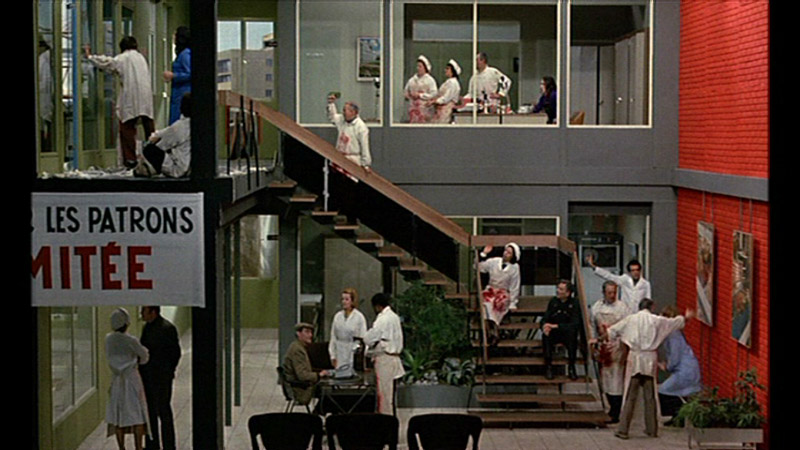
Watched Godard's TOUT VA BIEN (1972) the other night. His large-scale, multi-level set for the meat-packing plant brought to mind Jerry Lewis' similarly impressive "dollhouse" set from THE LADIES MAN (1961). I love the photo of Lewis directing on the camera crane.


Tuesday, July 21, 2020

Gloria (1980)

John Cassavetes wrote and directed this story of a woman with mob ties who takes on the role of protector to a little boy after his family is murdered. Gena Rowlands is excellent in the title role, bringing the right combination of charm and toughness to the character. Cassavetes manages to make the film suspenseful and touching in equal measures without hitting a false note.

Cowboy (1956)

This was an offbeat Western about greenhorn Jack Lemmon teaming up with seasoned cowboy Glenn Ford to learn the ropes of riding the trail and herding cattle. Ford appeared in so many films for Columbia Pictures around this time; it seems he was called on to portray virtually any kind of character they needed filled. He's effective here in the quieter, more introspective moments. Lemmon gives a typically excellent performance as the greenhorn who has his eyes opened to the realities of life on the trail. The beautiful color cinematography is a highlight.

Monday, July 06, 2020

R.I.P. Ennio Morricone (1928-2020)

The great composer Ennio Morricone has passed away at 91:
https://www.hollywoodreporter.com/news/ennio-morricone-dead-prolific-italian-composer-was-91-858358

I was just listening to the soundtrack from Salo last night and thinking about Morricone's versatility as a composer. This theme was such a brilliant choice to contrast with Pasolini's shocking images that follow in the film.


Saturday, June 13, 2020

Quarantine Filmmaking: "Isolation"

This is another short film I recently made under the current restrictions. Called Isolation, it is about a man reflecting on his experiences under quarantine.


Tuesday, June 09, 2020

"Scared 2 Death" -- Quarantine Filmmaking

Since the lockdown began, I've found myself inspired to start creating short films. I'd made a short film backed in January, Unknown Number, whose production I have detailed on this blog. I was certainly pleased with how that film had turned out, but I found myself wanting to return to making smaller-scale films, that could be written and filmed quickly and cheaply with minimal resources (even smaller than what I'd worked with on Unknown Number). It's liberating and invigorating to make films this way -- just small-scale, down 'n' dirty filmmaking.

I haven't felt this energized by making films in years.

This is the first of these that I put together back in May, called Scared 2 Death. It's based on an idea that I had a few years ago, when I was living in Brooklyn. I thought of this idea again recently and realized it would make a perfect small project that I could film under the current restrictions.

Friday, May 15, 2020

5 Against the House (1955)


This is an intriguing crime drama about a group of college students pulling off a heist of a Reno, Nevada casino. After a holiday trip to the casino, one of the students gets the idea of pulling off the perfect crime, and gets his classmates involved -- some of them against their will. One of them, a traumatized Korean war vet (Brian Keith) gets carried away and takes charge of the heist himself, with devastating consequences.

Directed by Phil Karlson, it builds some effective suspense about how the characters will be impacted by the scheme, but the heist itself is a relatively minor element compared with other films of this genre. The script is by a team of writers including Stirling Silliphant and Frank Tashlin. Guy Madison, Kerwin Mathewsm, and Kim Novak co-star.

Monday, May 11, 2020

Saskatchewan (1954)

An adventure-packed "North"-Western about a Canadian Mountie who takes up the protection of the lone survivor of an Indian attack, and defies commands in order to strategically lead his troops to the border to avoid another attack. Splendid Technicolor location photography (actually filmed in Alberta), with great contrasts between the bright red coats of the Mounties against the breathtaking mountain scenery in the background. Directed by Raoul Walsh.

Convicted (1938)

Rita Hayworth, age 19, in CONVICTED (1938)

"Quota Quickie" produced in Victoria B.C. for the British market, with American stars Charles Quigley and Marc Lawrence.

Hayworth plays a nightclub singer whose brother is framed for a murder, and must hunt down the real killer. Otherwise routine crime drama (based on the Cornell Woolrich story "Face Work") enhanced by the presence of Hayworth in an early role right before coming to the attention of Hollywood.

Playboy of Paris (1930)

Not a great or even particularly good film, by any means, but I could watch Maurice Chevalier in anything and this gives him a fun role as a cafe waiter who comes in to a fortune but has to continue working his job in the cafe. The plot is wafer thin but I enjoyed the fun spirit and energy of it all. I'm also intrigued by this director, Ludwig Berger (whose other films include the Korda THIEF OF BAGDAD and the 1937 Dutch version of PYGMALION), and was interested to see another example of his work.

Roadhouse Nights (1930)

I watched this strange little number from 1930 recently. It showed up on my radar after reading "Red Harvest", as this film is described as a loose (very loose, I'd say) adaptation of Hammett's book. It's so loose, in fact, that the book isn't even listed as a source in the film's credits, the script attributed solely to Ben Hecht.

I strongly suspect that little of Hecht's original script ended up on the screen, because it's an utterly bizarre mixed bag. The film tells the story of a reporter (Charlie Ruggles, in a dramatic role) who is sent to a small town outside of Chicago to investigate the disappearance of a fellow reporter, who went MIA while investigating a mob of rum-runners operating out of the town. We know that the reporter was bumped off by the mob leader when he got a little too close to uncovering the operation.

The plot finds time for music numbers by Helen Morgan, as the gangster's moll who also turns out to have been an old sweetheart of Ruggles, and some energetic comedy singing and dancing from the team of Clayton, Jackson & Durante (with Jimmy making his film debut in a role that also calls for some dramatic support).

It all runs out of steam by the end, with the absurdity of the situations working against the dramatic tension, but it's all oddly fascinating in its strangeness. The performances and direction have a stilted and lugubrious quality that give the impression of a bad dream.

Detective Story (1951)

Based on a play by Sidney Kingsley, this William Wyler film shows its theatrical roots but is imbued with a strong degree of realism. Set almost entirely inside a New York City police station and centered around the revolving group of characters who come and go throughout the day, it offers a first-rate showcase for its powerhouse ensemble cast headed by Kirk Douglas, Eleanor Parker, William Bendix, Cathy O'Donnell, and standout performances by newcomers Lee Grant and Joseph Wiseman.

This was right around the time that Douglas was essaying some really dark, intense roles (notably ACE IN THE HOLE), and his Jim McCleod here is one of the best of those. McCleod is angry and vengeful, uncompromising in his tough-as-nails attitude toward crime. He is anchored only by his love for his wife as his growing bitterness threatens to destroy him both personally and professionally.

The set design of the police station perfectly captures the claustrophobic atmosphere and the resulting high tensions of all who work within it. Special mention should also be made of the fine cinematography by Lee Garmes and John F. Seitz. Screenplay by Robert Wyler and Philip Yordan from Kingsley's 1949 play of the same name.

Saturday, May 09, 2020

Night Owls (1930)


I watched this Laurel and Hardy short on TV this morning. I've seen it probably close to a dozen times over the years, and it's never been one of my favorites. I've always found it a little too slow and plodding, even clumsily-staged compared to their best work. I had chalked this up partly due to the lack of fluidity in the early talkies, but even then, Laurel and Hardy had achieved a more relaxed, smooth pace in even earlier films like The Perfect Day and The Hoosegow (1929), so I wasn't sure I could explain my reaction to Night Owls based purely on the challenges of adapting their comedy to early sound film.

For whatever reason, when I watched Night Owls again this morning, I thoroughly enjoyed it, and found my estimation of it much higher than before. The version shown on the "Laurel and Hardy Show" features new musical under-scoring of the familiar LeRoy Shield tunes, arranged by Ronnie Hazlehurst, so perhaps that added to my enjoyment and smoothed over the flow of the action. But beyond that, the antics of the Boys' repeated attempted break-ins struck me as much funnier this time around. What had struck me as one of their weaker shorts in the past now had me in stitches.

Maybe it was just the laughs I needed this morning.

Tuesday, May 05, 2020

Sven Nykvist on working with Ingmar Bergman

American Cinematographer ran an article by Sven Nykvist, "Photographing the Films of Ingmar Bergman", in which the cinematographer talks about his work with the great director. The article provides a fascinating insight into their working relationship and Bergman's working methods.


Nykvist describes his approach to working with Bergman:
"I am grateful to Bergman’s scripts that his photographic goal always changes with each one. There is no possibility for his cameraman to just alter his ordinary routine lighting technique or to shoot production after production in the same manner. All easy-come effects must be sacrificed for the simplicity which does not disturb. Although public acclaim in cinematography often can be achieved by instantaneous effects, it is in the long run only the true light which is interesting and which I strive for more and more in my work."
Full article here:
https://ascmag.com/articles/photographing-the-films-of-ingmar-bergman